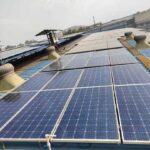
With Haryana emerging as one of India’s fastest-growing solar hubs, the demand for large-scale solar power plants has skyrocketed. A 500 kW solar power plant is ideal for factories, educational institutions, corporate parks, group housing societies, and hospitals that have high daytime power consumption.
At Smart Roof Solar, we specialize in engineering and installing such systems, offering complete transparency in solar installation charges, helping clients make the most of government solar subsidy schemes, and ensuring the total cost of solar installation remains economical and efficient.
What Is a 500 kW Solar Power Plant?
A 500 kW solar power plant can generate 6-7.5 lakh units of solar electricity per year, depending on sunlight availability and site layout. Given Haryana’s high solar radiation, this capacity provides excellent energy savings and quick returns.
This system size is perfect for:
- Large manufacturing units and industrial estates
- Commercial buildings and educational institutions
- Corporate parks and multi-story office complexes
- Housing societies with shared power requirements
Such a plant drastically reduces dependency on grid power, ensuring your facility enjoys reliable, clean, and renewable solar energy all year round.
Price & Cost Breakdown of 500 kW Solar Power Plant in Haryana (2025)
Capacity | Estimated Cost (excluding GST) |
500 kW in Haryana | Starting from ₹1,25,00,000* |
600 kW in Haryana | Starting from ₹1,44,00,000* |
700 kW in Haryana | Starting from ₹1,64,50,000* |
800 kW in Haryana | Starting from ₹1,88,00,000* |
*Prices quoted are indicative starting rates for the above mentioned solar installations may vary based on project-specific requirements, including ground mount or tin-shed structures, RC installation types, additional accessories like DG sync, safety rails, etc. Final pricing will be confirmed upon detailed site evaluation and project scope assessment.
Typically, a 500 kW solar system in Haryana costs around ₹36,000 – ₹48,000 per kW, depending on material quality and site conditions. That brings your overall solar energy installation cost close to ₹1.8 – ₹2.4 crore for a complete turnkey solution.
Once installed, your effective cost of solar per kWh installed falls below ₹3 over the system’s lifespan, far cheaper than grid tariffs.
Power Generation, Payback & Savings
The payback period generally ranges from 3.5 to 4.5 years, after which the electricity generated is almost free. Over a 25-year lifetime, you’ll continue to save tens of lakhs annually, making solar one of the smartest long-term investments for any business.
By opting for efficient panels and reliable components, your solar installation cost per kWh drops further, maximizing ROI. Refer to our blog – Solar Panel Payback Period Guide – Smart Roof Solar to know more.
Subsidy & Incentives in Haryana (2025)
PM Surya Ghar: Muft Bijli Yojana (Central Subsidy)
The PM Surya Ghar Scheme, launched in 2024, aims to make rooftop solar affordable for Indian households.
While commercial 500 kW systems don’t fall under this scheme, here’s how it works for smaller setups:
- ₹30,000 per kW for the first 2 kW
- ₹18,000 per kW for the next 1 kW (up to 3 kW total)
- Maximum subsidy capped at ₹78,000
- Applicable only for residential rooftop consumers.
State-Level Incentives (HAREDA & DISCOMs)
The Haryana Renewable Energy Development Agency (HAREDA) offers additional benefits under the state policy:
- Simplified net metering approval up to 500 kW (as per HERC regulation).
- Exemption from electricity duty and wheeling charges for captive use.
- Encouragement for Group Housing Societies (GHS) and Resident Welfare Associations (RWA) to install shared solar plants.
- Generation-Based Incentive (GBI) discussions for community rooftop and institutional projects (subject to new 2025 guidelines).
Although large C&I setups like a 500 kW solar plant do not directly qualify for subsidies, they gain a massive financial advantage through tax savings, depreciation benefits, and lower operational costs, ensuring that making solar energy economical remains achievable for every sector.
Factors Affecting Cost & Efficiency
Solar panel quality
Premium modules with higher efficiency reduce solar panel area per kW and maximize generation.
Roof or land condition
Structural reinforcement adds to the solar roof installation cost.
Cable quality and length
Impacts voltage drop and long-term reliability.
O&M & monitoring
Timely maintenance reduces downtime and protects your investment.
Net metering approvals
Compliance with HERC norms ensures billing and credit accuracy.
At Smart Roof Solar, we help you plan every detail, from technical layout to approvals, so you know exactly how your solar panel system costs break down.
Why Businesses Should Opt for Solar in Haryana
- Reduced Energy Bills: Replace costly grid electricity with self-generated power.
- Low Maintenance: Once installed, upkeep is minimal, reducing the total cost of solar installation.
- Sustainability Goals: Meet ESG targets by adopting renewable energy and solar energy solutions.
- Energy Independence: Protect your facility from tariff hikes and outages.
- Better ROI: Save lakhs every year, reinvesting profits back into business growth.
Haryana’s abundant sunlight makes the solar energy for home use and industrial setups highly efficient, ensuring consistent generation across the year.
Why Choose Smart Roof Solar
We’re committed to making solar energy economical and accessible for every client.
When you partner with us, you get:
- Transparent pricing on solar module price per watt and solar installation charges
- End-to-end project management, from design to commissioning
- Support for the government solar subsidy scheme documentation
- Reliable after-sales service and real-time system monitoring
With every project, our goal is simple: deliver maximum output at the most efficient solar energy installation cost.
Conclusion
A 500 kW solar power plant in Haryana is one of the most profitable renewable energy investments you can make in 2025. While subsidies mainly target smaller systems, businesses still benefit from large-scale savings, net metering, and depreciation incentives.
With the right design, premium components, and experienced EPC execution from Smart Roof Solar, you can lower your solar installation cost per kWh, boost profitability, and secure a greener future for your organization.
Get in touch with Smart Roof Solar today to get a customized proposal for your 500 kW system, including project cost, generation estimate, and detailed ROI analysis.
FAQs
Q1. What factors influence the total installation cost of a 500 kW system?
Ans: Key cost drivers include the type and efficiency of panels, mounting structure design, roof or land condition, cable length and quality, and monitoring system selection.
Q2. Why should businesses in Haryana invest in solar energy now?
Ans: With rising grid tariffs, favorable policies, and strong sunlight, going solar in 2025 ensures energy independence, long-term savings, and sustainability compliance, making it a smart financial and environmental decision.
Q3. How much space is required for a 500 kW solar power plant?
Ans: A 500 kW system needs about 40,000-45,000 sq. ft. of shadow-free area, depending on panel efficiency.
Q4. Can it work during power outages?
Ans: A grid-tied system won’t run during outages unless battery backup or hybrid inverters are installed.
Q5. What are the tax benefits for businesses installing solar?
Ans: Companies can claim accelerated depreciation and GST input credits, lowering project payback time.