
The successful completion of a solar photovoltaic (PV) project does not end with installation and commissioning. One of the most important activities in quality assurance, project management, and long-term system reliability is the preparation of a comprehensive inspection report and the implementation of appropriate corrective actions. Inspection reports serve as official records of system condition, installation quality, safety compliance, testing results, and identified deficiencies.
Whether the project involves a residential rooftop installation, commercial solar power plant, industrial solar facility, or utility-scale renewable solar project, inspection reports help stakeholders evaluate project quality, verify compliance with specifications, and ensure that corrective actions are implemented before project handover or system operation.
A well-prepared inspection report provides clear documentation of observations, test results, non-conformities, recommendations, and corrective measures. It also supports maintenance planning, warranty claims, regulatory compliance, and future audits. Without proper inspection reporting, critical issues may go unnoticed, resulting in reduced energy production, safety risks, increased maintenance costs, and higher solar panel system cost over the project lifecycle.
Inspection reporting and corrective action management are essential components of solar PV project quality assurance and renewable energy technology implementation.
This comprehensive guide explains the purpose of inspection reports, report preparation procedures, documentation requirements, corrective action processes, best practices, and common mistakes to avoid.
What is an Inspection Report?
An inspection report is an official document that records the findings of a site inspection, quality assessment, safety audit, installation verification, or commissioning activity.
The report typically includes:
- Inspection details
- Observations
- Test results
- Non-conformities
- Recommendations
- Corrective actions
Inspection reports provide evidence that project activities have been evaluated and documented.
Why Inspection Reports are Important
Inspection reports help:
- Verify compliance with project specifications
- Identify installation defects
- Improve system safety
- Support quality assurance programs
- Facilitate corrective action implementation
- Maintain project documentation
They also provide a permanent record for future reference.
Objectives of Inspection Reporting
The primary objectives include:
Quality Verification
Ensuring installations meet design requirements.
Safety Assessment
Identifying potential hazards.
Performance Evaluation
Verifying equipment functionality and system performance.
Regulatory Compliance
Supporting compliance with project standards and regulations.
Continuous Improvement
Providing information for future project enhancements.
Types of Inspection Reports in Solar PV Projects
Various inspections may require reporting.
1. Material Inspection Report
Prepared after receiving materials on site.
Documents:
- Quantity verification
- Physical condition
- Specification compliance
2. Civil Works Inspection Report
Covers:
- Excavation
- Foundation work
- Concrete quality
- Structural installations
3. Mechanical Installation Inspection Report
Includes:
- Mounting structures
- Module supports
- Structural alignment
4. Electrical Installation Inspection Report
Documents:
- Cable installations
- Grounding systems
- Terminations
- Electrical equipment
5. Safety Inspection Report
Evaluates:
- PPE compliance
- Hazard controls
- Site safety practices
6. Commissioning Inspection Report
Records:
- Testing results
- System performance
- Operational verification
Key Components of an Inspection Report
A complete inspection report should contain several important sections.
1. Project Information
Include:
- Project name
- Site location
- Client information
- Contractor details
- Inspection date
This information identifies the project being inspected.
2. Inspection Scope
Clearly define:
- Areas inspected
- Equipment assessed
- Activities reviewed
The scope helps establish inspection boundaries.
3. Inspection Team Details
Record:
- Inspector name
- Designation
- Organization
- Contact information
4. Inspection Checklist
A checklist ensures consistency and completeness.
Typical checklist items include:
- Mechanical installation quality
- Electrical installation quality
- Safety compliance
- Equipment condition
5. Observations
Document all findings accurately.
Observations may include:
- Compliant conditions
- Non-compliant conditions
- Potential risks
- Opportunities for improvement
Observations should be objective and factual.
6. Test Results
Include results from:
- Voltage measurements
- Current measurements
- Grounding tests
- Insulation resistance tests
- Performance verification tests
Test data support inspection conclusions.
7. Photographic Evidence
Photographs help:
- Document findings
- Support corrective actions
- Provide visual references
Photographic documentation is highly recommended.
8. Non-Conformance Details
Non-conformities should be clearly described.
Examples include:
- Loose connections
- Improper grounding
- Missing labels
- Structural defects
Each issue should be documented separately.
9. Recommendations
Provide practical recommendations for addressing identified issues.
Recommendations should be:
- Specific
- Measurable
- Achievable
10. Corrective Actions
Outline:
- Required actions
- Responsible personnel
- Completion deadlines
This section drives issue resolution.
11. Approval and Sign-Off
The report should include signatures from:
- Inspector
- Contractor representative
- Client representative (if applicable)
Common Inspection Findings in Solar PV Projects
Mechanical Deficiencies
Examples:
- Misaligned structures
- Loose fasteners
- Improper torque application
Electrical Deficiencies
Examples:
- Incorrect cable routing
- Loose terminations
- Grounding issues
Safety Deficiencies
Examples:
- Missing PPE
- Inadequate barricading
- Poor housekeeping
Documentation Deficiencies
Examples:
- Missing records
- Incomplete test reports
- Unapproved design changes
How to Document Inspection Findings Effectively
Good inspection reports should be:
- Clear: Avoid ambiguous language.
- Accurate: Document facts, not assumptions.
- Objective: Focus on observable conditions.
- Detailed: Provide sufficient information for corrective action.
- Traceable: Reference drawings, specifications, and standards where applicable.
Understanding Corrective Actions
Corrective actions are measures implemented to eliminate identified deficiencies and prevent recurrence. The goal is to restore compliance and improve system quality.
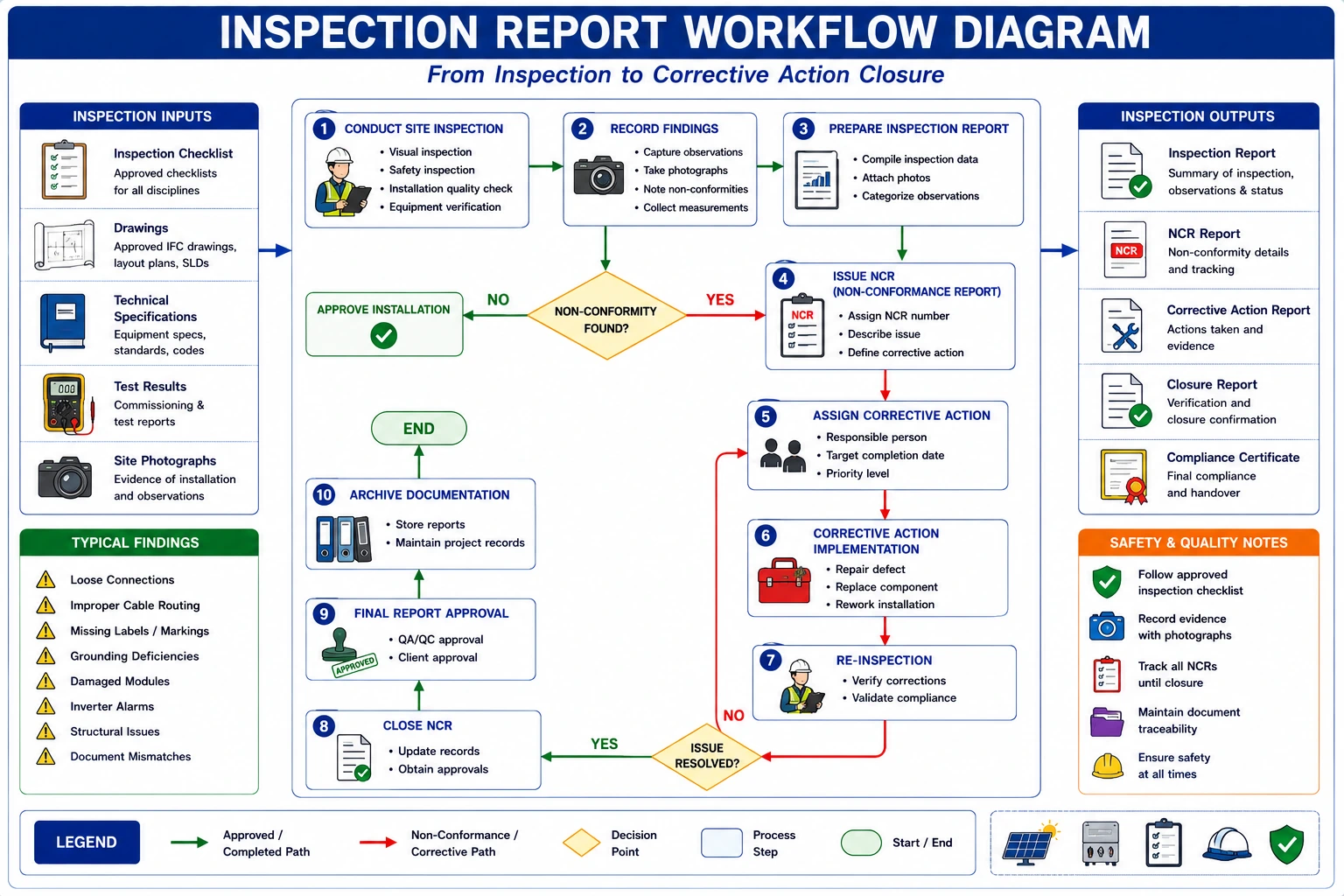
Steps for Taking Appropriate Action
Step 1 – Identify the Issue
Clearly define the non-conformance or problem.
Examples:
- Damaged cable
- Missing grounding connection
- Faulty equipment
Step 2 – Determine Root Cause
Investigate why the issue occurred.
Potential causes include:
- Installation errors
- Material defects
- Design problems
- Environmental factors
Step 3 – Develop Corrective Measures
Create an action plan addressing the identified issue. Actions should be practical and effective.
Step 4 – Assign Responsibility
Identify personnel responsible for implementing corrective actions. Clear accountability improves resolution efficiency.
Step 5 – Implement Corrective Actions
Carry out the required repairs, adjustments, or modifications.
Examples:
- Replacing damaged components
- Correcting wiring errors
- Improving grounding systems
Step 6 – Verify Effectiveness
Conduct follow-up inspections or testing.
Confirm that:
- The issue has been resolved
- Compliance has been restored
Step 7 – Close the Action
Document completion and update project records.
Importance of Root Cause Analysis
Addressing symptoms alone may not prevent recurrence.
Root cause analysis helps identify underlying issues such as:
- Inadequate training
- Poor supervision
- Design deficiencies
- Process failures
This improves long-term project quality.
Documentation Required for Corrective Actions
Maintain records including:
- Non-conformance reports
- Corrective action reports
- Photographic evidence
- Retesting results
- Approval records
Proper documentation supports audits and quality management.
Digital Inspection Reporting Systems
Many solar projects now use digital platforms for inspection reporting.
Benefits include:
- Faster reporting
- Real-time updates
- Improved traceability
- Better record management
Digital systems improve efficiency and transparency.
Conclusion
Preparation of inspection reports and implementation of appropriate corrective actions are fundamental aspects of quality assurance in solar PV projects. A well-structured inspection report provides a clear record of project conditions, testing results, safety compliance, and identified deficiencies, while corrective action management ensures that issues are resolved effectively and efficiently.
Documentation, inspection, and quality control are critical elements of successful solar electricity generation and renewable energy technology deployment. Furthermore, following standards and recommendations promoted by the Ministry of New and Renewable Energy helps maintain project quality, safety, and regulatory compliance.
By preparing detailed inspection reports, documenting findings accurately, performing thorough root cause analysis, implementing effective corrective actions, and maintaining comprehensive records, solar installers, EPC contractors, inspectors, and project managers can optimize solar panel system cost, improve renewable solar system reliability, reduce operational risks, and ensure the long-term success of residential, commercial, industrial, and utility-scale solar PV installations.
FAQs
Q1. What is the purpose of an inspection report in a solar PV project?
Ans: An inspection report documents inspection findings, test results, compliance status, non-conformities, and corrective actions to ensure project quality and safety.
Q2. What information should be included in an inspection report?
Ans: A complete report should include project details, inspection scope, observations, test results, photographs, non-conformities, recommendations, corrective actions, and approvals.
Q3. Why are corrective actions important?
Ans: Corrective actions help resolve identified deficiencies, restore compliance, improve safety, and prevent recurrence of similar issues.
Q4. What is root cause analysis?
Ans: Root cause analysis is the process of identifying the underlying reason for a problem rather than simply addressing its symptoms.
Q5. How do inspection reports improve solar project performance?
Ans: They help identify issues early, improve installation quality, reduce maintenance costs, support compliance, and enhance long-term system reliability.
Affordable Solar Systems and Plants for Small and Medium Enterprises
Learn how SMEs can harness solar energy through tailored solar systems and plants to reduce electricity bills, improve sustainability, and boost efficiency.
Corporate Safety Policies for Solar PV Workplaces
A complete guide to establishing and following safe work procedures in solar PV systems, ensuring worker safety during installation, testing, commissioning, operation, and maintenance.

How Solar Energy Is Converted into Electricity Using Solar Panels – Complete Guide
Solar panels convert sunlight into usable electricity through the photovoltaic effect. From photon absorption to inverter conversion and grid connection, each component plays a critical role in solar power generation. This complete guide explains the step-by-step process of how solar energy becomes electricity for homes, businesses, and industries, helping you understand the technology behind India’s growing renewable energy movement.
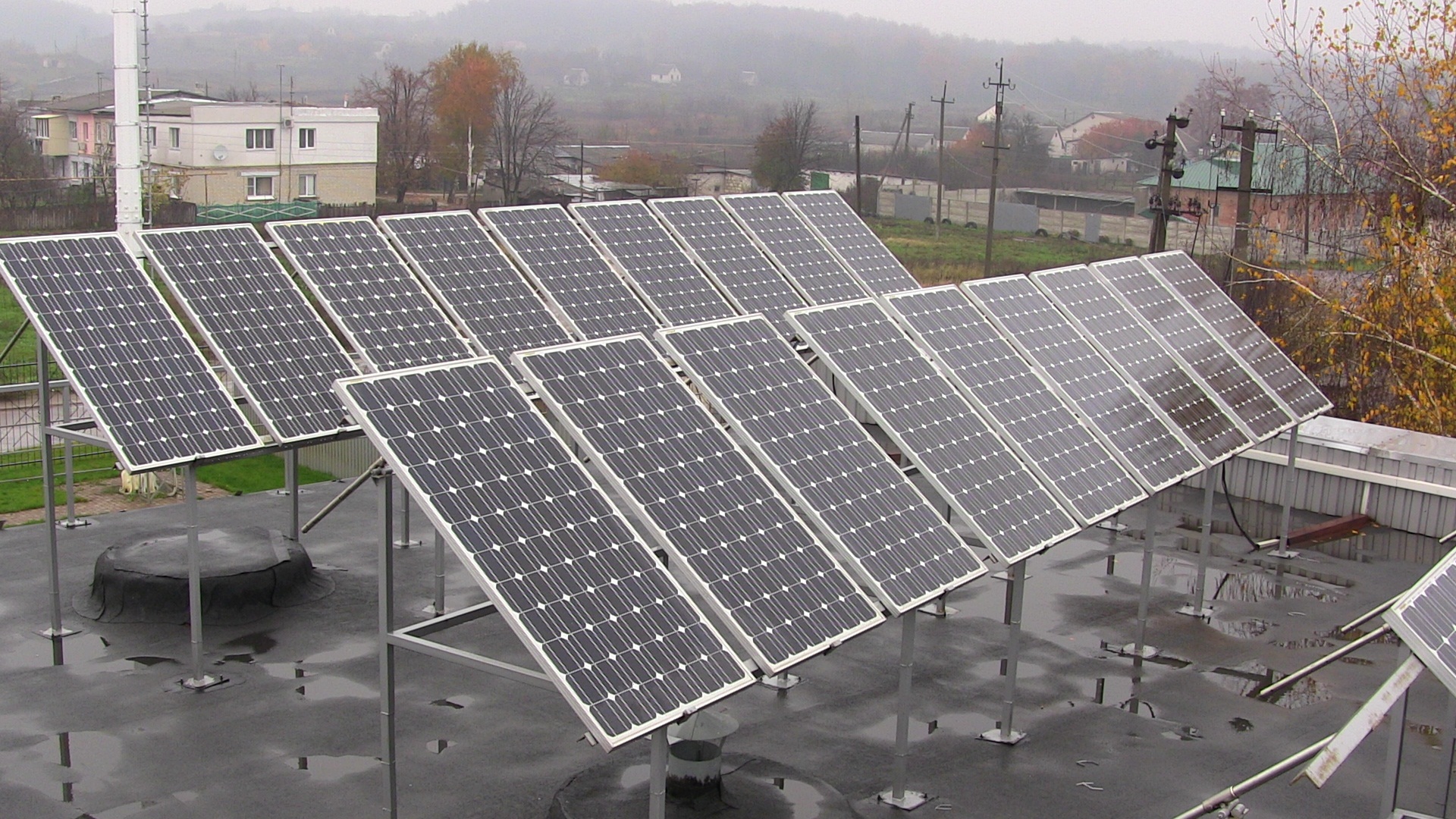
Solar Microgrids: All you need to know
Discover how solar batteries store excess energy, maximize your solar system’s efficiency, and provide reliable power during outages. Learn about the types, benefits, lifespan, and maintenance tips to make the most of your solar investment.
How to Check Materials Received on Site for Solar PV Projects: Complete Inspection Checklist
Ensuring the quality of materials received at site is critical for successful solar PV installation. This guide provides a detailed inspection checklist to verify solar components before installation.
How to Test PV Module Electrical Output: Step-by-Step Guide
A step-by-step guide to PV module electrical output testing, covering voltage, current measurement, and best practices for accurate performance evaluation.

Solar Loans, Subsidies & EMI Plans: Financing Made Easy
Explore solar loans, government subsidies, and flexible EMI plans to make installing solar panels affordable and hassle-free.
How to Check Solar PV Modules for Physical Damage
A complete guide on how to clean solar PV modules, including safe cleaning techniques, recommended tools, maintenance schedules, and best practices to maximize energy output.