
Handling solar panels at the installation site is a critical stage in any solar photovoltaic (PV) project. While much focus is given to design and installation, improper unpacking of solar panels can lead to micro-cracks, glass damage, and reduced performance, ultimately increasing solar installation charges and impacting system efficiency.
Solar panels are delicate despite their robust outer design. Therefore, proper unpacking procedures must be followed to ensure safe handling, zero damage, and optimal solar electricity generation.
Safe material handling practices are essential for maintaining quality in renewable solar installations.
This blog provides a complete guide on how to unpack solar panels on-site, including essential do’s and don’ts for installers and EPC teams.
Why Proper Unpacking is Important
Solar panels are sensitive to:
- Mechanical stress
- Impact during handling
- Improper stacking
Incorrect unpacking can result in:
- Micro-cracks (invisible but harmful)
- Glass breakage
- Frame damage
- Reduced solar electricity generation
Proper handling helps reduce solar energy installation cost and ensures long-term performance.
Pre-Unpacking Preparation
1. Site Readiness
- Ensure clean and level surface
- Allocate a designated unpacking area
2. Safety Measures
- Use PPE (gloves, helmets, safety shoes)
- Ensure trained personnel handle panels
3. Inspection of Packaging
- Check for visible damage
- Verify labeling and quantity
Step-by-Step Unpacking Process
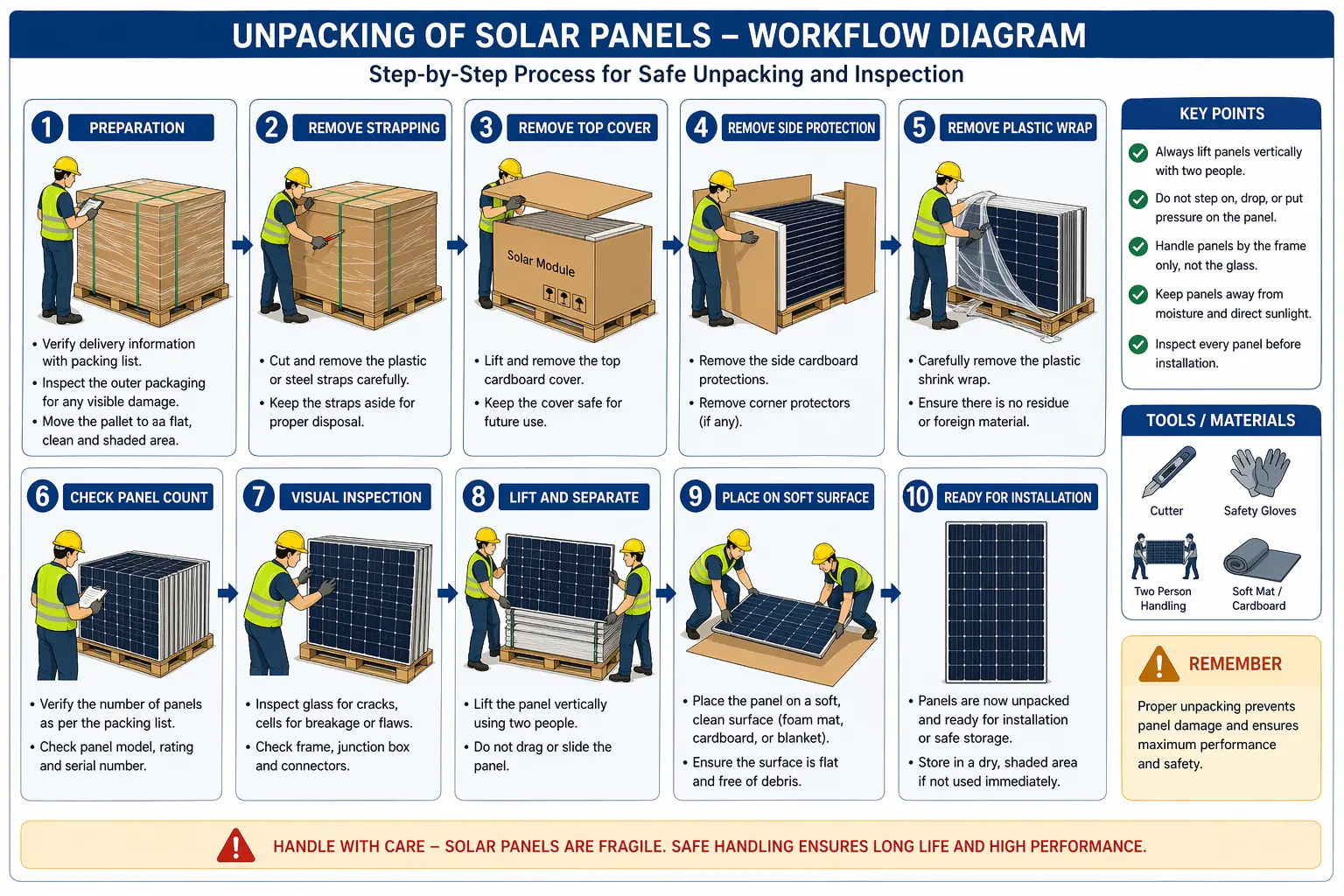
Step 1 – Place Boxes Properly
- Keep pallets on flat ground
- Avoid uneven surfaces
Step 2 – Open Packaging Carefully
- Cut straps and packaging gently
- Avoid sharp tools near panels
Step 3 – Remove Panels One by One
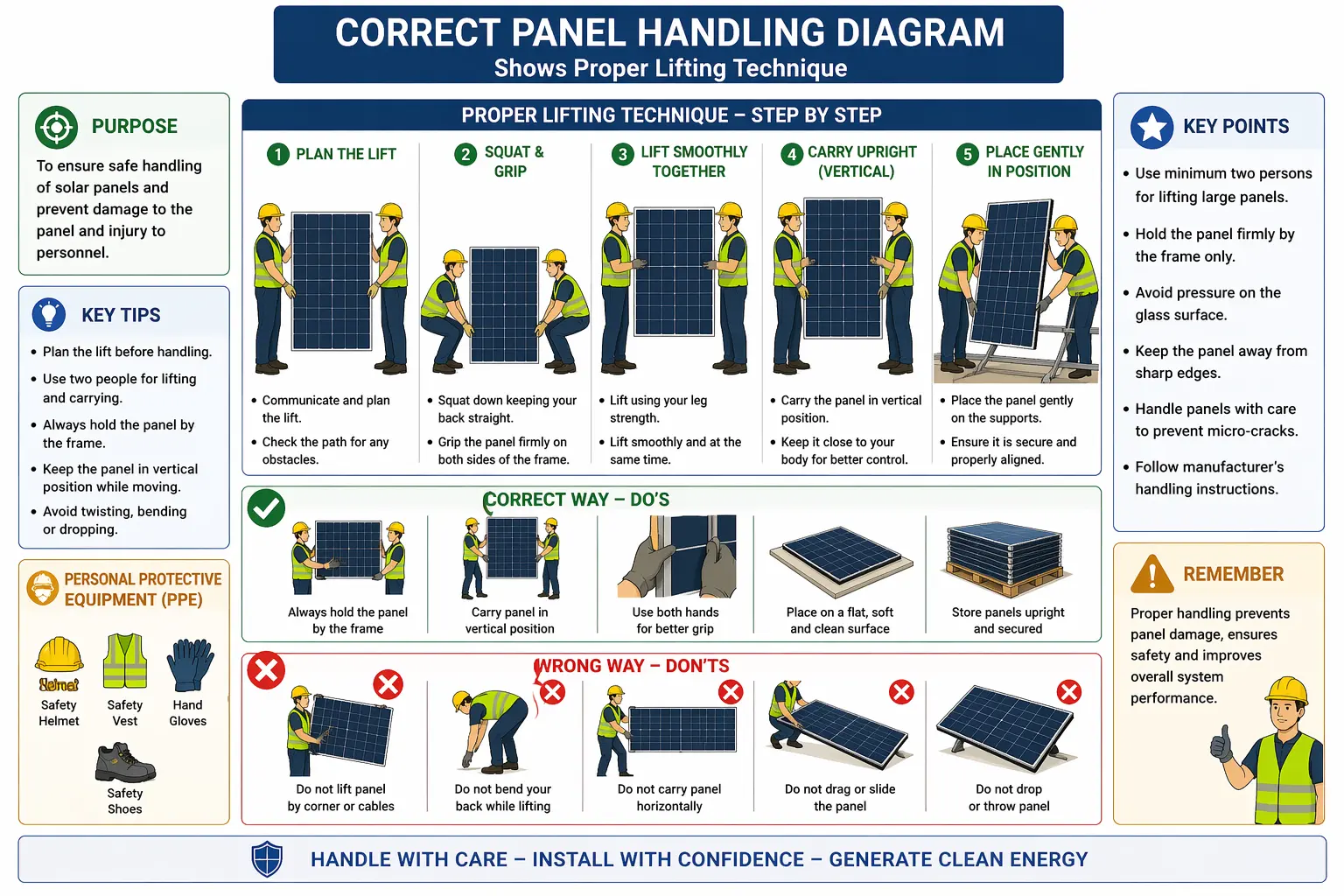
- Lift panels vertically
- Do not drag panels
Step 4 – Handle Panels with Care
- Hold from frame edges
- Avoid touching glass surface
Step 5 – Inspect Each Panel
Check for:
- Cracks
- Scratches
- Frame damage
Step 6 – Store Panels Safely
- Keep in vertical position
- Avoid stacking directly on ground
Do’s of Unpacking Solar Panels
- Use trained personnel for handling
- Wear protective gear
- Handle panels gently
- Inspect panels immediately after unpacking
- Store panels in a safe and dry area
Don’ts of Unpacking Solar Panels
- Do not drop or drag panels
- Do not stack panels horizontally
- Avoid using sharp tools near panels
- Do not expose panels to water during unpacking
- Avoid handling panels in windy conditions
Common Risks During Unpacking
1. Micro-Cracks
Caused by improper handling.
2. Glass Breakage
Due to impact or pressure.
3. Frame Damage
Occurs during rough handling.
4. Electrical Damage
Damage to connectors or cables.
Conclusion
Proper unpacking of solar panels is essential for maintaining quality and ensuring efficient solar PV system performance. By following best practices, using appropriate tools, and conducting thorough inspections, installers can prevent damage and improve project outcomes.
Safe material handling is a key aspect of successful solar installations. Additionally, compliance with standards set by the Ministry of New and Renewable Energy ensures safety and reliability.
With the right unpacking practices, solar professionals can optimize solar panel system cost, enhance solar electricity generation, and contribute to sustainable solar energy for home use and large-scale renewable solar solutions.
FAQs
Q1. Why is proper unpacking important for solar panels?
Ans: It prevents damage and ensures optimal performance.
Q2. What are the common risks during unpacking?
Ans: Micro-cracks, glass breakage, and frame damage.
Q3. How should solar panels be handled?
Ans: They should be lifted vertically and handled gently.
Q4. Can damaged panels affect solar electricity generation?
Ans:Yes, even minor damage can reduce efficiency.
Q5. Does proper handling impact solar panel system cost?
Ans: Yes, it reduces replacement and maintenance costs

1MW Solar Power Plant Construction Cost & Profit in India
Choosing the right industrial solar EPC is critical for plant performance and ROI. This guide explains how Indian industries can select the best solar EPC partner.

Haryana Electricity Tariff Hike Impacts All Consumer Categories in 2015-16
Haryana electricity tariffs were increased across all consumer categories in 2015-16, raising power costs for households, industries, and businesses statewide.
Sloped Roof Solar Anchors & Attachments Installation Guide
A step-by-step guide to sloped roof solar anchors installation, covering roof attachments, fixing techniques, and best practices for durable and leak-proof systems.
Battery Inspection in Solar PV Systems Guide
A complete guide to battery inspection in solar PV systems, helping identify performance issues, safety concerns, and maintenance requirements.
100 kW Solar Power Plant Cost in Haryana: The Ultimate Guide to the Best Rate Per Watt
Explore the 100 kW solar power plant cost in Haryana for 2025. Learn about pricing, government subsidy options, and how much you can save with solar energy.

1 MW Solar Power Plant Cost in Rajasthan: A Complete Guide
A detailed guide on the cost of setting up a 1 MW solar power plant in Rajasthan. Learn about pricing, EPC components, land needs, subsidies, and expected payback for commercial and industrial users.
Installation of Solar Cables for Modules and Inverters
A step-by-step guide to solar cable installation for modules, inverters, and other system components to ensure safe and reliable operation.
Grid-Connected Solar PV System Startup Guide
A complete guide to starting up a grid-connected solar PV system, including commissioning, grid synchronization, electrical safety checks, and operational verification.