
The increasing electricity tariffs in India are pushing house owners and businesses to explore affordable and environmentally clean energy solutions. Rooftop solar systems and net-metering, being a smart cost-saving method, have been gaining traction in the current market. This allows users to lower their electricity bills and earn from the excess energy produced.
In Haryana, the government has introduced a structured net metering procedure, making it simpler for residents to shift to solar electricity. This blog will guide you through the basics of net metering and the application process of net metering in Haryana.
What is Net-metering
Net metering is a method that allows you to send back any excess electricity generated to the grid. So instead of storing energy in batteries, you earn credits on them. The user only pays for the net energy used (Generated – Consumed) at the end of the month.
Usually, when a solar panel produces electricity in the daylight, it is consumed and stored for later, unfavorable weather conditions, like rainy season or cloudy days. By the end of the month, if the amount of consumed energy is less than the amount of generated energy, then the user is credited for the excess energy generated. This is only possible through net metering.
Benefits of Net-metering
Net metering is not only pocket-friendly, but also very useful in a broader sense. With solar producing its own electricity, it is environmentally feasible as well as economical. Let’s see some of the benefits that it provides –
- Net-metering helps avoid major electricity charges and helps the users earn credits for the electricity supplied back to the grid.
- It has the fastest ROI, like 4-5 years, for the residential users.
- Reduce your carbon footprint by switching to renewable energy.
- Solar systems require minimal upkeep post-installation.
Net Metering Process in Haryana
Below is the entire process of how one can apply for net metering in Haryana through the DHBVN/UHBVN e-portal.
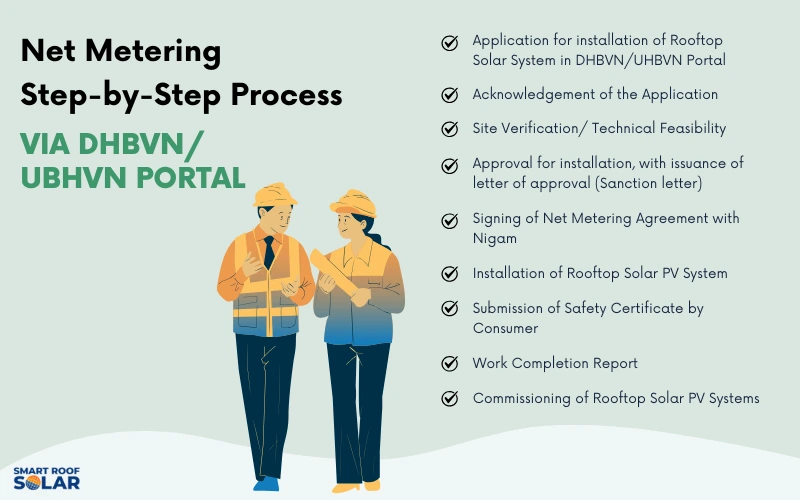
Step 1: Application for the installation of rooftop solar
- Go to UHBVN or DHBVN and create an account.
- Fill in basic consumer details like account number, mobile number, and email address.
Step 2: Submit the Solar Application
- Select the capacity (in kW) of the rooftop solar system.
- Upload the required documents and keep them handy –
- Occupancy proof along with roof rights(for residential).
- Registered Sale Deed of property/ Registered GPA/Registered Lease
- Deed/Allotment letter (for businesses)
- Latest paid electricity bill (not older than 3 months)
- Pan card of the applicant
- Photo (Applicant)
- Adhaar Card
- Memorandum of Article(MOA), Company PAN, and GST certificate (for businesses)
Note: – Name of the applicant should be the same on the Residential Proof, Aadhar card, and electricity bill.
Step 3: Feasibility Approval
- The DISCOM (DHBVN/UBHVN) will appoint an SDO to verify the site, and then the system feasibility will be verified for a capacity of up to 5 kWp.
- And then approval or rejection is generally provided within 15–20 working days by the XEN (OP).
Step 4: Installation of Solar Panels
- After feasibility approval, you can proceed with installation using an approved vendor, listed under ALMM.
- Installation should be done within 180 days from the date of the LOA.
Step 5: Work Completion Report
- The applicant needs to submit the work completion report along with enclosures.
Step 6: Submission of the safety certificate by the consumer
- For systems up to 20 kWp, work completion by the agency is sufficient. But for systems above 20 kWp, an inspection report by the Chief Electrical Inspector is required.
Step 7: Commissioning of Rooftop Solar PV System
- The meter will be provided by the agency, and if not available in the Nigam Store, the Meter with the issue specifications must be purchased and set up.
- After submission of work completion and CEIG/safety certificate, the Joint Commissioning of the RTS plant will be uploaded by the SDO on the portal.
Things to Keep in Mind Before Applying
- Make sure to check your sanctioned load. One can’t apply for a solar system capacity more than that.
- Choose a certified/ALMM vendor before applying for a subsidy.
- Make sure your roof is shadow-free for 5-6 hours daily for maximum generation.
- Keep your electricity bill and meter readings handy while filling out the application.
Conclusion
Net metering is not just an eco-friendly choice, but it’s a smart financial decision for residents. The government has also simplified the application process by giving them an online facility.
Start your application today with Smart Roof Solar and turn your rooftop into a power plant.
FAQs
Q1. Can I install a solar system without applying for net metering?
Ans: Yes, you can install a solar system for personal use without applying for net metering. However, without a net metering connection, you won’t be able to send excess power back to the grid or earn credits.
Q2. Is net metering available for both single-phase and three-phase connections?
Ans: Yes, net metering is applicable to both single-phase and three-phase electricity connections, but the applicable capacity and technical requirements may vary based on your connection type.
Q3. Can tenants apply for net metering if they live in a rented house?
Ans: Tenants can apply if they provide valid proof of occupancy and written consent from the property owner granting rights to use the rooftop for solar installation.
Q4. Are there any penalties for delayed installation after feasibility approval?
Ans: Yes, installations must be completed within 180 days of receiving the Letter of Approval (LOA). Delays beyond this period can lead to cancellation of the application or require re-approval.
Q5. Can I monitor my solar system’s performance in real time?
Ans: Yes, most modern rooftop systems come with smart monitoring tools or mobile apps that allow users to track energy generation, usage, and grid export in real-time.
Solar PV Procurement Process Guide for EPC & Installers | Step-by-Step
A well-planned procurement process is critical for the success of any solar PV project. This guide explains step-by-step how EPC companies and installers can efficiently source solar panels, inverters, and balance of system components while ensuring quality, cost-effectiveness, and timely delivery.
Solar PV Testing Equipment Inspection & Maintenance Guide
A complete guide to solar PV testing equipment inspection and maintenance, ensuring accurate measurements and reliable system performance.
Solar Inverter Troubleshooting Guide for Solar PV Systems
A complete guide to troubleshooting charge controllers in solar PV systems, including fault diagnosis, electrical testing, error identification, and corrective maintenance for reliable system performance.

Case Study: Successful Design, Installation, and Commissioning of a 50 kWp Rooftop Solar PV Plant
This case study details our experience in designing, installing, and commissioning a 50 kWp solar PV rooftop power plant. Learn how we overcame technical challenges, optimized system performance, and delivered clean, reliable energy. Discover insights on panel selection, inverter sizing, monitoring, and commissioning processes that ensured maximum efficiency and long-term performance for the rooftop solar installation.
Installation of DC Energy Meters in Solar PV Systems: Step-by-Step Guide
DC energy meters are used in solar PV systems to measure generated DC power and energy. This guide explains installation, wiring, testing, and safety procedures for solar installers.
How the RESCO Model Works in Solar: A Complete Guide for Industries
The RESCO model allows businesses to adopt solar with zero upfront investment. Under this model, a developer installs, owns, and operates the solar plant while you simply pay for the power you consume—making clean energy both affordable and hassle-free.
Grid-Connected Solar PV System Startup Guide
A complete guide to starting up a grid-connected solar PV system, including commissioning, grid synchronization, electrical safety checks, and operational verification.
How to Connect Solar Panels to Battery: Step-by-Step Guide
Connecting solar panels to a battery is essential for storing solar energy and ensuring power availability when sunlight is low. This step-by-step guide explains how to connect solar panels to a battery safely using a charge controller, wiring diagrams, and best practices for beginners and professionals alike.