
For a commercial or industrial solar plant, looking only at the total electricity generated by the entire system does not always tell the complete story.
A C&I solar plant may be generating the expected amount of electricity overall, while one or more sections of the plant are producing significantly less than they should. This is where inverter-wise solar generation monitoring becomes important.
By analysing the generation of each inverter separately, the O&M team can identify underperforming sections, compare equipment performance, detect faults early and reduce energy losses.
For large rooftop and ground-mounted C&I projects, inverter-wise monitoring is therefore an important part of effective solar plant operation.
What Is Inverter-wise Solar Generation?
Inverter-wise generation means recording and analysing the electricity produced by each individual inverter installed in a solar plant.
For example, suppose a C&I solar plant has 10 inverters. Instead of only monitoring the total plant generation, the O&M team can track:
- Inverter 1 generation
- Inverter 2 generation
- Inverter 3 generation
- And so on
The individual readings can then be compared with each other and with the expected generation under similar operating conditions.
This provides a more detailed picture of plant performance.
Why Is Inverter-wise Monitoring Important?
Large C&I plants are divided into multiple electrical sections. Each inverter generally receives power from a specific group of solar modules or strings.
If one inverter develops a problem, the entire plant may continue operating, but that particular section can lose generation. If the operator only checks total plant output, this loss may remain hidden.
Inverter-wise monitoring makes it easier to answer questions such as:
- Which inverter is producing less?
- When did the performance reduction begin?
- Is the problem temporary or recurring?
- Is the issue related to the inverter or the connected solar array?
- How much energy may have been lost?
Comparing Similar Inverters
One of the simplest ways to identify abnormal performance is to compare similar inverters.
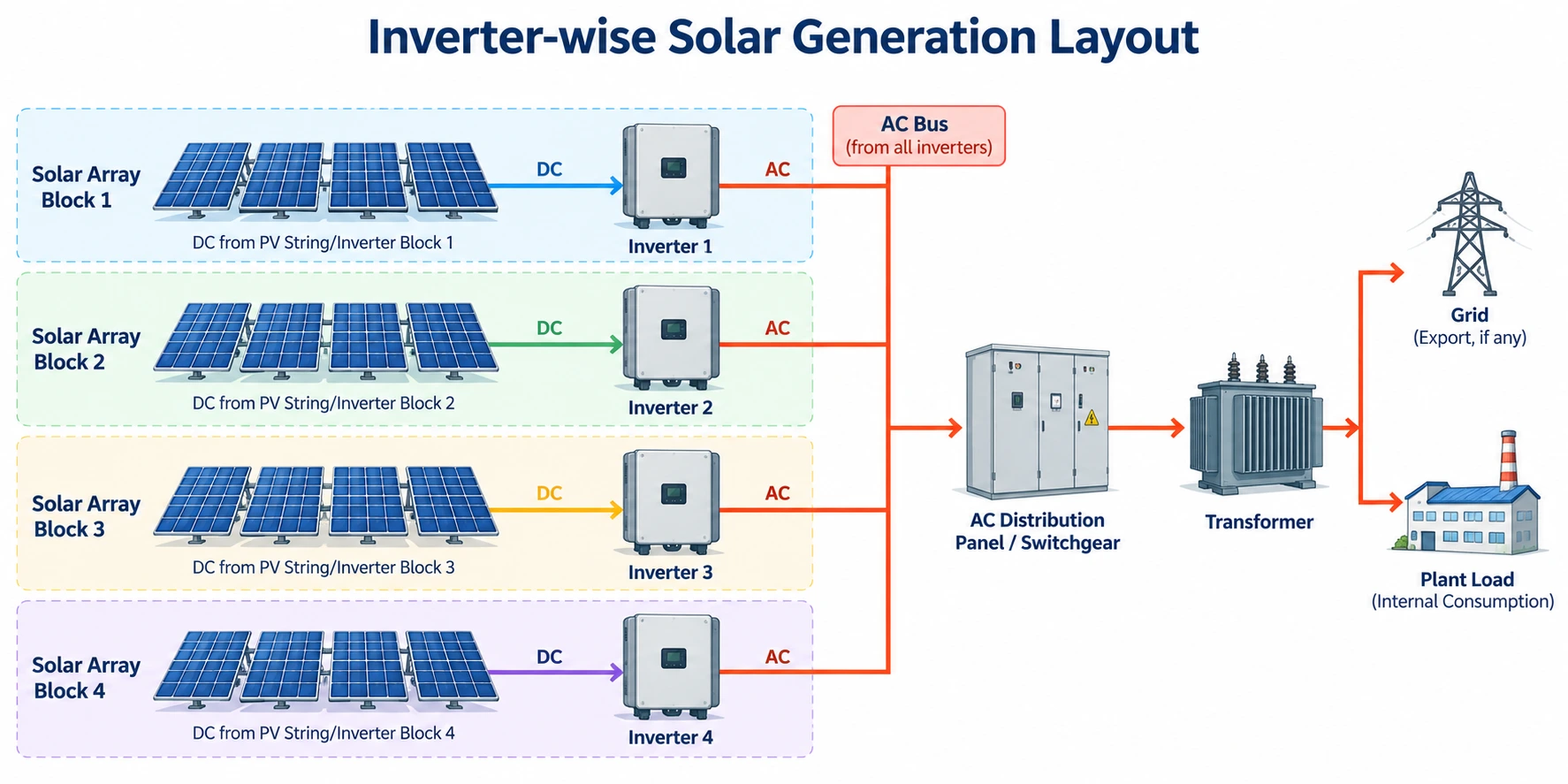
Suppose several inverters have:
- Similar capacity
- Similar solar irradiation
- Similar module configuration
- Similar operating conditions
If most inverters are producing around the same level while one inverter consistently produces much less, it becomes a potential area for investigation.
However, the comparison should not be based only on raw energy values. Different inverters may have different capacities or may serve arrays with different orientations.
Therefore, specific yield, operating conditions, and system configuration should also be considered.
What Can Cause One Inverter to Generate Less?
There can be several reasons for low inverter-wise generation.
1. Inverter Fault
An inverter may experience a fault, alarm, overheating, communication failure or internal component problem.
Depending on the severity, the inverter may shut down completely or continue operating at reduced output.
2. Low DC Input
The inverter may be healthy, but the solar array connected to it may not be providing sufficient DC power.
Possible reasons include:
- Dirty modules
- Shading
- Damaged modules
- Faulty strings
- Blown fuses
- Loose connectors
- Cable problems
3. Uneven Soiling
In a large rooftop or ground-mounted plant, dust accumulation may not be uniform.
One section may become significantly dirtier than another because of nearby roads, industrial activity, construction, or wind patterns. The inverter connected to that section may consequently show lower generation.
4. Shading
A new structure, tree, equipment, or nearby building can create shading on part of the solar array.
If the affected modules are connected to one inverter, the inverter-wise generation data may show a noticeable reduction.
5. Grid-side Issues
Voltage fluctuations, grid interruptions, or other AC-side conditions can also affect inverter operation.
An inverter may trip or temporarily stop feeding power to the grid because of abnormal grid conditions.
Use Specific Yield for Better Comparison
Simply comparing total kWh generated by different inverters may sometimes be misleading.
A better parameter is specific yield.
Specific yield indicates how much energy is generated per unit of installed capacity, commonly expressed as:
- Specific Yield = Energy Generated ÷ Installed Capacity
For example, if two inverters have different capacities, comparing their total kWh generation alone would not provide a fair comparison. Specific yield allows the O&M team to make a more meaningful comparison.
Inverter-wise Generation Helps Find Energy Losses
Consider a 5 MW C&I solar plant divided across several inverters.
If one inverter is unavailable for several hours, its connected solar capacity is effectively unable to contribute during that period. By tracking inverter-wise generation, the O&M team can estimate the impact of such downtime.
This helps convert a technical problem into a measurable business impact:
- Inverter Downtime → Lost Solar Generation → More Grid Electricity → Higher Energy Cost
This is particularly important for C&I consumers because solar electricity is often installed to reduce grid electricity purchases and improve overall energy economics.
How Should Inverter-wise Data Be Analysed?
A useful analysis should look at both short-term and long-term trends.
Daily Analysis
- Check whether each inverter is operating and producing electricity.
Weekly Analysis
- Look for repeated differences between inverters.
Monthly Analysis
- Compare generation, specific yield, availability, and performance trends across the plant.
Seasonal Analysis
- Compare performance while considering seasonal changes in irradiation, temperature, and weather.
The objective is not to expect every inverter to produce exactly the same amount of energy. Instead, the objective is to identify unusual deviations.
Inverter-wise Monitoring During Troubleshooting
Inverter-wise generation data can significantly reduce troubleshooting time.
A typical investigation can follow:
- Low Plant Generation → Compare Inverters → Identify Low-Performing Inverter → Check Alarms → Check DC Input → Check Strings → Inspect Array → Identify Root Cause → Correct → Verify
This approach allows the maintenance team to narrow down the problem instead of inspecting the entire solar plant unnecessarily.
Any electrical testing or repair should be performed by appropriately trained and authorised personnel following the site’s safety procedures and equipment manufacturer’s instructions.
Inverter-wise Monitoring and O&M
Inverter-wise data should become part of the plant’s regular O&M process.
An O&M team can maintain records of:
- Inverter-wise daily generation
- Specific yield
- Inverter availability
- Faults and alarms
- Downtime
- DC input
- AC output
- Maintenance activities
- Repeated faults
- Corrective actions
Over time, these records create a performance history for every inverter.
This can help identify equipment that repeatedly experiences problems and may require deeper inspection or manufacturer support.
Practical Inverter-wise Monitoring Checklist
For a C&I solar plant, regularly check:
- Generation from every inverter
- Installed capacity connected to each inverter
- Specific yield
- Inverter availability
- DC input
- AC output
- Inverter alarms
- Temperature and operating conditions
- String-level performance where available
- Grid interruptions
- Downtime
- Historical performance
- Corrective maintenance records
Conclusion
For a C&I solar plant, total generation is only one part of the performance picture. Inverter-wise solar generation provides a much deeper view of what is happening inside the plant.
By comparing individual inverters, operators can identify unusual performance, locate potential faults, track downtime and estimate generation losses more quickly. Parameters such as specific yield, availability, DC input, AC output and inverter alarms make the analysis even more useful.
For businesses investing in solar energy, solar roof panels or a large solar plant, this level of monitoring can help protect both energy production and financial returns.
A well-designed monitoring system therefore does more than display numbers. It helps the O&M team move from “the plant is generating less” to “this particular section is underperforming, this is why, and this is what needs to be investigated.”
That visibility is what makes inverter-wise monitoring an essential part of reliable C&I solar plant performance.
FAQs
Q1. What is inverter-wise solar generation?
Ans: It is the measurement and analysis of electricity generated by each individual inverter instead of looking only at total plant generation.
Q2. Why is inverter-wise monitoring important for C&I plants?
Ans: It helps identify underperforming sections and equipment faults that may not be visible when only total plant generation is monitored.
Q3. Can one faulty inverter affect the entire solar plant?
Ans: Usually, a fault affects the solar capacity connected to that inverter rather than the entire plant. However, the overall impact depends on the plant’s electrical configuration.
Q4. How can I identify an underperforming inverter?
Ans: Compare similar inverters under similar operating conditions using generation, specific yield, availability, DC input, and alarm information.
Q5. Is comparing kWh between inverters enough?
Ans: No. If inverter capacities or connected array configurations differ, specific yield and operating conditions should also be considered.
Solar PV Module Damage Inspection & Quality Checks in Solar EPC
A practical solar panel unpacking guide covering safe handling, on-site precautions, and key do’s and don’ts to avoid module damage.
Solar Financing for Businesses: Complete Guide to Funding Commercial & Industrial Solar Projects in India
Discover solar financing options for businesses in India, including CAPEX, OPEX, PPA models, solar loans, ROI, and funding strategies for commercial and industrial solar projects.

How to Check Battery Location for Solar PV Systems
A complete guide to solar PV battery location assessment, helping installers select safe and efficient locations for battery storage systems.
Why Industrial Solar Plants Underperform
Understand what happens when an industrial solar plant underperforms, how it affects energy generation and cost savings, and how monitoring, diagnostics, and preventive maintenance can improve performance.
Solar Site Safety Plan and Work Area Management Guide
A step-by-step guide to solar inverter stand installation as per drawings and manuals, ensuring proper alignment, stability, and safety.
Top Solar Companies & Suppliers in Delhi/NCR – A Complete Guide
Looking for trusted solar panel suppliers in Delhi/NCR? Explore leading solar companies serving Gurgaon, Noida, Faridabad, Manesar, and Ghaziabad. Compare product quality, technology, and services to choose the right solar partner for your home, business, or factory.
1 MW Solar Plant for Industry: Cost, Generation & Payback
A detailed guide on 1 MW solar plant for industry covering installation cost, area requirement, power generation, ROI, and long-term savings in India.
Should You Switch to Solar in India? Complete Guide
India has become a hot-selling solar market and people are interested in installing solar systems in their homes as well as in industries and factories.