
In a solar photovoltaic (PV) system, the DC Combiner Box plays a critical role in collecting and managing the DC power generated from multiple solar panel strings. To ensure safety and smooth operation, the combiner box is often equipped with disconnect protection devices such as DC isolators, fuses, and surge protection devices (SPDs).
Proper installation of a DC combiner box with disconnect protection is essential for preventing electrical hazards, simplifying maintenance, and improving overall solar electricity generation efficiency. Incorrect installation can lead to overheating, voltage drops, equipment failure, and increased solar installation charges.
Proper electrical protection and isolation are mandatory in renewable solar installations for safety and system reliability.
This blog provides a complete step-by-step guide for installing a DC combiner box with disconnect protection, aligned with industry best practices and solar training standards.
What is a DC Combiner Box?
A DC combiner box is an enclosure that combines the output from multiple solar PV strings into a single DC output connected to the inverter.
It typically includes:
- String fuses
- DC isolators/disconnect switches
- Surge Protection Devices (SPDs)
- Terminal blocks
- Monitoring devices
Importance of Disconnect Protection
Disconnect protection ensures that solar PV circuits can be safely isolated during:
- Maintenance
- Emergency shutdown
- Fault conditions
- Inspection and testing
It improves:
- Worker safety
- Equipment protection
- Fire prevention
- System reliability
Components Required for Installation
1. DC Combiner Box Enclosure
Weatherproof enclosure for housing components.
2. DC Disconnect Switch
Allows manual isolation of DC power.
3. String Fuses
Protect individual solar strings from overcurrent.
4. Surge Protection Device (SPD)
Protects against voltage surges and lightning.
5. Terminal Blocks
Provide secure cable connections.
6. Cable Glands and Conduits
Protect and organize cable entry.
Tools Required for Installation
- Insulated screwdrivers
- Wire stripper
- Crimping tool
- Torque wrench
- Multimeter
- Insulation tester
Pre-Installation Preparation
1. Review Design Drawings
Understand:
- String configuration
- Cable routing
- Combiner box location
2. Verify Component Ratings
Ensure compatibility with:
- System voltage
- Current rating
- Environmental conditions
3. Inspect Installation Area
Check for:
- Safe accessibility
- Structural support
- Environmental protection
Step-by-Step Installation Procedure
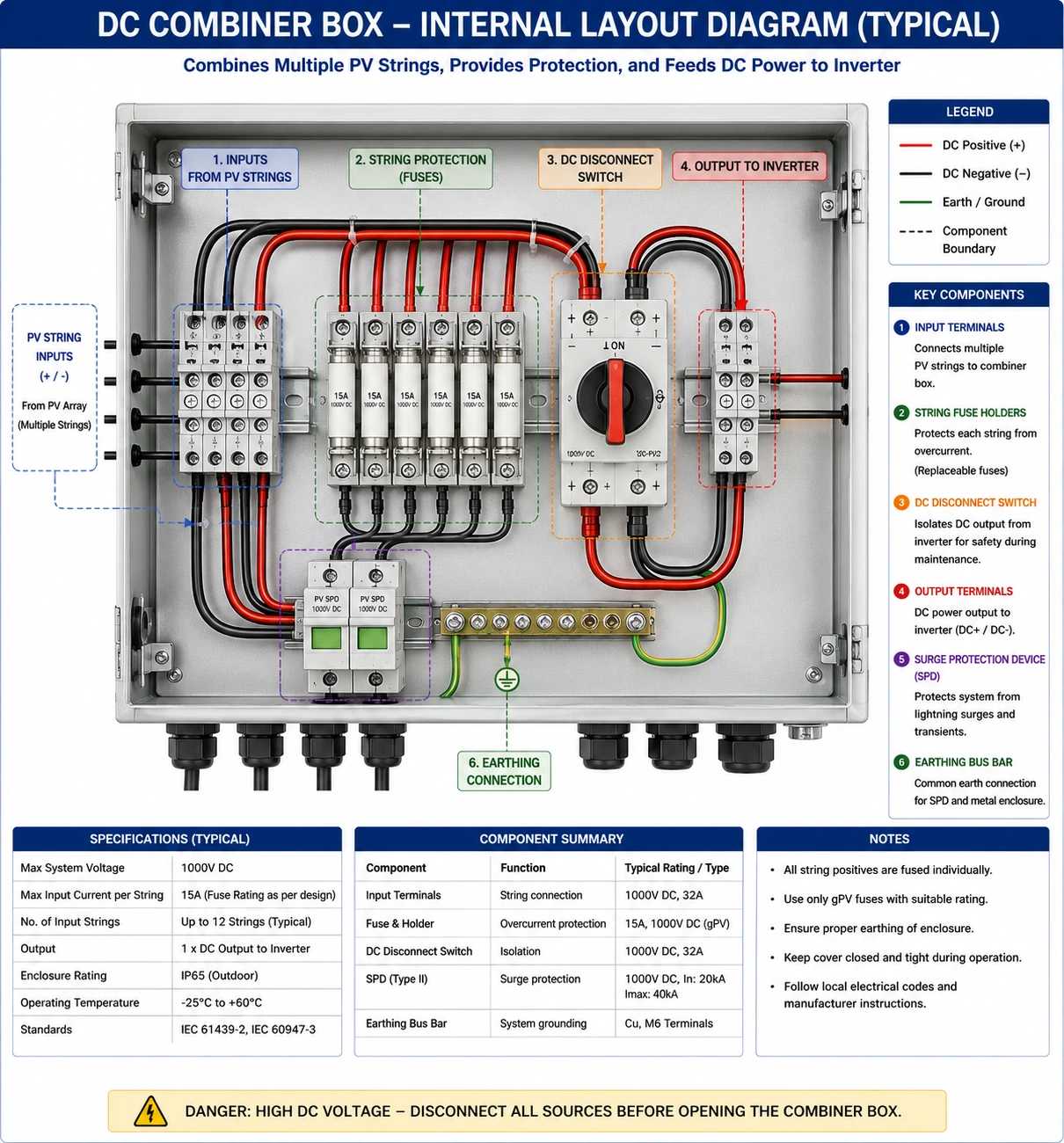
Step 1 – Select Installation Location
Choose a location that is:
- Close to solar arrays
- Easily accessible
- Protected from water and excessive heat
Step 2 – Mount the DC Combiner Box
- Fix the enclosure securely
- Ensure proper alignment and stability
Step 3 – Install Disconnect Switch
- Mount the DC isolator inside or adjacent to the box
- Ensure clear labeling
Step 4 – Install String Fuses
- Connect fuses for each solar string
- Ensure correct fuse ratings
Step 5 – Install Surge Protection Device
- Connect SPD according to the manufacturer’s instructions
- Ensure proper grounding
Step 6 – Route and Connect Cables
- Use proper cable glands and conduits
- Maintain polarity and cable identification
Step 7 – Tighten Electrical Connections
- Use the torque wrench as per the specifications
- Avoid loose terminals
Step 8 – Ground the Combiner Box
- Connect the grounding cable securely
- Verify earthing continuity
Step 9 – Perform Electrical Testing
Test for:
- Voltage
- Continuity
- Insulation resistance
- Polarity
Step 10 – Label and Document Installation
- Label circuits and disconnect switches
- Update project documentation
Quality Checks After Installation
1. Mechanical Stability
Ensure secure mounting.
2. Proper Cable Management
Check routing and organization.
3. Tightness of Connections
Verify torque values.
4. Functional Testing
Ensure the disconnect switch operates correctly.
5. Weatherproofing
Ensure enclosure sealing.
Conclusion
Installing a DC combiner box with disconnect protection is essential for ensuring the safety, reliability, and efficiency of solar PV systems. By following proper installation procedures, ensuring correct protection device selection, and maintaining quality standards, installers can prevent electrical hazards and improve system performance.
Electrical isolation and protection are fundamental aspects of renewable solar installations. Additionally, compliance with standards set by the Ministry of New and Renewable Energy ensures safe and standardized system operation.
With correct installation practices, solar professionals can optimize solar panel system cost, improve solar electricity generation, and support sustainable solar energy for home use and advanced renewable energy technology solutions.
FAQs
Q1. What is the function of a DC combiner box?
Ans: It combines multiple solar strings into a single DC output.
Q2. Why is disconnect protection important?
Ans: It allows safe isolation during maintenance and emergencies.
Q3. What components are included in a DC combiner box?
Ans: Fuses, SPDs, disconnect switches, and terminal blocks.
Q4. Does proper installation affect solar panel system cost?
Ans: Yes, it reduces maintenance and improves efficiency.
Q5. What safety measures should be followed during installation?
Ans: Use PPE, insulated tools, and isolate circuits before work.
Solar Energy Gadgets in India: 9 Cool Devices to Explore
Explore 9 innovative solar-powered gadgets in India that make daily life more sustainable, energy-efficient, and eco-friendly.
Measure and Record ESS Voltage in Solar PV Systems
A complete guide to measuring and recording energy storage system voltage for battery performance monitoring, troubleshooting, and maintenance.
Solar PV Startup & Energy Meter Recording Guide
A complete guide to solar PV startup procedures and energy meter recording, ensuring proper commissioning, documentation, and system performance verification.
Grid-Connected Solar PV System Startup Guide
A complete guide to starting up a grid-connected solar PV system, including commissioning, grid synchronization, electrical safety checks, and operational verification.
Save on Electricity in Haryana Using Net Metering: A Complete Guide
Learn how to save on electricity in Haryana with net metering. Step-by-step guide on benefits, installation, and cost savings for your home or business
How to Check Solar PV Module Performance
A complete guide to testing solar PV module performance, including voltage and current measurements, power output analysis, and performance verification techniques.
Solar Installation on Sloped Roofs: Design, Mounting Systems & Best Practices
A practical guide to flat roof solar installation covering key design considerations, mounting system types, and best practices for efficient and reliable performance.
Maintenance of Cables, Connectors & Switches Guide
A complete guide to maintaining cables, connectors, and switches in solar PV systems, including inspection, cleaning, testing, and preventive maintenance for long-term system reliability.