Rooftop Solar for Factories: Maximum kW You Can Install
Industrial Rooftop Solar installer can plan to install solar panels (KW) as per their solar requirements. Let us say solar requirements of factories, cold storages, warehouses, commercial buildings, Malls etc.
Understanding sizing of industrial rooftop solar plant
To understand industrial rooftop solar plant sizing, let us assume a hypothetical case of industry located in Kundali, Sonipat (Haryana). Following is known about the plant.
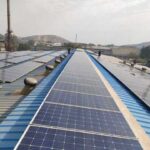
- Roof made of metal shed and has an area of 3000sqmeters,
- Contract load of 1,500 KW,
- An average monthly electricity consumption of 70,000 units or kWh
- Connected to a distribution transformer of 2,000KVA.
Factors of consideration to design industrial rooftop solar plant design
Following factors should be taken into consideration while designing the solar system for your roof.
- Roof Size determines the maximum capacity of the solar plant that can be installed.
- Each panel has an area of roughly 2 sq meter (1 meter X 2 meter) with a capacity of around 325 watts. So broadly, 3 panels can make 1 KW of solar installation. Which implies 1 KW can be installed in 6 sq meter of roof area in ideal conditions.
- However, space is required to be left between the panel rows to avoid shadow on the panels. As the panel structures are raised to provide inclination and better exposure to sunlight, the shadow free area further decreases.
- Typically, on concrete roofs, 10 sq meter would be a good estimate for 1 KW of solar panels. For inclined metal sheds and asbestos roofs, the area required to install 1 KW of solar panels would decrease based on the direction of the shed. A South facing shed can accommodate more solar panels than the one facing north.
- For the roof in the above example, a solar plant of 300-350 KW (=3000 /10) can be installed based on the size and inclination of roof.
2. Industrial rooftop Solar Plant size in KWs cannot be more than the Contract Load. In Haryana, Delhi, Uttar Pradesh, Rajasthan and other states, the size of solar plant is constraint by the Contract Load of the Building as per the Discom’s regulations. So, in this case, the maximum size of the solar plant that can be installed on the roof is 1500 KW.
3. Electricity bill is an important factor to determine the industrial rooftop solar plant size. As the Net Metering facility is available in all the states of India. Thus, the annual electricity consumption of the industrial unit, factory, warehouse or the building should be considered while sizing the industrial rooftop solar plant.
- In Haryana, UP and Delhi, consumers should consider a solar generation of 1400 kWh per KW of solar panels with 5 percent variation in the first year of the plant’s installation.
- In the above example, the factory has average monthly consumption of 70,000 units or annual consumption of 8,40,000 units (=70,000 X 12).
- To reduce the variable part of the electricity bill to zero, the industrial unit should install 600 KW (=8,40,000 / 1,400) of solar panels on the roof or within the campus.
4. Availability of Distribution Transformer capacity is important for the solar plant.
All the state regulators and Discoms have specified the maximum capacity of solar plants that can be connected to a Distribution transformer. For example, Haryana allows only 15% of the distribution transformer capacity that can be used by the solar plant. While Delhi allows 20% of the transformer capacity and Uttar Pradesh allows 25% of transformer capacity.
In the example above, the transformer has a capacity of 2000 KVA. So, a maximum of 300 KW (=15% of 2000) of solar panels can be connected to this transformer.
Discoms may consider the distribution transformer located in the premises of the industry also. As the distribution transformer in spite of the transformer being owned by the consumer. Therefore, it is important to check with the Discom for the maximum solar capacity that can be installed and Net Metered with the Distribution Transformer.
So, going by the above 4 factors, the Kundali consumer in this example can plan for a solar plant of only 300 KW. The factors are (1) Roof Size (2) Contract Load (3) Electricity Bill (4) Distribution Transformer capacity. In this case, the size of distribution transformer and the roof size are constraining factors.
Suggested Articles

Solar Power Park Scheme: Central Government Expands Clean Energy Initiative
The Union government plans to launch the second phase of a dedicated program to develop solar parks across the country that will aim to plug loopholes and overcome slow progress.

Net Metering and Its Advantages Explained: How Solar Users Save More on Energy Bills
Learn what Net Metering and its advantages mean for you—cut electricity costs, earn energy credits, and boost solar efficiency easily.

Solar Farm Development: Overcoming the Rising Challenge of Wiring Costs
Wiring costs are soaring in solar farms, affecting project budgets and timelines. Learn why infrastructure is becoming a key challenge.

Haryana’s GEOA 2025: A Boost for Captive Solar Plants and Wind Energy Developers
Haryana’s GEOA 2025 paves the way for growth in captive wind and solar energy projects with investor-friendly reforms.

Delhi Government Pledges to Boost Renewable Energy Generation
Delhi, the capital city of India, is moving towards a greener future with an ambitious plan to generate an additional 6,000 MW of electricity using renewable energy sources.

500 kW Solar Power Plant Cost in Rajasthan | Latest Price, Benefits and Payback Period
Planning to install a 500 kW solar power plant in Rajasthan? Discover the 2025 price estimate, government subsidy options, and ROI potential. Learn how industries and businesses can cut electricity costs and earn long-term returns through solar energy investments.

Best Solar Panels for Rooftop Projects: How to Choose the Right One
Selecting the right solar panel is crucial for rooftop project success. This guide explains how to evaluate panel types, efficiency, warranties, and performance to ensure maximum power output and long-term savings for your home or business.

Steps for Conducting a Load Assessment Before Solar Installation and Its Requirements
Load assessment is an essential step before installing a solar PV system. It helps determine electricity consumption and ensures accurate system sizing for optimal solar performance.