
In solar photovoltaic (PV) installations, testing equipment plays a vital role in ensuring system safety, performance, and reliability. From checking voltage and current to analyzing insulation resistance and system efficiency, testing instruments help installers verify that every component of the solar plant is functioning correctly.
However, even the best testing equipment can produce inaccurate results if it is not properly inspected and maintained. Faulty or poorly calibrated tools may lead to incorrect measurements, system failures, and increased solar installation charges.
Regular inspection and maintenance of testing equipment are essential for maintaining quality in renewable solar installations.
This blog provides a complete guide to inspecting and maintaining testing equipment used in solar PV systems, helping installers improve accuracy, safety, and overall solar electricity generation performance.
Importance of Testing Equipment in Solar PV Systems
Testing equipment helps installers:
- Verify system performance
- Detect faults and abnormalities
- Ensure electrical safety
- Maintain system efficiency
Properly maintained equipment ensures accurate readings and reliable solar electricity generation.
Common Testing Equipment Used in Solar Installations
1. Digital Multimeter
Purpose
- Measures voltage, current, and resistance.
2. Clamp Meter
Purpose
- Measures current without disconnecting circuits.
3. Insulation Resistance Tester (Megger)
Purpose
- Check insulation quality and leakage resistance.
4. Earth Resistance Tester
Purpose
- Measures grounding effectiveness.
5. Solar Irradiance Meter
Purpose
- Measures sunlight intensity.
6. I-V Curve Tracer
Purpose
- Analyzes solar module performance.
7. Thermal Imaging Camera
Purpose
- Detects hotspots and overheating.
Why Inspection of Testing Equipment is Important
1. Measurement Accuracy
Ensures reliable readings.
2. Safety
Prevents electrical accidents.
3. Compliance
Ensures adherence to testing standards.
4. Equipment Longevity
Reduces wear and damage.
Step-by-Step Inspection Process
Step 1 – Visual Inspection
Check for:
- Cracks
- Broken parts
- Damaged cables
Step 2 – Functional Testing
- Turn equipment on
- Verify display and controls
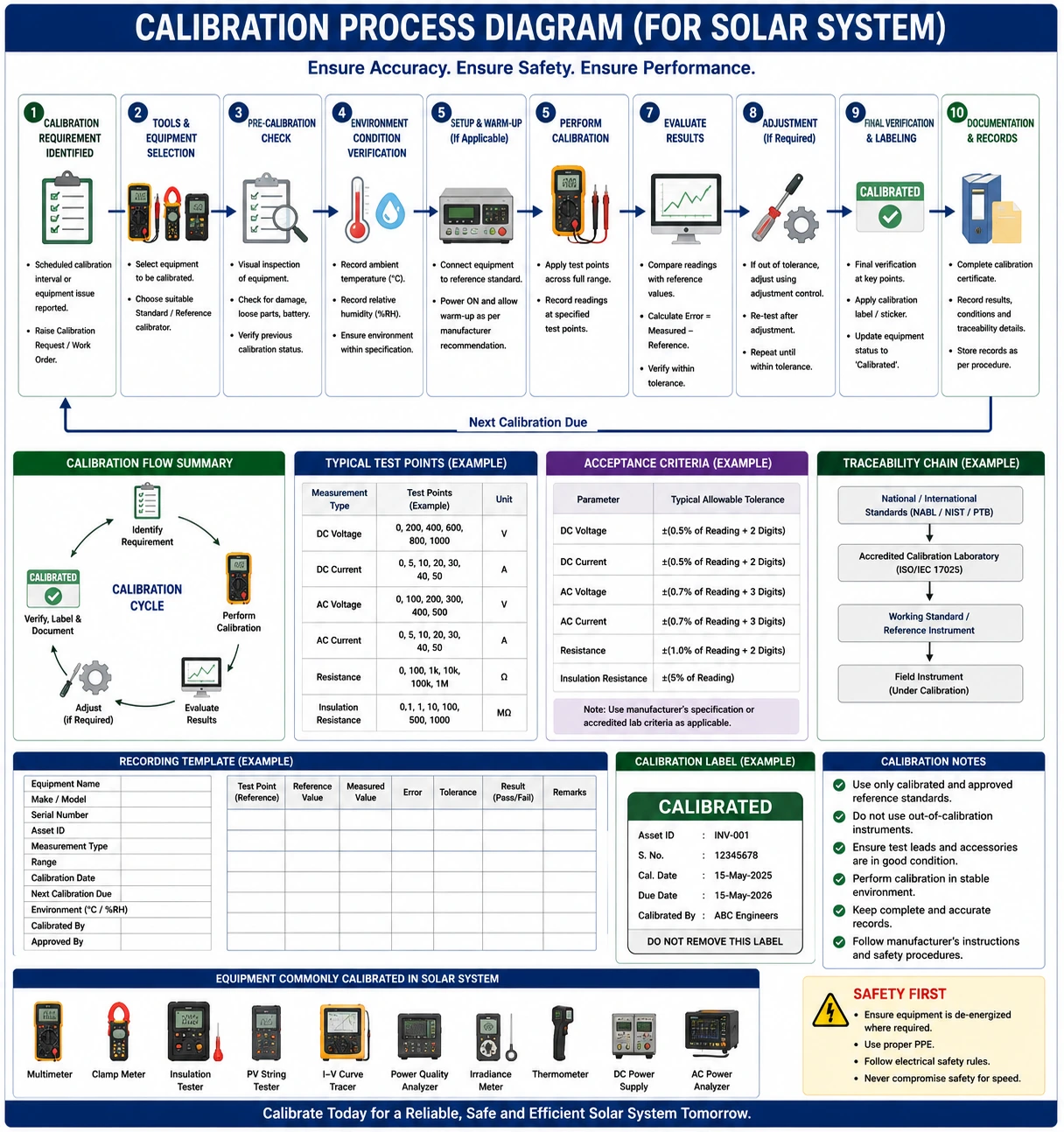
Step 3 – Calibration Verification
- Ensure readings are accurate
- Compare with reference values
Step 4 – Battery Check
- Inspect battery condition
- Replace weak batteries
Step 5 – Safety Inspection
- Check insulation
- Verify protective features
Step 6 – Documentation
- Record inspection details
- Maintain maintenance logs
Maintenance Procedures for Testing Equipment
1. Cleaning
- Remove dust and moisture
- Use soft dry cloth
2. Proper Storage
- Store in dry and safe area
- Use protective cases
3. Regular Calibration
- Calibrate periodically
- Follow manufacturer recommendations
4. Battery Maintenance
- Recharge or replace batteries regularly
5. Cable and Probe Inspection
- Replace damaged leads immediately
Quality Checks for Testing Equipment
1. Reading Accuracy
Verify measurements.
2. Physical Condition
Ensure no visible damage.
3. Calibration Status
Ensure equipment is calibrated.
4. Operational Safety
Check insulation and protective features.
Common Problems in Testing Equipment
1. Inaccurate Readings
Caused by poor calibration.
2. Battery Failure
Leads to unreliable operation.
3. Damaged Probes
Can cause unsafe measurements.
4. Moisture Damage
Affects internal electronics.
Conclusion
Inspecting and maintaining testing equipment is a critical part of ensuring safe, efficient, and reliable solar PV system installations. By following proper inspection procedures, maintaining calibration, and storing equipment correctly, installers can improve testing accuracy and system performance.
Maintaining testing instruments is essential for quality assurance in renewable solar projects. Additionally, adherence to standards set by the Ministry of New and Renewable Energy ensures compliance and operational safety.
With proper maintenance practices, solar professionals can optimize solar panel system cost, enhance solar electricity generation, and support sustainable solar energy for home use and modern renewable energy technology adoption.
FAQs
Q1. Why is testing equipment maintenance important?
Ans: It ensures accurate measurements and safe operation.
Q2. What is the most commonly used testing tool in solar installations?
Ans: A digital multimeter is widely used.
Q3. How often should testing equipment be calibrated?
Ans: As per manufacturer recommendations and project requirements.
Q4. What happens if testing equipment is not maintained?
Ans: It may produce inaccurate readings and compromise safety.
Q5. Does equipment maintenance affect solar panel system cost?
Ans: Yes, it reduces failures and improves installation quality.
How to Prepare Battery Terminals and Install Interconnection Cables
Proper battery terminal preparation and cable installation are essential for safe and efficient battery bank operation. This guide explains the complete installation process for solar projects.

Tools to Perform Shading Analysis Prior to Solar Installation
A solar site assessment helps installers evaluate location, shading, structure, and energy requirements before installation. This guide explains the essential steps for accurate solar system planning.
Fixed Structure – Solar Mounting Post Installation Guide
A step-by-step guide to solar mounting post installation for fixed structures, covering alignment, positioning, and best practices for durable solar foundations.
Solar Rooftop: अपने घर को बनाओ खुद का पावर हाउस | Complete Guide
सौर रूफटॉप सिस्टम आपके घर को पावर हाउस बना सकता है। यह न केवल बिजली के बिलों में बचत करता है, बल्कि साफ और नवीकरणीय ऊर्जा भी प्रदान करता है। जानें सौर पैनल की इंस्टालेशन प्रक्रिया, लागत, लाभ और कैसे यह आपके घर को आत्मनिर्भर ऊर्जा का स्रोत बना सकता है।
Optimum Solar Plant Capacity for Industries
A complete guide to sizing a solar plant for an industrial facility, covering electricity consumption, peak demand, rooftop space, load patterns, grid export limits, and financial feasibility.
Should You Switch to Solar in India? Complete Guide
India has become a hot-selling solar market and people are interested in installing solar systems in their homes as well as in industries and factories.
Solar Cable Guide | Types, Sizing & Specifications for PV Systems
Solar cables play a critical role in ensuring efficient and safe power transmission in PV systems. This guide explains cable types, specifications, sizing methods, and best practices for selecting the right solar cables.
Difference Between Inverter and Solar Inverter: A Complete Comparison
Confused between an inverter and a solar inverter? This guide explains their key differences, working principles, advantages, and which option is best for your home or business.