
Solar photovoltaic (PV) technology converts sunlight directly into electrical energy through semiconductor materials. It is one of the most widely used technologies for producing clean solar electricity for homes, businesses, industries, and utility-scale projects. Understanding the working principle of a PV system is essential for anyone involved in installation, commissioning, operation, maintenance, or troubleshooting.
A solar PV system consists of several interconnected components that work together to capture sunlight, convert it into electrical power, regulate and protect the electricity, and deliver it to loads, batteries, or the electrical grid. Understanding how these components interact also helps installers identify faults and maintain efficient system operation.
What Is a Solar PV System?
A solar PV system is an electrical system designed to convert solar radiation into usable electricity.
The major components may include:
- PV modules
- Mounting structures
- DC cables and connectors
- Combiner boxes
- DC protection devices
- Inverter
- AC distribution equipment
- Energy meter
- Battery or energy-storage system, where applicable
- Earthing and protection system
The exact configuration depends on whether the system is standalone, grid-connected, or a hybrid system.
1. Solar Energy Reaches the PV Module
The working process begins when sunlight reaches the surface of the PV module.
A solar module consists of multiple solar cells made from semiconductor materials, commonly silicon. When photons from sunlight strike these cells, they transfer energy to electrons within the semiconductor.
This causes the electrons to move and creates an electrical potential.
The phenomenon responsible for this conversion is known as the photovoltaic effect.
2. Solar Cells Generate DC Electricity
Individual solar cells produce direct current (DC) electricity.
Several cells are interconnected within a module to obtain the required voltage and current. Multiple modules may then be connected together to form strings, and several strings can be combined to create a PV array.
Therefore, the basic energy path can be represented as:
Sunlight → Solar Cell → PV Module → String → PV Array
The electrical output depends on factors such as solar irradiance, temperature, module characteristics, orientation, shading, and system condition.
3. PV Modules Are Connected to Form an Array
A single module may not provide enough voltage or power for the intended application. Modules are therefore connected in series, parallel, or a combination of both.
Series Connection
Connecting modules in series generally increases the system voltage while the current remains approximately that of the individual module, subject to operating conditions.
Parallel Connection
Connecting strings in parallel increases current while maintaining approximately the same voltage.
The system designer selects the configuration according to the inverter, electrical requirements, environmental conditions, and applicable design limits.
4. DC Electricity Travels Through the PV System
The DC electricity generated by the array travels through appropriately sized DC cables and connectors.
Depending on the system design, it may pass through:
- String connections
- DC combiner boxes
- Fuses
- DC isolators
- Surge protection devices
- Other DC protection equipment
These components help provide safe isolation and protection while allowing the generated electricity to reach the inverter.
5. The Inverter Converts DC Into AC
Most electrical appliances and grid-connected systems require alternating current (AC).
The inverter performs the critical task of converting the DC electricity produced by the PV array into AC electricity.
The conversion process can be simplified as:
PV DC Electricity → Inverter → AC Electricity
Modern inverters also perform functions such as system monitoring, maximum power point tracking (MPPT), protection, fault detection, and grid synchronization, depending on the inverter type.
6. MPPT Helps Extract Available Solar Power
Solar modules do not produce the same power under every operating condition.
The inverter’s MPPT system continuously seeks a suitable operating point that allows the PV array to deliver available power efficiently.
Factors such as:
- Solar irradiance
- Temperature
- Shading
- Module characteristics
This is one reason why proper system design and regular inspection are important for maintaining efficient solar electricity generation.
7. AC Electricity Supplies the Load
After conversion, AC electricity can be supplied to electrical loads.
In a typical grid-connected installation, the generated electricity may first serve local loads. Depending on system configuration and applicable metering arrangements, surplus electricity may be exported to the grid.
For solar energy for home use, this can reduce dependence on electricity purchased from the utility.
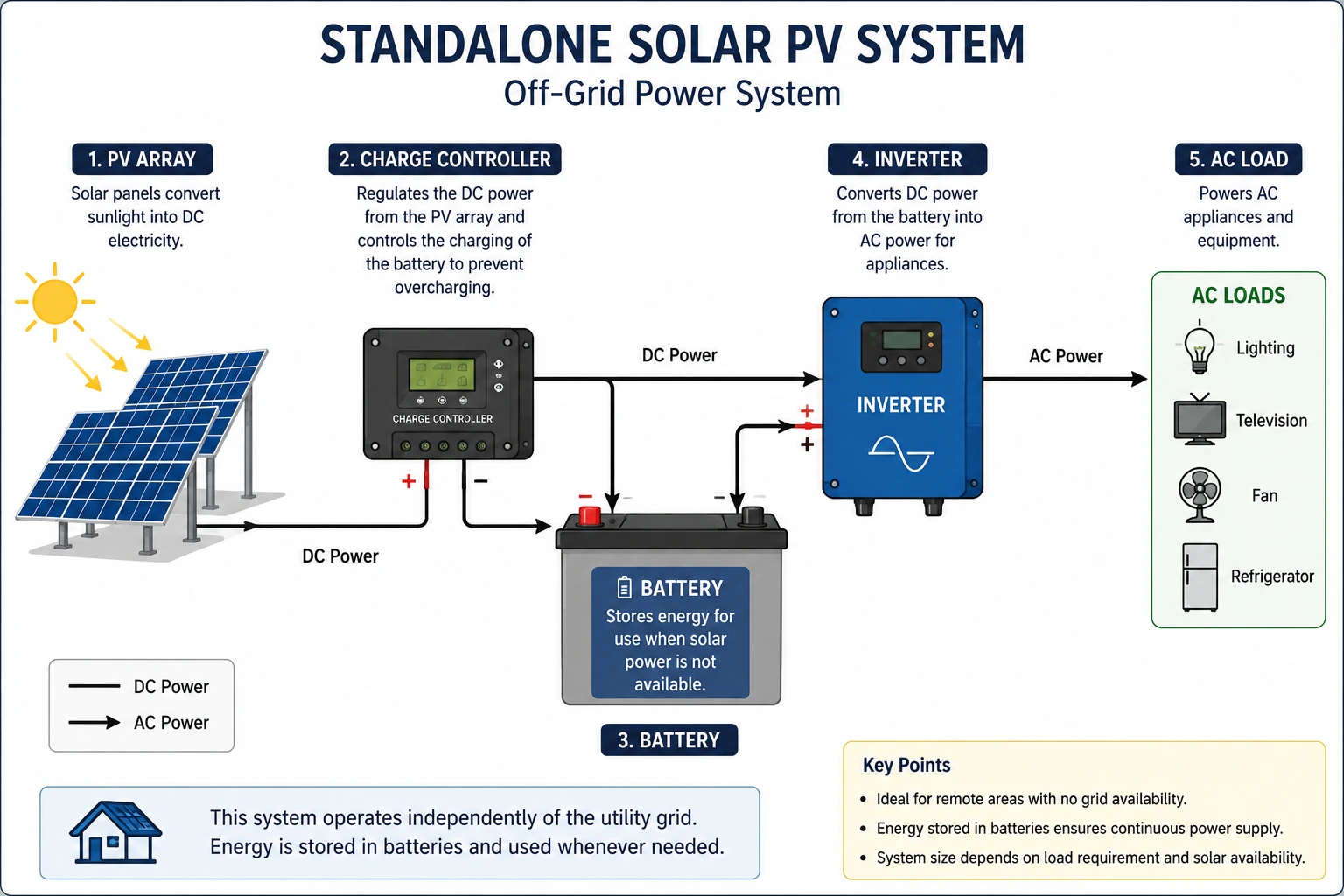
8. Batteries Can Store Solar Energy
Standalone and hybrid systems may incorporate batteries or other energy-storage technologies.
When solar generation exceeds the immediate load requirement, available energy can be directed toward charging the storage system, subject to the system’s control strategy. During periods when solar generation is insufficient, stored energy can be used to supply loads.
A simplified energy path is:
PV Array → Charge Controller/Inverter → Battery → Load
The exact arrangement depends on the system architecture.
9. Grid-Connected Systems Synchronize With the Grid
A grid-connected inverter must operate within the required electrical conditions for connection to the utility network.
The inverter monitors parameters such as:
- Voltage
- Frequency
- Phase
- Grid status
If grid conditions fall outside the permitted operating range, the inverter may disconnect according to its programmed protection functions and applicable requirements.
This contributes to the safe operation of the PV system and the connected electrical network.
10. Protection and Earthing Improve System Safety
A PV system requires appropriate protection against electrical faults and other hazards.
Depending on the design, protection can include:
- Fuses
- Circuit breakers
- DC isolators
- AC isolators
- Surge protection devices
- Earthing and bonding
- Overcurrent protection
Correct protection selection and installation are essential for personnel safety and equipment protection.
11. Monitoring Helps Verify System Performance
A PV system may include monitoring equipment that records parameters such as:
- DC voltage
- DC current
- AC voltage
- AC current
- Power output
- Energy generation
- Inverter status
- Fault conditions
Monitoring allows operators and maintenance personnel to identify unusual performance and investigate potential problems.
This is particularly important for maintaining the expected output of a solar plant.
How the Complete Solar PV System Works
The complete working principle can be summarized as:
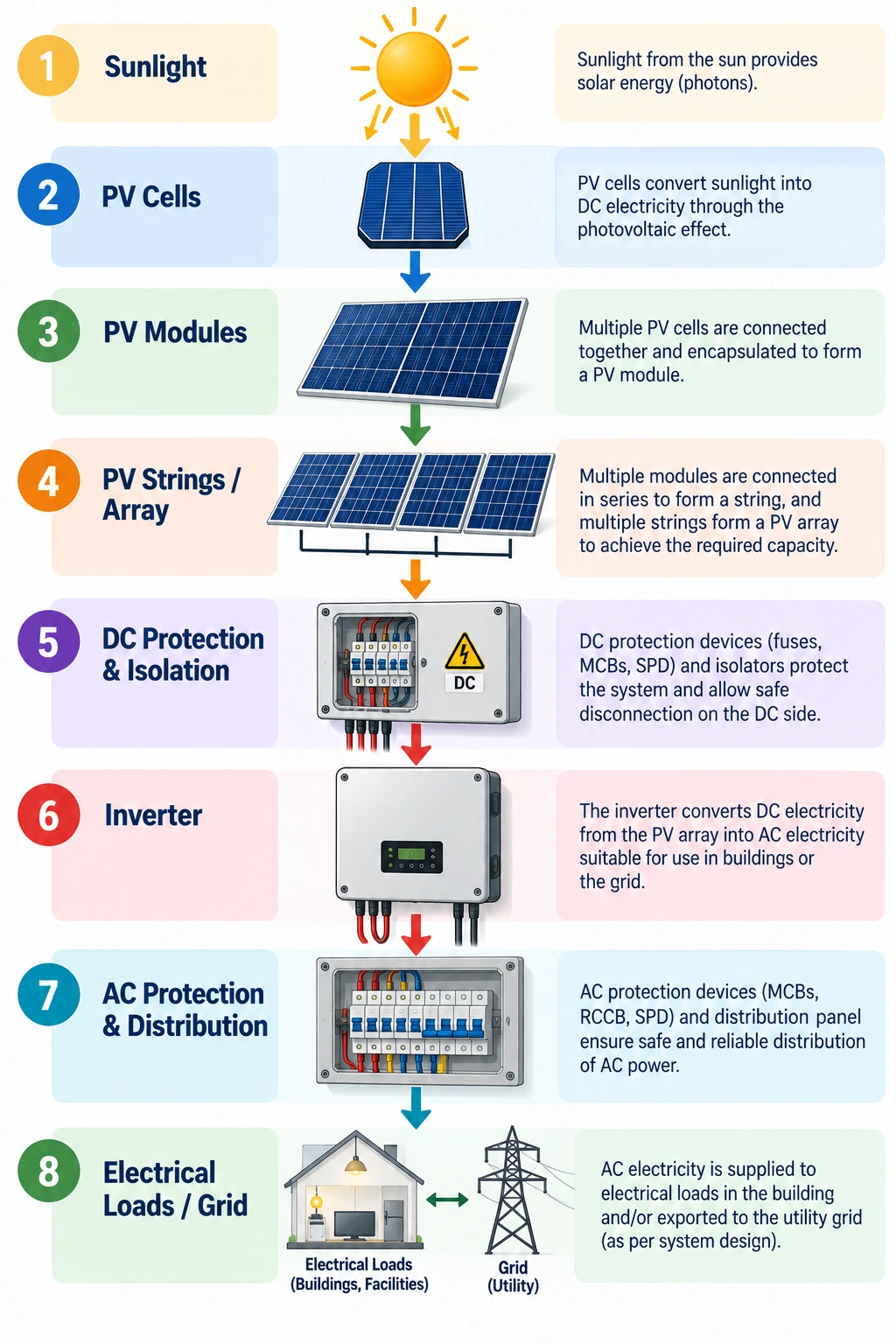
Where energy storage is included:
PV Array → Charge/Power Conversion System → Battery → Loads
This complete process allows solar radiation to be transformed into useful electrical energy.
Factors Affecting PV System Performance
The actual electricity produced by a PV system can vary because of:
- Solar irradiance
- Shading
- Module temperature
- Dust and soiling
- Module degradation
- Cable losses
- Inverter efficiency
- Incorrect installation
- Faulty connections
- Orientation and tilt
Regular inspection and maintenance can help identify issues that reduce output.
Conclusion
The working principle of a solar PV system is based on the conversion of sunlight into electrical energy through the photovoltaic effect. Solar cells generate DC electricity, multiple cells form modules, and modules are connected into strings and arrays to achieve the required electrical output.
The generated DC power passes through appropriate protection and isolation equipment before reaching the inverter. The inverter converts the electricity into AC power suitable for electrical loads and, in grid-connected systems, synchronizes with the utility network. Standalone and hybrid systems may additionally use batteries to store energy for later use.
Understanding this complete energy pathway—from sunlight to solar cell, PV array, inverter, AC distribution, storage, load, or grid—is fundamental for safe PV installation and maintenance. It also helps technicians identify performance issues and understand the purpose of different components.
Whether used for solar energy for home use, commercial applications, or large-scale solar plants, proper understanding of PV operation supports efficient and reliable solar electricity generation. Combined with appropriate design, testing, maintenance, and safety practices, it helps maximize the value of renewable energy and solar energy while supporting responsible management of the solar installation cost and overall solar energy installation cost.
FAQs
Q1. What is the working principle of a solar PV system?
Ans: A solar PV system uses the photovoltaic effect to convert sunlight into DC electricity, which can then be converted into AC electricity using an inverter for use by electrical loads or connection to the grid.
Q2. What is the photovoltaic effect?
Ans: It is the process through which semiconductor materials generate electrical voltage and current when exposed to light.
Q3. Why does a PV system need an inverter?
Ans: Most conventional electrical loads and utility grids use AC electricity, while PV modules naturally generate DC electricity. The inverter converts DC into suitable AC power.
Q4. What is MPPT in a solar inverter?
Ans: Maximum Power Point Tracking (MPPT) is a control function that helps the inverter operate the PV array near an operating point where available power can be effectively extracted.
Q5. What happens to excess solar electricity?
Ans: Depending on the system configuration, surplus electricity may be stored in batteries, supplied to other loads, or exported to the grid where permitted.
US Lawmakers Approve Tariffs on Solar Imports from Southeast Asia
US lawmakers vote to restore tariffs on solar imports from Southeast Asia, affecting pricing, supply, and the solar industry landscape.
Latest Solar Mounting Structures: Smarter, Stronger, and More Efficient
Learn how the latest solar mounting structures in 2025 improve efficiency, reduce costs, and power the future of solar installations.
Identify All Major Components of a Solar PV System: Complete Guide for Installers
Understand all major components of a solar PV system, from panels and inverters to mounting structures and BOS. This complete guide helps installers design efficient and reliable solar power systems.

Improve Your Power Factor After Solar Installation: Complete Guide
Power factor after solar installation often fluctuates due to system design and load patterns. Learn the key causes, challenges, and solutions for better efficiency.
Net Metering and its Advantages
Net Metering allows solar panel owners to feed excess electricity back to the grid and earn credits, reducing energy bills. Learn the key advantages of net metering for homes and businesses.

Solar PPA for Commercial Buildings: Cost, Benefits & Savings
Looking to cut electricity bills without investing in solar assets? Commercial Solar PPA providers offer zero-investment solar solutions where businesses pay only for the power generated—simple, risk-free, and cost-effective.

Solar ROI vs Payback Period Explained for Commercial & Industrial Projects
Compare payback period and ROI for solar systems. Discover how businesses should evaluate solar investments effectively.
Charge Controller Troubleshooting Guide for Solar PV Systems
A complete guide to troubleshooting charge controllers in solar PV systems, including fault diagnosis, electrical testing, error identification, and corrective maintenance for reliable system performance.