
A solar photovoltaic (PV) system is designed to generate reliable and continuous electricity whenever sufficient sunlight is available. However, interruptions in power generation can occur due to electrical faults, equipment failures, environmental conditions, improper installation, component degradation, or communication issues. Even a temporary interruption can significantly reduce energy production, affect the return on investment, and increase maintenance costs if the root cause is not identified and resolved promptly.
Power generation interruptions may occur in residential rooftop systems, commercial solar installations, industrial solar plants, hybrid systems, off-grid systems, and utility-scale solar power projects. The interruption may be partial, where only a few strings or inverters stop producing electricity, or complete, where the entire solar plant shuts down. Identifying the source of the fault quickly is essential for restoring normal operation, protecting equipment, and minimizing downtime.
A systematic troubleshooting approach allows technicians to inspect each component of the renewable solar system, including PV modules, cables, connectors, combiner boxes, inverters, batteries, charge controllers, protection devices, and monitoring systems. Modern solar installations also provide fault codes and performance data that help technicians diagnose issues efficiently.
Identifying faults during interruptions in power generation is a core competency for solar installers, commissioning engineers, EPC contractors, and operations and maintenance (O&M) professionals.
This comprehensive guide explains the common causes of power generation interruptions, troubleshooting procedures, inspection methods, testing equipment, safety precautions, documentation requirements, and industry best practices.
Why Does Power Generation Stop in a Solar PV System?
Power generation may stop due to one or more faults affecting the electrical or mechanical operation of the system.
Common reasons include:
- Inverter shutdown
- Grid failure
- Faulty PV modules
- Loose electrical connections
- Damaged cables
- Blown fuses
- Tripped circuit breakers
- Battery faults
- Charge controller malfunction
- Ground faults
- Insulation failure
- Communication errors
- Severe shading
- Lightning damage
- Weather-related issues
Early identification minimizes energy loss and protects system components.
Importance of Fault Identification
Routine troubleshooting helps to:
- Restore power generation quickly
- Reduce downtime
- Improve the renewable solar system’s reliability
- Prevent equipment damage
- Improve electrical safety
- Extend equipment lifespan
- Reduce maintenance costs
- Maximize solar electricity production
Common Faults That Interrupt Power Generation
1. PV Module Faults
Possible problems include:
- Cracked glass
- Broken solar cells
- Delamination
- Hotspots
- Burn marks
- Water ingress
Damaged modules reduce power generation.
2. Shading Issues
Temporary or permanent shading caused by:
- Trees
- Buildings
- Dust
- Bird droppings
- Leaves
Shading reduces both current and power output.
3. Cable Faults
Inspect for:
- Broken cables
- Loose terminals
- Rodent damage
- UV degradation
- Damaged insulation
Cable faults interrupt electrical continuity.
4. Connector Failures
Common issues include:
- Loose MC4 connectors
- Corrosion
- Water ingress
- Burnt connectors
- Improper mating
Faulty connectors increase electrical resistance.
5. Combiner Box Problems
Inspect:
- DC fuses
- Surge protection devices (SPDs)
- Busbars
- Wiring
- Terminal blocks
Faults may isolate entire strings.
6. Inverter Faults
Common inverter problems include:
- Grid synchronization failure
- Overvoltage
- Undervoltage
- Overtemperature
- Isolation faults
- Internal hardware failure
- Firmware errors
Fault codes should always be investigated.
7. Battery Faults (Hybrid and Off-Grid Systems)
Possible causes:
- Low voltage
- Battery imbalance
- Overcharging
- Deep discharge
- Loose terminals
- Battery Management System (BMS) alarms
Battery faults may prevent normal inverter operation.
8. Grid-Related Problems
Grid interruptions may result from:
- Utility outages
- Voltage fluctuations
- Frequency deviations
- Utility maintenance
- Protection trips
Grid-connected systems automatically stop exporting power during unsafe grid conditions.
9. Ground Faults
Ground faults may occur because of:
- Damaged insulation
- Moisture ingress
- Cable deterioration
- Incorrect grounding
Ground faults activate inverter protection mechanisms.
10. Environmental Factors
Performance interruptions may also result from:
- Heavy dust
- Snow accumulation
- Storm damage
- Flooding
- High temperatures
- Lightning strikes
Environmental inspections are important during troubleshooting.
Tools Required for Fault Identification
Technicians commonly use:
- Digital multimeter
- Clamp meter
- Insulation resistance tester
- Earth resistance tester
- PV analyzer
- Infrared thermal camera
- IV curve tracer
- Laptop with inverter software
- Irradiance meter (Pyranometer)
- Personal Protective Equipment (PPE)
Only calibrated instruments should be used.
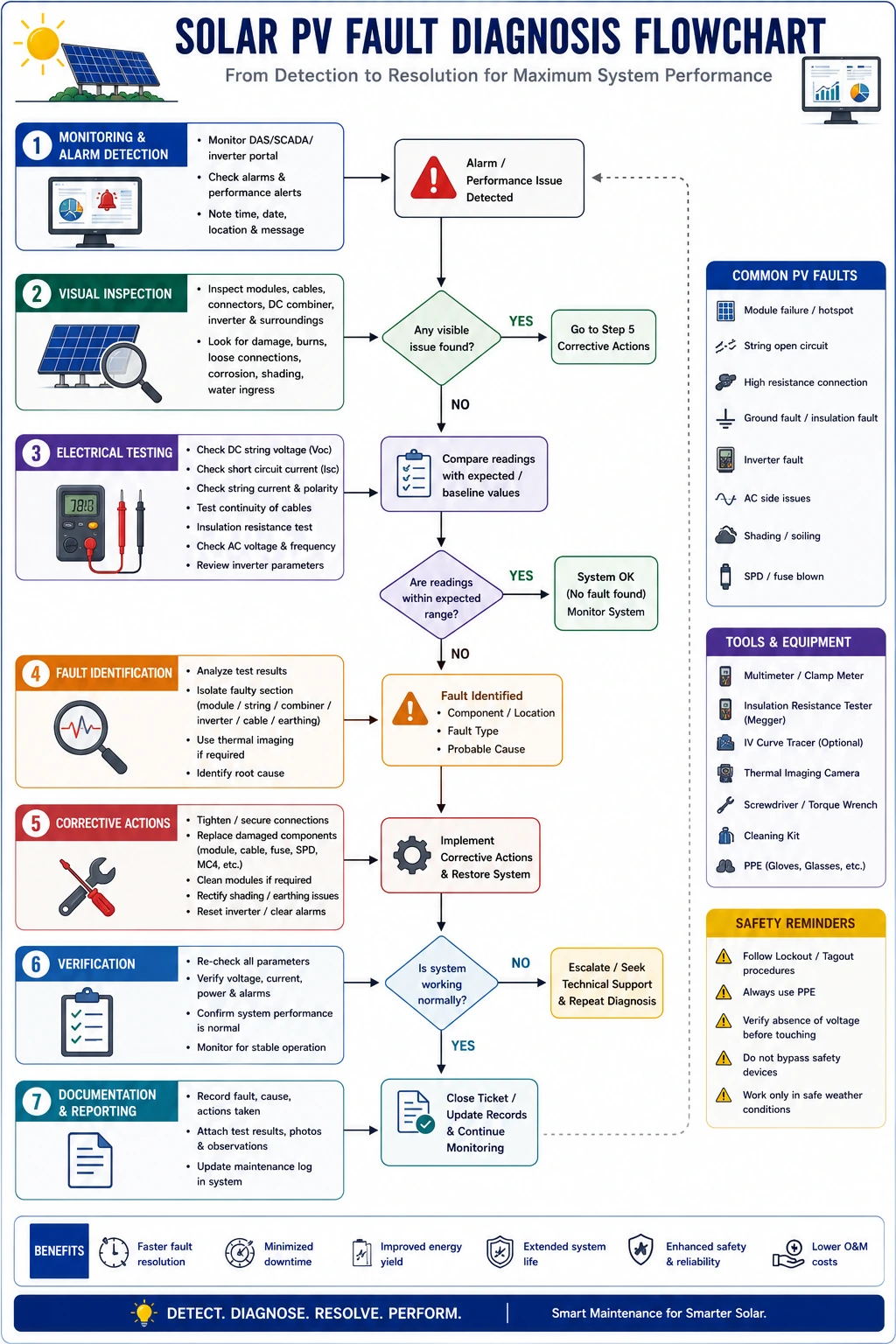
Step-by-Step Troubleshooting Procedure
Step 1 – Review System Information
Before visiting the site:
Review:
- System drawings
- Previous maintenance records
- Monitoring platform data
- Fault history
Historical information often speeds up diagnosis.
Step 2 – Verify Environmental Conditions
Check:
- Solar irradiance
- Weather conditions
- Shading
- Module cleanliness
Poor weather may temporarily reduce power generation.
Step 3 – Perform Visual Inspection
Inspect:
- PV modules
- Mounting structures
- Cables
- Connectors
- Junction boxes
- Combiner boxes
- Inverters
- Battery systems
Record visible defects.
Step 4 – Check Monitoring System
Review:
- Energy generation
- String performance
- Inverter alarms
- Communication status
- Historical trends
Monitoring software often identifies affected components.
Step 5 – Inspect the Inverter
Verify:
- Display messages
- Fault codes
- Operating status
- LED indicators
- Cooling system
- Communication links
Follow the manufacturer’s troubleshooting recommendations.
Step 6 – Test Electrical Parameters
Measure:
- Open Circuit Voltage (Voc)
- Short Circuit Current (Isc)
- DC string voltage
- DC current
- AC output voltage
- AC current
- Frequency
- Insulation resistance
Compare measurements with design specifications.
Step 7 – Inspect Protection Devices
Check:
- DC fuses
- AC breakers
- Isolator switches
- Surge Protection Devices (SPDs)
Replace defective protection devices if required.
Step 8 – Verify Battery Operation (If Installed)
Inspect:
- Battery voltage
- State of charge
- Battery temperature
- BMS alarms
- Charging status
Battery faults may interrupt hybrid system operation.
Step 9 – Perform Thermal Inspection
Use an infrared thermal camera to inspect:
- Connectors
- Cables
- Switches
- Inverter terminals
- Combiner boxes
Hotspots often indicate loose or overloaded connections.
Step 10 – Identify Root Cause
Determine whether the interruption results from:
- Equipment failure
- Environmental conditions
- Electrical faults
- Installation errors
- Component degradation
Root cause analysis prevents repeat failures.
Step 11 – Carry Out Corrective Actions
Possible corrective actions include:
- Cleaning PV modules
- Tightening terminals
- Replacing damaged cables
- Repairing connectors
- Resetting inverters
- Replacing faulty modules
- Updating firmware
- Repairing grounding systems
Always verify system performance after repairs.
Step 12 – Prepare the Inspection Report
Record:
- Fault identified
- Test results
- Components replaced
- Corrective actions
- Technician observations
- Recommendations
Complete documentation supports preventive maintenance.
Conclusion
Interruptions in solar power generation can significantly affect system performance, energy production, and project profitability if faults are not identified and corrected promptly. A structured troubleshooting process that combines visual inspections, monitoring system analysis, electrical measurements, thermal imaging, and root cause analysis enables technicians to accurately diagnose problems affecting PV modules, inverters, cables, connectors, batteries, protection devices, and other critical components. Prompt corrective actions not only restore power generation but also prevent further equipment damage and improve long-term system reliability.
Identifying faults during power generation interruptions is a fundamental skill for solar installers, EPC contractors, commissioning engineers, and operations and maintenance professionals. Furthermore, following technical recommendations and safety practices promoted by the Ministry of New and Renewable Energy, together with manufacturer guidelines, helps ensure safe, standards-compliant, and efficient troubleshooting of renewable solar systems.
By implementing preventive maintenance schedules, monitoring system performance regularly, using calibrated testing instruments, maintaining detailed inspection records, and addressing faults without delay, solar professionals can optimize solar panel system cost, maximize renewable solar system reliability, improve solar electricity generation, reduce the cost of solar per kWh installed, and ensure the long-term success of residential, commercial, industrial, and utility-scale solar energy projects.
FAQs
Q1. What are the most common causes of interruptions in solar power generation?
Ans: Common causes include inverter faults, damaged PV modules, loose electrical connections, faulty cables, blown fuses, tripped circuit breakers, shading, battery problems, grid outages, communication failures, ground faults, and adverse weather conditions.
Q2. How can technicians identify the source of a solar PV system fault?
Ans: Technicians use a combination of visual inspections, monitoring system data, inverter fault codes, electrical measurements, thermal imaging, insulation resistance testing, and continuity testing to identify the root cause of the interruption.
Q3. Why is inverter fault information important during troubleshooting?
Ans: Modern inverters display fault codes and alarms that provide valuable information about issues such as grid faults, overvoltage, undervoltage, overtemperature, insulation failures, communication errors, and internal hardware problems, helping technicians diagnose faults more efficiently.
Q4. Which testing instruments are commonly used for fault identification?
Ans: Common instruments include digital multimeters, clamp meters, insulation resistance testers, earth resistance testers, PV analyzers, IV curve tracers, infrared thermal cameras, and irradiance meters.
Q5. How does preventive maintenance reduce interruptions in power generation?
Ans: Routine inspection, cleaning, electrical testing, thermal imaging, monitoring system reviews, and timely replacement of worn or damaged components help detect problems early, reducing unexpected failures, improving system reliability, and maintaining consistent solar electricity generation.
Generation Based Incentive Proposed for Rooftop Solar in Haryana
Haryana plans to offer Generation Based Incentive (GBI) for rooftop solar installations, promoting clean energy adoption and reducing electricity costs for consumers.

Solar for Food Processing Units: Cost, Benefits, Installation & ROI in India
A complete guide on solar systems for the FMCG industry in India covering installation cost, benefits, ROI, system sizing, and the installation process.
Grid-Connected Solar PV System Startup Guide
A complete guide to starting up a grid-connected solar PV system, including commissioning, grid synchronization, electrical safety checks, and operational verification.
Solar PV Testing Equipment Inspection & Maintenance Guide
A complete guide to solar PV testing equipment inspection and maintenance, ensuring accurate measurements and reliable system performance.
Understanding Solar Battery Specifications: Capacity, Voltage & Efficiency Explained
Solar batteries are essential for energy storage and backup in PV systems. This guide explains key specifications like capacity, voltage, efficiency, and depth of discharge to help you choose the right battery.
Solar EPC Installation Tools & Consumables Guide for Civil & Mechanical Work
A complete Solar EPC guide covering essential tools and consumables required for civil and mechanical installation to ensure smooth and efficient project execution.
How to Read the Electricity Bill Before Deciding Solar Plant Capacity
Load assessment is an essential step before installing a solar PV system. It helps determine electricity consumption and ensures accurate system sizing for optimal solar performance.
Solar Inverter Installation: On-Grid, Off-Grid & Hybrid
A complete guide to on-grid, off-grid, and hybrid solar inverter installation, including setup, wiring, and best practices for safe operation.