
The commissioning phase of a solar photovoltaic (PV) system marks the transition from installation to operational status. One of the most critical activities during this stage is initiating startup procedures according to manufacturer instructions and accurately recording energy meter readings at startup. This process verifies that all components are functioning correctly, ensures safe energization of the system, establishes baseline performance data, and confirms readiness for regular operation.
Whether it is a residential rooftop solar installation, a commercial solar project, an industrial renewable energy system, or a utility-scale solar power plant, proper startup procedures are essential for protecting equipment, ensuring personnel safety, and maximizing long-term system performance. Incorrect startup sequences can lead to equipment damage, inverter faults, electrical hazards, inaccurate monitoring data, and reduced system reliability.
Energy meter readings recorded during startup serve as the initial reference point for future energy generation analysis, performance ratio calculations, maintenance planning, warranty verification, and operational reporting. These baseline readings are crucial for evaluating solar electricity generation throughout the project lifecycle.
Systematic startup procedures and proper documentation are essential components of solar PV commissioning and renewable energy technology implementation.
This comprehensive guide explains startup preparation, commissioning requirements, startup sequences, meter verification procedures, documentation methods, safety precautions, and industry best practices.
Importance of Proper Startup Procedures
Startup is the first controlled energization of a completed solar PV installation.
Proper startup procedures help:
- Protect equipment
- Ensure system safety
- Verify installation quality
- Confirm design compliance
- Establish baseline operational data
- Support successful commissioning
Following approved startup procedures reduces the risk of operational problems.
Why Manufacturer Instructions Must Be Followed
Each solar PV component is designed with specific startup requirements.
Manufacturers provide procedures for:
- Inverters
- Battery systems
- Charge controllers
- Monitoring equipment
- Protection devices
Failure to follow manufacturer instructions may result in:
- Warranty issues
- Equipment malfunction
- Reduced efficiency
- Safety risks
Therefore, startup activities should always align with manufacturer documentation.
Components Involved During Startup
Several key components are energized during startup.
1. Solar PV Array
The primary energy-generating source.
2. DC Combiner Box
Combines multiple string outputs.
3. DC Disconnects
Provide isolation for maintenance and emergencies.
4. Solar Inverter
Converts DC power into usable AC electricity.
5. AC Distribution Equipment
Distributes generated power.
6. Utility Interconnection Equipment
Required for grid-connected systems.
7. Battery Energy Storage Systems
Applicable in hybrid and off-grid installations.
8. Monitoring Systems
Track operational and performance data.
Pre-Startup Inspection Requirements
Before initiating startup procedures, several inspections must be completed.
-
Verify Installation Completion
Confirm that:
- All equipment is installed
- Construction activities are complete
- Required inspections have been completed
-
Verify Mechanical Integrity
Inspect:
- Mounting structures
- Fasteners
- Enclosures
- Equipment supports
All components should be securely installed.
-
Verify Electrical Installation
Inspect:
- Cable terminations
- Conduit systems
- Grounding connections
- Protection devices
All wiring should comply with design drawings.
-
Confirm Testing Completion
Verify successful completion of:
- Continuity testing
- Insulation resistance testing
- Grounding verification
- Polarity testing
The startup should not proceed if testing is incomplete.
-
Verify Labeling
Ensure all equipment and circuits are properly identified. Proper labeling supports safe operation and maintenance.
Tools Required During Startup
Common tools and instruments include:
- Digital multimeter
- Clamp meter
- Insulation tester
- Commissioning checklist
- Manufacturer manuals
- Personal protective equipment (PPE)
- Startup documentation forms
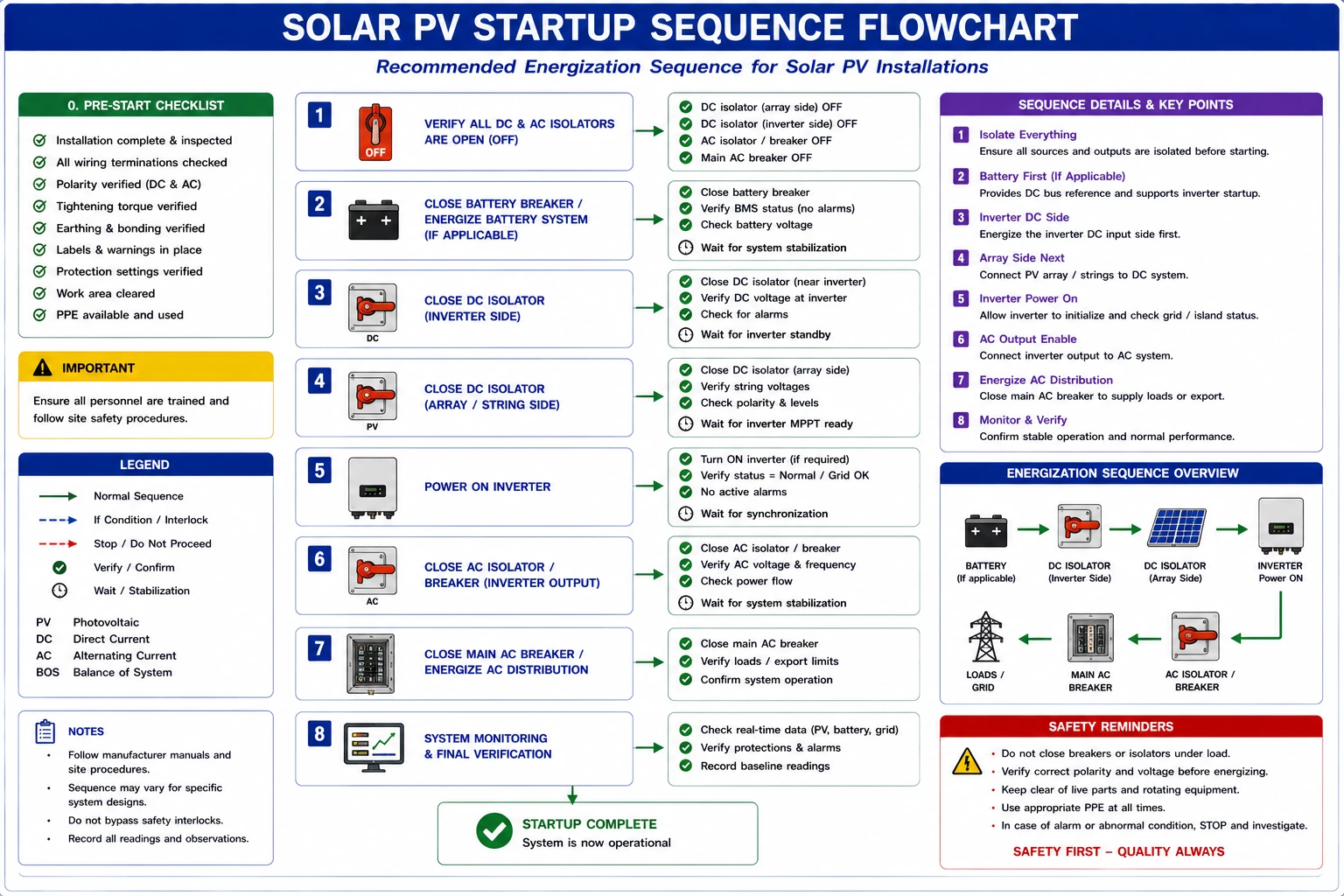
Step-by-Step Solar PV Startup Procedure
Step 1 – Review Manufacturer Documentation
Before energization:
Review:
- Startup instructions
- Safety warnings
- Equipment manuals
- Commissioning requirements
Ensure personnel understand the procedure.
Step 2 – Verify Safety Conditions
Confirm:
- Work areas are clear
- Personnel are informed
- Required PPE is being used
- Lockout/tagout procedures have been removed appropriately
Safety must remain the highest priority.
Step 3 – Inspect DC Side Components
Verify:
- Solar strings are connected correctly
- DC combiner boxes are secure
- Disconnect switches are properly configured
Ensure no visible defects exist.
Step 4 – Verify Battery System Status
For battery-based systems:
Check:
- Battery voltage
- Battery polarity
- Battery condition
- Battery protection settings
Battery systems should be ready before inverter startup.
Step 5 – Energize DC Circuits
Close DC disconnects according to manufacturer procedures.
Verify:
- Correct voltage levels
- Stable operation
- No abnormal conditions
Monitor system responses carefully.
Step 6 – Start the Inverter
Initiate inverter startup according to manufacturer instructions.
Verify:
- Startup sequence completion
- Status indicators
- Display information
- Fault-free operation
Most modern inverters perform automatic self-checks during startup.
Step 7 – Energize AC Side Equipment
After successful inverter startup:
Activate:
- AC disconnects
- Distribution equipment
- Utility interconnection devices
Follow the prescribed sequence carefully.
Step 8 – Verify System Synchronization
For grid-connected systems:
Confirm:
- Voltage synchronization
- Frequency synchronization
- Successful grid connection
Verify inverter operational status.
Step 9 – Check Monitoring Systems
Confirm operation of:
- Data acquisition systems
- Monitoring software
- Communication systems
- Remote monitoring platforms
Monitoring systems should begin recording operational data.
Step 10 – Observe Initial System Operation
Monitor:
- DC voltage
- DC current
- AC voltage
- AC current
- Power output
Ensure values remain within expected ranges.
Importance of Recording Energy Meter Readings at Startup
Energy meter readings provide baseline operational data.
Startup readings establish:
- Initial energy production value
- Commissioning reference point
- Warranty documentation
- Performance monitoring baseline
These records are important throughout the system lifecycle.
Types of Energy Meters Used in Solar PV Systems
Generation Meter
- Measures total solar energy produced.
Import/Export Meter
- Measures energy exchanged with the utility grid.
Net Meter
- Records imported and exported electricity.
Revenue Meter
- Used for billing and energy accounting.
Parameters Commonly Recorded During Startup
Startup records often include:
|
Parameter |
Description |
|
DC Voltage |
Array Operating Voltage |
|
DC Current |
Array Operating Current |
|
AC Voltage |
Inverter Output Voltage |
|
AC Current |
Inverter Output Current |
|
Frequency |
Frid Frequency |
|
Energy Meter Reading |
Baseline Energy Value |
|
Inverter Status |
Operational Condition |
|
Startup Date & Time |
Commissioning reference |
Conclusion
Initiating startup procedures according to manufacturer instructions and accurately recording energy meter readings at startup are critical steps in the successful commissioning of solar PV systems. These activities verify installation quality, ensure safe energization, establish baseline performance data, support regulatory compliance, and contribute to long-term renewable solar system reliability.
Proper commissioning procedures are essential for achieving efficient solar electricity generation and maintaining renewable energy technology performance. Furthermore, adhering to technical recommendations and quality standards promoted by the Ministry of New and Renewable Energy helps ensure safe, compliant, and professional solar PV installations.
By following approved startup sequences, verifying equipment readiness, documenting energy meter readings accurately, monitoring system performance, maintaining comprehensive commissioning records, and addressing operational issues promptly, solar installers, EPC contractors, commissioning engineers, and project managers can optimize solar panel system cost, improve renewable solar system reliability, maximize operational efficiency, and ensure the long-term success of residential, commercial, industrial, and utility-scale solar energy projects.
FAQs
Q1. Why are manufacturer startup procedures important in solar PV systems?
Ans: Manufacturer procedures ensure safe equipment energization, protect system components, maintain warranty compliance, and verify proper operation.
Q2. What should be checked before starting a solar PV system?
Ans: Installers should verify mechanical installation, electrical connections, grounding systems, testing completion, equipment labeling, and safety conditions.
Q3. Why is the energy meter reading recorded at startup?
Ans: Startup meter readings establish a baseline reference for future energy production monitoring, warranty verification, maintenance planning, and performance analysis.
Q4. What types of meters are commonly used in solar PV systems?
Ans: Common meter types include generation meters, net meters, import/export meters, and revenue meters.
Q5. What should be done if an inverter displays a fault during startup?
Ans: The startup process should be paused, the fault investigated according to manufacturer guidelines, corrective actions implemented, and the system retested before proceeding.
Industrial Solar Power: 7 Reasons to Make the Switch
Top 7 benefits of solar energy for industries, including cost savings, environmental impact, and improved energy reliability.
Solar Installation on Sloped Roofs: Design, Mounting Systems & Best Practices
A practical guide to flat roof solar installation covering key design considerations, mounting system types, and best practices for efficient and reliable performance.
How to Prepare Battery Terminals and Install Interconnection Cables
Proper battery terminal preparation and cable installation are essential for safe and efficient battery bank operation. This guide explains the complete installation process for solar projects.
Solar Tracking System Installation for Maximum Efficiency
A step-by-step guide to solar tracking system installation, covering setup, alignment, and best practices for maximum efficiency and performance.

India’s Renewable Energy Revolution: The Role of Agrivoltaics
Agrivoltaics, the integration of solar panels with agricultural land, is emerging as a key driver in India’s renewable energy revolution. This blog explains how agrivoltaics supports sustainable farming, increases land efficiency, and contributes to clean energy production, helping India meet its solar energy targets while boosting rural economies.
Solar PV Fault Escalation & Troubleshooting Guide
A complete guide to escalating unresolved faults in solar PV systems, including troubleshooting procedures, documentation, supervisor notification, and technical support for efficient maintenance.
How to Inspect and Maintain Solar Arrays
A complete guide to solar array inspection and maintenance, helping improve system reliability, energy output, and long-term performance through routine inspections and preventive care.

Solar for Metal & Fabrication Units: Cost, Benefits and Installation in India
A practical guide on solar for metal and fabrication units in India covering installation cost, benefits, system options, and the installation process.