
The inverter is often referred to as the “heart” or “brain” of a solar photovoltaic (PV) system because it performs the critical task of converting the direct current (DC) generated by solar PV modules into alternating current (AC) that powers homes, commercial buildings, industries, and utility grids. Modern solar inverters also perform advanced functions such as Maximum Power Point Tracking (MPPT), system monitoring, grid synchronization, anti-islanding protection, battery management (in hybrid systems), fault detection, and communication with energy management systems.
Since the inverter is responsible for managing power conversion and system protection, any malfunction can significantly reduce solar electricity generation, interrupt power supply, trigger system shutdowns, lower overall efficiency, and increase maintenance costs. Common inverter issues include communication failures, grid synchronization errors, DC input faults, overheating, firmware problems, insulation faults, internal hardware failures, and abnormal voltage or frequency conditions.
Systematic inverter troubleshooting enables technicians to identify the root cause of faults accurately rather than replacing expensive equipment unnecessarily. A structured troubleshooting process includes reviewing fault codes, inspecting wiring, measuring electrical parameters, checking communication systems, verifying protection devices, testing environmental conditions, and documenting corrective actions. Following these procedures helps restore system performance while ensuring safety and compliance with industry standards.
Understanding inverter operation and troubleshooting techniques is a core competency for solar installers, commissioning engineers, EPC contractors, and Operations & Maintenance (O&M) professionals.
This comprehensive guide explains common inverter faults, troubleshooting methods, testing procedures, required tools, documentation practices, safety precautions, and industry best practices.
What Is a Solar Inverter?
A solar inverter converts the DC electricity generated by solar panels into AC electricity suitable for powering electrical loads or exporting energy to the utility grid.
In addition to power conversion, modern inverters perform:
- Maximum Power Point Tracking (MPPT)
- Grid synchronization
- Anti-islanding protection
- Battery charging and management (hybrid systems)
- System monitoring
- Fault detection
- Communication with monitoring platforms
- Electrical protection
Types of Solar Inverters
1. String Inverters
Used in residential and commercial installations where multiple solar modules are connected in series.
2. Central Inverters
Installed in utility-scale solar plants with large power capacities.
3. Hybrid Inverters
Designed for systems with battery storage, allowing seamless switching between solar power, batteries, and the electrical grid.
4. Off-Grid Inverters
Operate independently of the utility grid and supply power directly from batteries and solar panels.
5. Microinverters
Installed on individual solar modules, enabling independent optimization and monitoring of each panel.
Why Is Inverter Troubleshooting Important?
Routine troubleshooting helps to:
- Maintain uninterrupted solar electricity generation
- Improve conversion efficiency
- Reduce downtime
- Protect connected equipment
- Increase inverter lifespan
- Improve renewable solar system reliability
- Minimize maintenance costs
Common Inverter Problems
Technicians frequently encounter:
- Inverter not starting
- Inverter shutting down unexpectedly
- Low power output
- Grid synchronization failure
- Anti-islanding alarms
- Communication failure
- DC overvoltage
- DC undervoltage
- AC overvoltage
- AC undervoltage
- Frequency errors
- Ground faults
- Insulation resistance faults
- Overtemperature alarms
- Cooling fan failure
- Internal hardware faults
- Firmware errors
Each issue requires systematic diagnosis.
Common Causes of Inverter Faults
Inverter problems may result from:
- Loose electrical connections
- Damaged PV modules
- Faulty DC cables
- Incorrect polarity
- Poor grounding
- High ambient temperature
- Blocked ventilation
- Dust accumulation
- Water ingress
- Grid disturbances
- Battery faults (hybrid systems)
- Firmware corruption
- Component aging
Understanding the root cause prevents unnecessary inverter replacement.
Tools Required
Technicians commonly use:
- Digital multimeter
- Clamp meter
- Insulation resistance tester (Megger)
- Earth resistance tester
- Infrared thermal camera
- Power quality analyzer
- Solar irradiance meter
- Laptop with inverter monitoring software
- Manufacturer diagnostic software
- Personal Protective Equipment (PPE)
Only calibrated instruments should be used.
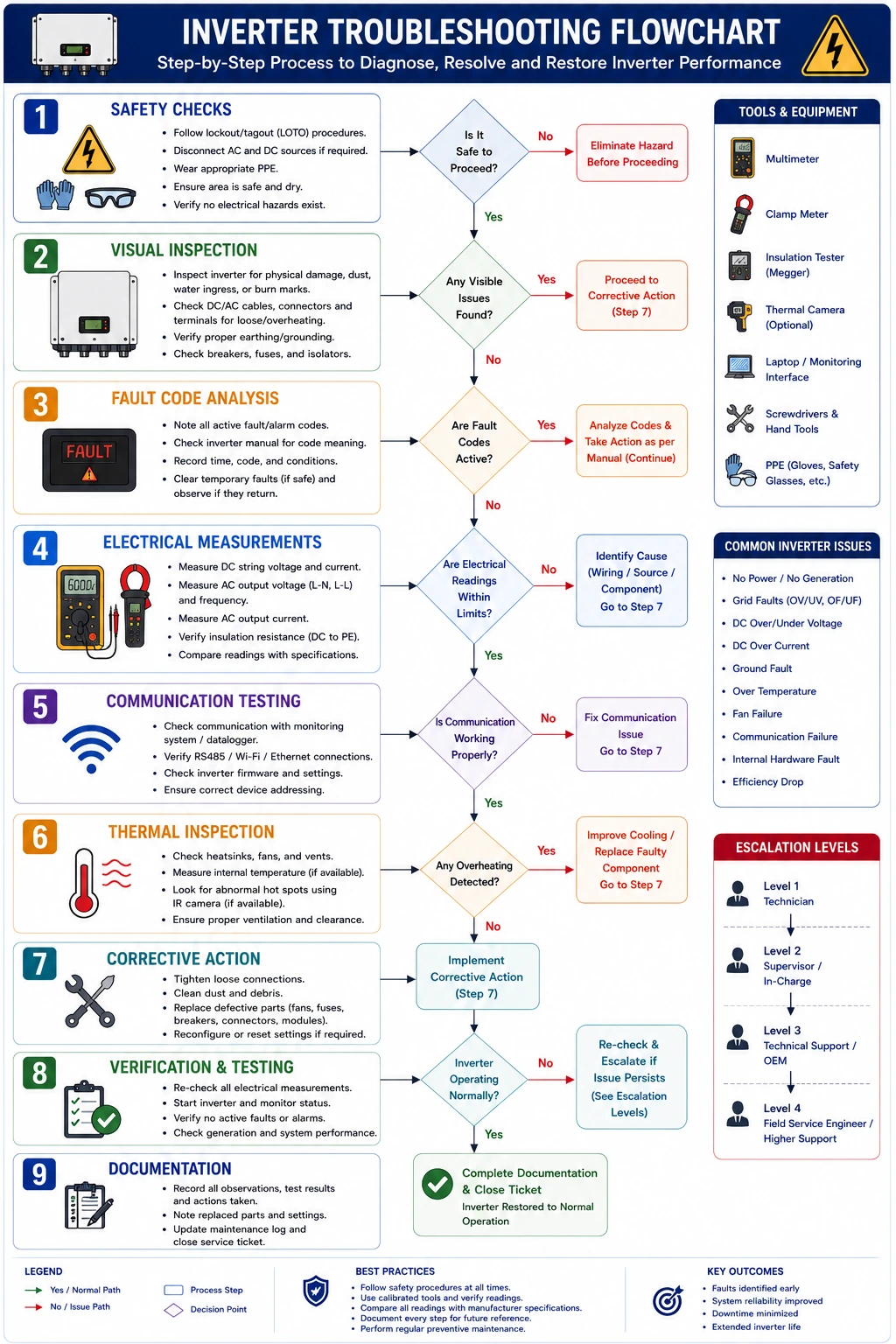
Step-by-Step Inverter Troubleshooting Procedure
Step 1 – Ensure Safety
Before beginning:
- Follow Lockout/Tagout (LOTO) procedures where applicable.
- Isolate equipment if necessary.
- Wear appropriate PPE.
- Ensure the work area is safe.
Safety should always be the highest priority.
Step 2 – Review System Documentation
Check:
- Single-line diagram (SLD)
- Wiring diagrams
- Inverter manual
- Previous maintenance records
- Commissioning reports
- Monitoring history
Proper documentation speeds up diagnosis.
Step 3 – Perform a Visual Inspection
Inspect for:
- Loose wiring
- Burn marks
- Damaged insulation
- Corroded terminals
- Water ingress
- Dust accumulation
- Damaged connectors
- Blocked cooling vents
- Cooling fan operation
Many inverter faults can be identified visually.
Step 4 – Review Fault Codes and Alarm Messages
Check:
- Inverter display
- LED indicators
- Alarm history
- Event logs
- Remote monitoring portal
Manufacturer fault codes provide valuable diagnostic information.
Step 5 – Verify DC Input Parameters
Measure:
- Open Circuit Voltage (Voc)
- Operating DC voltage
- String current
- Polarity
Compare measured values with design specifications and manufacturer recommendations.
Step 6 – Verify AC Output Parameters
Measure:
- AC voltage
- AC current
- Frequency
- Power output
- Power factor (where applicable)
Abnormal readings may indicate inverter or grid-related problems.
Step 7 – Check Grid Conditions
Verify:
- Grid voltage
- Grid frequency
- Utility availability
- Grid stability
Many inverter shutdowns occur because utility parameters exceed allowable operating limits.
Step 8 – Inspect Grounding and Insulation
Perform:
- Ground continuity testing
- Earth resistance testing
- Insulation resistance testing
Poor grounding can trigger inverter protection systems.
Step 9 – Verify Communication Systems
Inspect:
- RS485 communication
- Ethernet connection
- Wi-Fi module
- CAN communication
- Data logger
- SCADA interface
- Monitoring software
Reliable communication improves system monitoring and fault diagnosis.
Step 10 – Perform Thermal Inspection
Using an infrared thermal camera:
Inspect:
- Power terminals
- Internal components
- Cooling fans
- Heat sinks
- Cable connections
Overheating often indicates loose electrical connections or inadequate ventilation.
Step 11 – Verify Cooling System Operation
Inspect:
- Cooling fans
- Air filters
- Ventilation openings
- Ambient temperature
Proper cooling prevents thermal shutdowns.
Step 12 – Implement Corrective Actions
Depending on the diagnosis:
- Tighten loose terminals
- Replace damaged cables
- Clean ventilation openings
- Replace cooling fans
- Correct wiring errors
- Update firmware
- Improve grounding
- Replace defective components where authorized
Only manufacturer-approved corrective actions should be performed.
Step 13 – Verify Normal Operation
After repairs:
Confirm:
- Stable inverter startup
- Correct DC and AC values
- Normal monitoring
- Alarm clearance
- Expected power generation
- Grid synchronization
The inverter should return to normal operation.
Step 14 – Document Findings
Record:
- Fault codes
- Voltage measurements
- Current measurements
- Temperature readings
- Corrective actions
- Parts replaced
- Final operating status
- Technician details
Complete documentation supports preventive maintenance.
Common Inverter Faults and Corrective Actions
Fault | Corrective Action |
DC overvoltage | Verify PV string configuration and voltage limits |
AC undervoltage | Inspect utility supply and AC wiring |
Ground fault | Test grounding system and insulation resistance |
Communication failure | Inspect communication cables and settings |
Overtemperature alarm | Improve ventilation and inspect cooling system |
Inverter not starting | Verify DC supply, AC supply, and startup sequence |
Benefits of Proper Inverter Troubleshooting
Improved Renewable Solar System Efficiency
Efficient inverter operation maximizes energy conversion.
Increased Solar Electricity Generation
Prompt fault diagnosis minimizes production losses.
Extended Equipment Lifespan
Routine maintenance reduces component stress and wear.
Enhanced Safety
Regular inspections reduce electrical hazards.
Lower Maintenance Costs
Preventive troubleshooting minimizes expensive repairs and downtime.
Conclusion
The inverter is one of the most important components of a solar PV system, serving as the central unit responsible for converting DC power into usable AC electricity while managing system protection, monitoring, grid synchronization, and energy optimization. Because inverter faults can significantly reduce solar electricity generation and affect the performance of the entire installation, a structured troubleshooting process is essential for maintaining reliable and efficient operation. By conducting systematic inspections, reviewing fault codes, measuring electrical parameters, verifying grounding and communication systems, performing thermal inspections, and implementing manufacturer-approved corrective actions, technicians can accurately diagnose problems and restore normal system performance.
Troubleshooting inverters is a fundamental competency for solar installers, EPC contractors, commissioning engineers, and operations and maintenance professionals. Furthermore, adhering to technical recommendations and safety practices promoted by the Ministry of New and Renewable Energy, together with manufacturer guidelines and local electrical standards, ensures that inverter maintenance and troubleshooting activities are performed safely, accurately, and in compliance with industry requirements.
By carrying out routine inspections, maintaining secure electrical connections, ensuring adequate ventilation, using calibrated testing instruments, keeping firmware updated, documenting maintenance activities, and escalating complex faults to authorized service personnel when required, solar professionals can optimize solar panel system cost, improve renewable solar system reliability, maximize solar electricity generation, reduce the cost of solar per kWh installed, lower the solar installation cost per kWh, and ensure the long-term success of residential, commercial, industrial, and utility-scale solar energy projects.
FAQs
Q1. What are the most common inverter faults in solar PV systems?
Ans: Common inverter faults include DC overvoltage, AC undervoltage, grid synchronization failures, communication errors, overheating, insulation faults, ground faults, cooling fan failures, firmware issues, and internal hardware faults.
Q2. Why does a solar inverter shut down automatically?
Ans: An inverter may shut down due to abnormal grid voltage or frequency, excessive temperature, insulation resistance faults, DC input issues, ground faults, communication failures, or internal protection mechanisms designed to prevent equipment damage.
Q3. How can technicians determine whether an inverter is operating correctly?
Ans: Technicians should verify DC input voltage, AC output voltage, current, frequency, power output, review fault codes, inspect communication systems, perform thermal imaging, and compare all measurements with manufacturer specifications.
Q4. What should be done if an inverter displays repeated fault codes?
Ans: Repeated fault codes should not be ignored. Technicians should review the manufacturer’s fault code manual, perform systematic troubleshooting, document all measurements, inspect connected equipment, and escalate the issue to authorized service personnel if necessary.
Q5. Why is preventive inverter maintenance important?
Ans: Preventive maintenance improves solar electricity generation, increases inverter efficiency, extends equipment lifespan, enhances renewable solar system reliability, minimizes downtime, and reduces long-term maintenance costs.

UP Government Incentive: Stamp Duty Exemption for Solar Land
Uttar Pradesh offers stamp duty exemption on land for solar projects, encouraging investment and growth in renewable energy.

Everything You Should Know About Solar Batteries
Discover how solar batteries store excess energy, maximize your solar system’s efficiency, and provide reliable power during outages. Learn about the types, benefits, lifespan, and maintenance tips to make the most of your solar investment.
Industrial Solar Power: 7 Reasons to Make the Switch
Top 7 benefits of solar energy for industries, including cost savings, environmental impact, and improved energy reliability.

Sanctioned Load & Rooftop Solar: Everything You Need to Know
Learn why sanctioned load is crucial before rooftop solar installation. Understand its role, process, and impact on solar panel efficiency and subsidy eligibility.

SECI Sets Record in Renewable Energy Trading, Surpasses ₹100 Billion
SECI achieves record renewable power trading revenue surpassing ₹100 billion, marking a milestone in India’s clean energy growth and solar market expansion.

Researchers Propose New Way to Make Nuclear Power Plants Safer
Researchers propose innovative methods to enhance the safety of nuclear power plants, aiming to reduce risks and improve operational security.
100 kW Solar Plant Cost in Rajasthan: Latest Cost, Maintenance & Payback Time
Installing a 100 kW solar plant in Rajasthan costs around ₹40–60 lakh in, with annual savings up to ₹10–12 lakh. Discover maintenance needs, ROI, and payback period of 4–6 years.
Solar PV Startup & Energy Meter Recording Guide
A complete guide to solar PV startup procedures and energy meter recording, ensuring proper commissioning, documentation, and system performance verification.