
Before installing a solar plant, one of the most important tasks is conducting a load assessment. Load assessment helps determine the total electricity demand of a household or commercial facility so that the solar system can be designed appropriately. Without proper load calculation, the installed solar PV system may either produce insufficient electricity or become unnecessarily expensive.
Load assessment allows installers to understand the energy consumption pattern, peak load requirements, and future electricity demand of the customer. Performing an accurate load assessment is essential for designing efficient solar PV systems and optimizing solar panel system cost.
This article explains the steps involved in conducting a load assessment before solar installation and why it is necessary for efficient solar energy systems.
What is Load Assessment in Solar Installation?
Load assessment refers to the process of calculating the total electrical demand of a building or facility before installing a solar PV system.
The assessment includes evaluating:
- Electrical appliances used
- Power ratings of devices
- Daily usage hours
- Peak electricity demand
This information helps determine the required capacity of the solar plant and ensures reliable solar electricity generation.
Why Load Assessment is Required Before Solar Installation
A proper load assessment ensures that the solar PV system is designed to meet the customer’s electricity needs efficiently.
Key reasons include:
- Determining the correct solar plant capacity
- Selecting an appropriate inverter size
- Estimating solar panel system cost
- Improving renewable solar system performance
Without accurate load assessment, the system may either be undersized or oversized, leading to higher solar installation charges or poor performance.
Steps for Conducting a Load Assessment
Below are the essential steps followed by solar installers when performing a load assessment.
Step 1 – Identify All Electrical Appliances
The first step is to list all electrical appliances used in the building.
Common appliances include:
- Lights
- Fans
- Refrigerators
- Air conditioners
- Televisions
- Washing machines
- Computers
Each appliance contributes to the total electricity demand of the facility.
Step 2 – Record Power Ratings of Appliances
After identifying appliances, installers must note their power ratings, which are usually mentioned on the device label.
Power ratings are typically measured in:
- Watts (W)
- Kilowatts (kW)
For example:
- LED bulb – 10 W
- Ceiling fan – 70 W
- Refrigerator – 200 W
Recording power ratings helps estimate the total electrical load accurately.
Step 3 – Determine Daily Usage Hours
The next step is to calculate how many hours each appliance is used per day.
For example:
- Lights – 6 hours/day
- Fans – 8 hours/day
- Refrigerator – 24 hours/day
Daily usage patterns help estimate total energy consumption in kilowatt-hours (kWh).
Step 4 – Calculate Daily Energy Consumption
Energy consumption can be calculated using the formula:
Energy Consumption = Power Rating × Usage Hours
Example:
If a 100 W appliance runs for 5 hours:
- 100 W × 5 hours = 500 Wh (0.5 kWh)
By calculating energy consumption for all appliances, installers can determine the total daily electricity requirement.
Step 5 – Determine Peak Load Demand
Peak load refers to the maximum electricity demand at a particular time when multiple appliances operate simultaneously.
For example:
If a customer runs:
- Air conditioner – 1500 W
- Refrigerator – 200 W
- Lights – 100 W
- Fan – 70 W
The total peak load will be:
- 1870 W (1.87 kW)
Understanding peak demand helps in selecting the correct inverter capacity.
Step 6 – Evaluate Monthly Electricity Consumption
Installers also analyze electricity bills to verify monthly consumption.
Electricity bills provide information about:
- Total units consumed
- Seasonal variations in energy usage
- Tariff category
This data helps confirm whether the calculated load aligns with actual consumption.
Step 7 – Consider Future Load Expansion
Customers may plan to add new appliances in the future, such as:
- Electric vehicles
- Air conditioners
- Additional lighting systems
Considering future expansion ensures that the solar PV system can handle increased demand without requiring major redesign.
Step 8 – Decide Solar System Capacity
Based on the load assessment results, installers determine the required solar plant capacity.
Factors considered include:
- Daily electricity consumption
- Available rooftop area
- Budget constraints
- Solar panel efficiency
Proper capacity planning ensures efficient solar electricity generation and renewable solar system performance.
Importance of Load Assessment in Solar PV Systems
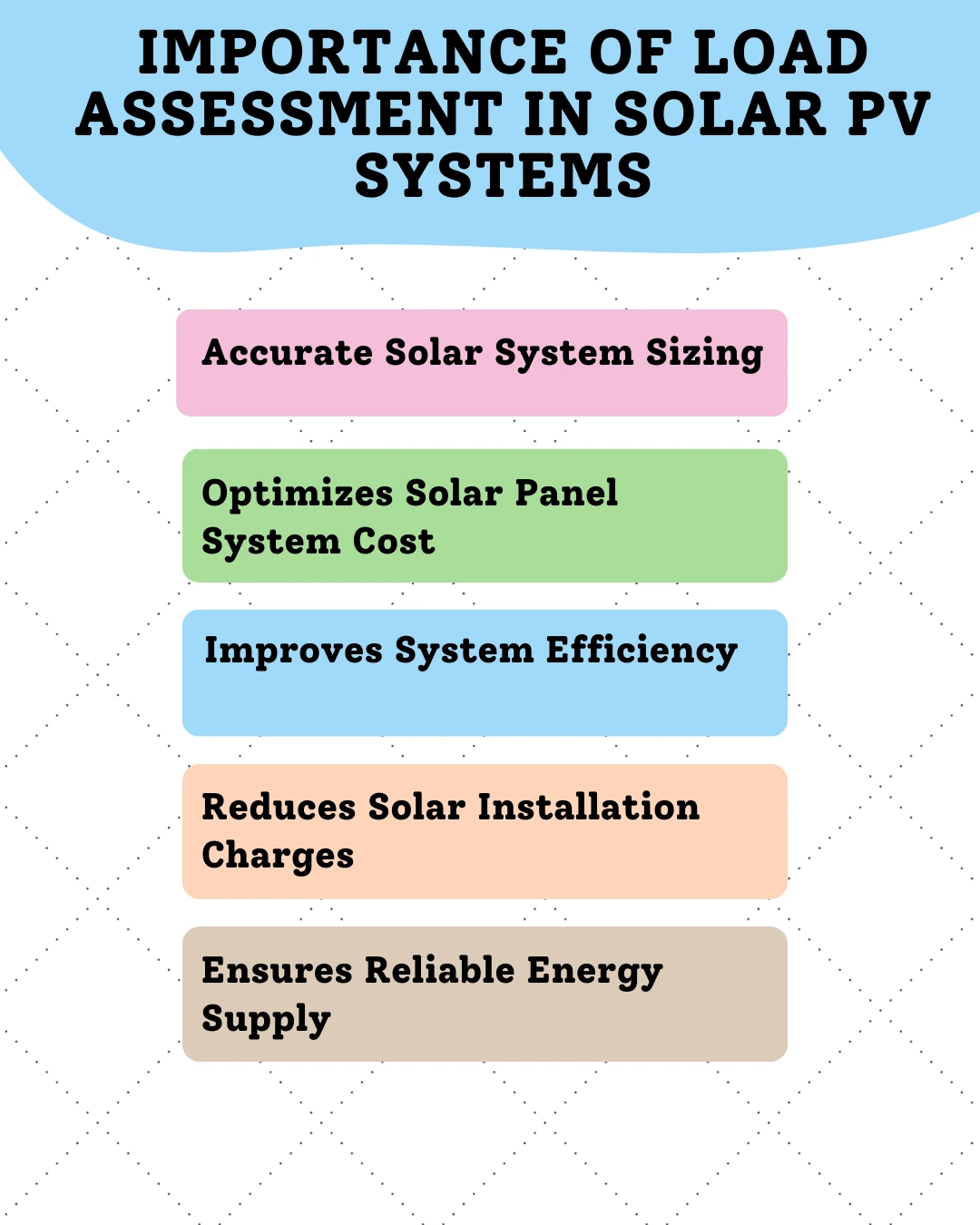
Load assessment provides several benefits for solar installations.
1. Accurate Solar System Sizing
Correct load calculation ensures the solar PV system produces sufficient electricity to meet the customer’s needs.
2. Optimizes Solar Panel System Cost
By installing the right number of panels, customers can avoid unnecessary expenses and optimize their investment.
3. Improves System Efficiency
A properly sized system delivers consistent solar electricity output and prevents overloading.
4. Reduces Solar Installation Charges
Accurate planning prevents system redesign and reduces additional installation costs.
5. Ensures Reliable Energy Supply
Load assessment ensures that solar energy systems provide reliable power for solar energy for home use or commercial applications.
Impact of Load Assessment on Solar Energy Installation Cost
Load assessment directly affects the solar energy installation cost and system efficiency.
Proper load evaluation helps:
- Avoid oversizing the solar plant
- Improve financial returns
- Reduce the cost of solar per kWh installed
- Enhance renewable energy technology performance
Incorrect load assessment may lead to:
- System underperformance
- Higher maintenance costs
- Customer dissatisfaction
Best Practices for Conducting Load Assessment
Professional solar installers follow several best practices when conducting load assessments.
- Record accurate appliance power ratings
- Verify electricity consumption from bills
- Consider seasonal energy usage changes
- Plan for future load expansion
- Perform detailed documentation
These practices help design efficient solar panel in rooftop installations.
Conclusion
Load assessment plays a vital role in designing efficient solar PV systems. By carefully analyzing appliance usage, electricity consumption patterns, and peak demand, installers can determine the appropriate system capacity and ensure reliable solar electricity generation. Proper load evaluation helps optimize solar panel system cost, reduce solar energy installation cost, and improve overall renewable solar system performance.
Solar technicians must conduct detailed load assessments before installing any solar plant. This ensures accurate system sizing, improved financial returns, and efficient renewable energy technology adoption.
With proper load assessment, solar installations can deliver consistent solar electricity, reduce dependence on conventional power sources, and provide sustainable solar energy for home use and commercial applications.
FAQs
Q1. What is load assessment in solar installation?
Ans: Load assessment is the process of calculating the electricity demand of a building to determine the required solar plant capacity.
Q2. Why is load assessment important before installing a solar system?
Ans: It helps design a system that meets electricity needs efficiently without oversizing or undersizing the installation.
Q3. How is energy consumption calculated during load assessment?
Ans: Energy consumption is calculated by multiplying the power rating of an appliance by its daily usage hours.
Q4. What is peak load in solar systems?
Ans: Peak load refers to the maximum electrical demand when multiple appliances operate simultaneously.
Q5. Can an incorrect load assessment affect solar panel system cost?
Ans: Yes. Incorrect calculations may lead to installing too many or too few panels, affecting system cost and performance.

Flat Roof Solar Installation Guide: Design, Mounting Systems & Best Practices
A practical guide to flat roof solar installation covering key design considerations, mounting system types, and best practices for efficient and reliable performance.

Net Metering and its Advantages
Net Metering allows solar panel owners to feed excess electricity back to the grid and earn credits, reducing energy bills. Learn the key advantages of net metering for homes and businesses.
How to Check Solar PV Module Performance
A complete guide to testing solar PV module performance, including voltage and current measurements, power output analysis, and performance verification techniques.
Solar PV Procurement Process Guide for EPC & Installers | Step-by-Step
A well-planned procurement process is critical for the success of any solar PV project. This guide explains step-by-step how EPC companies and installers can efficiently source solar panels, inverters, and balance of system components while ensuring quality, cost-effectiveness, and timely delivery.

Solar Panel Wattage, Output & Ratings: Complete Buyer Guide
Solar panel wattage and ratings decide how much electricity you generate. This guide explains panel output, efficiency, and how to choose the right solar panel for your needs.

Latest Solar Mounting Structures: Smarter, Stronger, and More Efficient
Learn how the latest solar mounting structures in 2025 improve efficiency, reduce costs, and power the future of solar installations.

Solar PV System Working Principle Explained
A complete guide explaining how solar PV systems work, covering the photovoltaic effect, solar modules, DC power generation, inverters, energy distribution, and grid integration.

Why Is Investing In Grade A Panels Important?
Investing in Grade A solar panels guarantees superior performance, safety, and maximum return on your solar investment.