
Solar photovoltaic (PV) systems are designed to provide reliable, clean, and efficient electricity for 25 years or more. However, maintaining peak performance throughout their operational life requires regular inspection, preventive maintenance, testing, troubleshooting, cleaning, and timely repairs. Whether the installation is a residential rooftop system, a commercial solar plant, an industrial installation, or a utility-scale renewable solar project, maintenance activities rely heavily on the proper selection and use of specialized tools and equipment.
The right maintenance tools not only improve work efficiency but also ensure worker safety, equipment protection, accurate testing, and compliance with industry standards. Solar technicians, commissioning engineers, EPC contractors, and operations and maintenance (O&M) teams must be familiar with the purpose, operation, calibration, and maintenance of each tool before performing any service activities.
Using inappropriate, damaged, or uncalibrated equipment can lead to incorrect test results, electrical hazards, equipment damage, increased maintenance costs, and reduced renewable solar system performance. Therefore, identifying and using the correct maintenance tools is a fundamental skill for every solar professional.
Selecting appropriate tools and equipment is an essential aspect of solar PV inspection, commissioning, troubleshooting, and preventive maintenance.
This comprehensive guide explains the different categories of maintenance tools, their applications, inspection procedures, safety considerations, calibration requirements, storage practices, and best practices for maintaining solar PV systems.
Why Are Proper Maintenance Tools Important?
Maintenance tools enable technicians to inspect, test, diagnose, repair, and maintain solar PV systems safely and accurately.
Proper tools help:
- Improve worker safety
- Prevent equipment damage
- Increase maintenance efficiency
- Produce accurate measurements
- Extend the system’s lifespan
- Support reliable solar electricity generation
The correct tools are essential for professional maintenance practices.
Categories of Tools Used in Solar PV Maintenance
Solar maintenance requires multiple categories of tools and equipment.
These include:
- Hand tools
- Electrical testing instruments
- Mechanical tools
- Cleaning equipment
- Safety equipment
- Specialized diagnostic instruments
Each category serves a specific maintenance purpose.
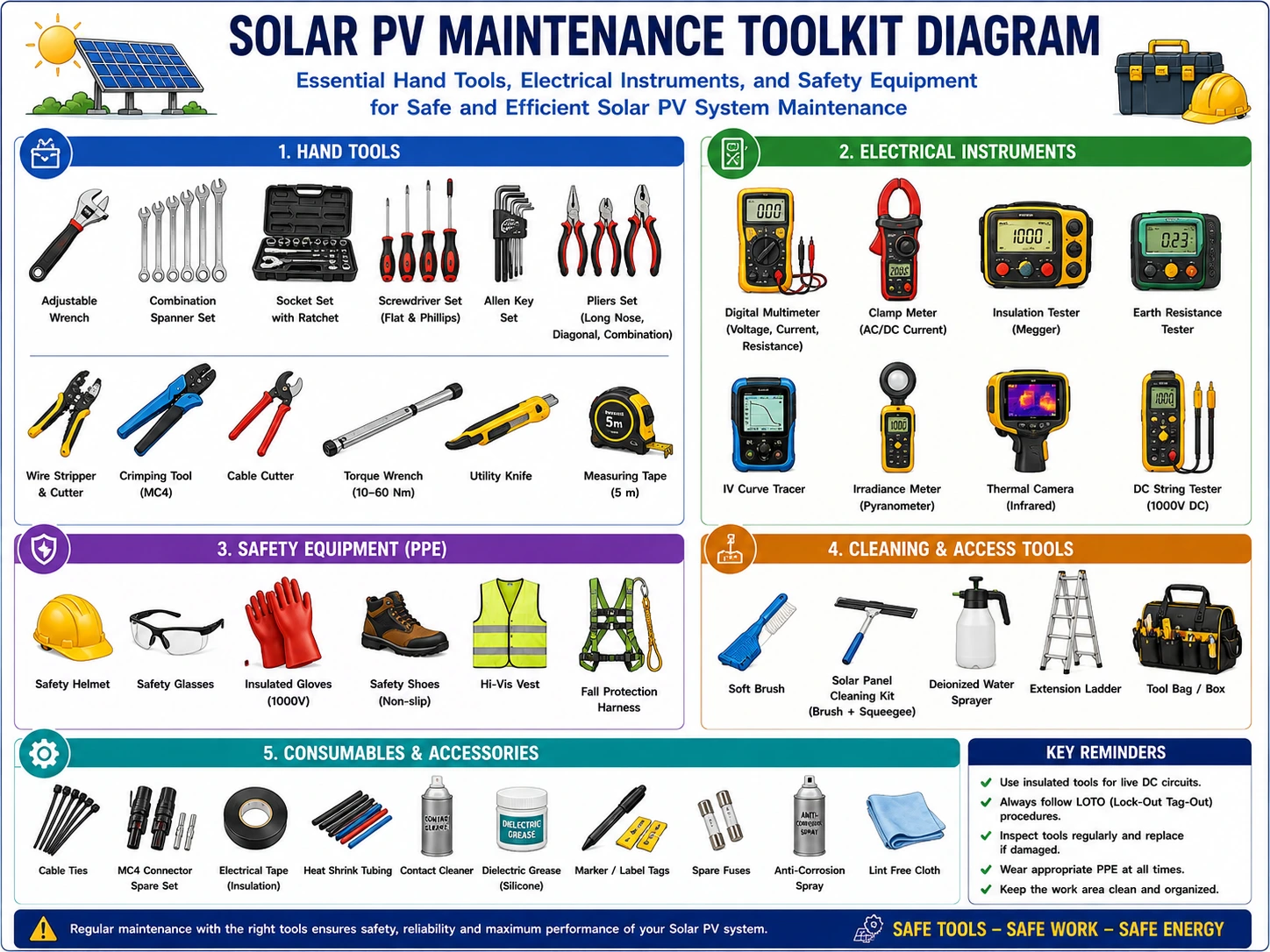
Hand Tools Used in Solar PV Maintenance
Hand tools are used for routine inspection, tightening, replacement, and repair activities.
1. Screwdriver Set
Used for:
- Tightening terminals
- Removing equipment covers
- Electrical maintenance
Both insulated flat-head and Phillips screwdrivers should be available.
2. Combination Pliers
Useful for:
- Holding conductors
- Bending wires
- General repair work
Insulated handles improve electrical safety.
3. Long Nose Pliers
Ideal for:
- Small electrical connections
- Connector installation
- Precision work
4. Side Cutting Pliers
Used for:
- Cutting electrical wires
- Removing damaged conductors
5. Adjustable Wrench
Suitable for:
- Tightening bolts
- Mechanical assembly
- Mounting structure maintenance
6. Socket and Spanner Set
Commonly used during:
- Structural maintenance
- Fastener tightening
- Equipment installation
7. Torque Wrench
A torque wrench ensures bolts and terminals are tightened according to manufacturer specifications.
Proper torque prevents:
- Loose connections
- Over-tightening
- Equipment damage
Electrical Testing Instruments
Testing equipment is essential for troubleshooting and preventive maintenance.
1. Digital Multimeter
One of the most important maintenance tools.
Measures:
- Voltage
- Current
- Resistance
- Continuity
Digital multimeters are widely used during solar PV inspections.
2. Clamp Meter
Allows current measurement without disconnecting cables.
Used for:
- Load measurements
- Inverter output verification
- String current measurements
3. Insulation Resistance Tester (Megger)
Measures insulation resistance between conductors and ground.
Helps identify:
- Insulation damage
- Moisture ingress
- Cable deterioration
4. Earth Resistance Tester
Measures grounding system performance.
Proper grounding improves:
- Personnel safety
- Equipment protection
- Lightning protection effectiveness
5. PV String Tester
Specifically designed for solar PV systems.
Measures:
- String voltage
- String current
- Polarity
- Insulation resistance
These instruments simplify solar commissioning and maintenance.
6. IV Curve Tracer
An advanced diagnostic tool used to evaluate the electrical performance of solar modules and strings.
It helps detect:
- Module degradation
- Mismatch losses
- Internal defects
7. Power Quality Analyzer
Used in commercial and industrial systems to measure:
- Voltage quality
- Frequency
- Harmonics
- Power factor
Thermal Inspection Equipment
Infrared Thermal Camera
Thermal imaging detects:
- Hotspots
- Loose connections
- Overheating components
- Defective modules
Thermal inspections can identify problems before failures occur.
Solar Radiation Measurement Equipment
Pyranometer
Measures solar irradiance.
Used during:
- Performance testing
- Commissioning
- System evaluation
Module Temperature Sensor
Measures PV module temperature during performance analysis.
Cleaning Equipment
Cleaning tools help maintain module efficiency.
Common equipment includes:
- Soft brushes
- Microfiber cloths
- Deionized water systems
- Non-abrasive cleaning solutions
- Extension poles
Avoid harsh chemicals that may damage module surfaces.
Battery Maintenance Equipment
For battery-based systems, additional tools are required.
Hydrometer
- Measures electrolyte specific gravity in flooded lead-acid batteries.
- Helps determine battery state of charge.
Battery Load Tester
- Evaluates battery performance under load.
Battery Terminal Cleaning Brush
- Removes corrosion from battery terminals.
Specialized Cable Tools
Cable Cutter
- Provides clean cable cuts.
Wire Stripper
- Removes insulation without damaging conductors.
Hydraulic Crimping Tool
Used for:
- Cable lug installation
- High-quality cable terminations
Proper crimping improves electrical reliability.
Labeling Equipment
Used for:
- Cable identification
- Equipment labeling
- Safety markings
Proper labeling simplifies future maintenance.
Safety Equipment (PPE)
Personal Protective Equipment is essential during maintenance.
Required PPE includes:
- Safety helmet
- Electrical insulating gloves
- Safety glasses
- Flame-resistant clothing
- Safety shoes
- Fall protection harness (for rooftop systems)
Safety equipment should always be inspected before use.
Additional Maintenance Equipment
Other useful tools include:
- Flashlight
- Measuring tape
- Ladder
- Tool bag
- Notebook or digital inspection software
- Camera for documentation
Calibration Requirements
Testing instruments should be calibrated periodically.
Calibration ensures:
- Accurate measurements
- Reliable testing
- Compliance with quality standards
Uncalibrated equipment may produce misleading results.
Inspection of Maintenance Tools
Before use, inspect tools for:
- Physical damage
- Cracked insulation
- Loose components
- Calibration status
- Battery condition (for electronic instruments)
Damaged tools should not be used.
Proper Storage of Tools
Maintenance equipment should be stored:
- In clean, dry conditions
- Away from moisture
- Inside protective carrying cases
- According to the manufacturer’s recommendations
Proper storage extends tool lifespan.
Maintenance of Testing Equipment
Regular maintenance includes:
- Cleaning instruments
- Replacing batteries
- Checking calibration dates
- Inspecting test leads
- Verifying measurement accuracy
Preventive maintenance improves reliability.
Common Maintenance Activities Requiring These Tools
Maintenance tools are used during:
- Visual inspections
- Electrical testing
- Module cleaning
- Cable inspection
- Battery maintenance
- Inverter diagnostic
- Grounding verification
- Preventive maintenance
Conclusion
Identifying the appropriate tools and equipment for solar PV system maintenance is essential for ensuring safe working practices, accurate testing, efficient troubleshooting, and long-term renewable solar system reliability. Well-maintained and properly calibrated tools enable technicians to detect faults early, perform preventive maintenance effectively, protect valuable equipment, and maximize solar electricity generation while minimizing operational risks.
Selecting the correct maintenance tools and using them according to manufacturer recommendations is a key competency for solar installers, commissioning engineers, and operations and maintenance professionals. Furthermore, following technical guidelines and safety practices promoted by the Ministry of New and Renewable Energy helps ensure professional, compliant, and high-quality maintenance of solar PV installations.
By investing in quality maintenance tools, regularly calibrating testing instruments, inspecting equipment before use, following proper storage practices, maintaining complete maintenance records, and prioritizing safety throughout every maintenance activity, solar professionals can optimize solar panel system cost, extend equipment lifespan, improve renewable solar system performance, and ensure the long-term success of residential, commercial, industrial, and utility-scale solar energy projects.
FAQs
Q1. Why are specialized tools required for solar PV maintenance?
Ans: Specialized tools ensure accurate testing, safe maintenance, reliable fault diagnosis, and compliance with electrical safety standards while protecting both technicians and equipment.
Q2. Which testing instrument is most commonly used during PV maintenance?
Ans: A digital multimeter is one of the most commonly used instruments because it measures voltage, current, resistance, and continuity, making it essential for routine inspections and troubleshooting.
Q3. Why is a torque wrench important in solar maintenance?
Ans: A torque wrench ensures that bolts, connectors, and electrical terminals are tightened according to manufacturer specifications, preventing loose connections and mechanical damage.
Q4. How often should testing equipment be calibrated?
Ans: Calibration intervals depend on the manufacturer, project requirements, and organizational quality procedures. Instruments should always be within their valid calibration period before use.
Q5. What personal protective equipment should solar maintenance personnel wear?
Ans: Technicians should wear safety helmets, insulated gloves, safety glasses, protective footwear, flame-resistant clothing where required, and fall protection equipment for rooftop work.
Solar Charge Controller Explained: Purpose, Need & Advantages
A charge controller is a vital component of any solar system. Learn what it does, how it works, and why a solar system cannot function safely without it.
Tools and Tackles Required for Installation of Solar PV Panels: Complete Installer Checklist
Proper tools and tackles are essential for efficient and safe solar PV installation. This guide provides a complete checklist of mechanical, electrical, and safety tools required for installers and EPC teams.
Unintentional Islanding Test for Solar PV Systems
A complete guide to performing the solar PV anti-islanding test, ensuring safe grid-connected operation, regulatory compliance, and reliable inverter performance.

Save on Electricity in Haryana Using Net Metering: A Complete Guide
Learn how to save on electricity in Haryana with net metering. Step-by-step guide on benefits, installation, and cost savings for your home or business
What Is Renewable Energy? What Is the Best Source of Renewable Energy and Why? – Complete Guide
Renewable energy comes from natural sources like sunlight, wind, water, and biomass that are constantly replenished. As India accelerates its transition toward clean energy, understanding different renewable energy sources and identifying the most efficient and cost-effective option is crucial. This complete guide explains renewable energy types, their advantages, and compares them to determine the best source based on sustainability, scalability, and long-term benefits.
Tools to Perform Shading Analysis Prior to Solar Installation
A solar site assessment helps installers evaluate location, shading, structure, and energy requirements before installation. This guide explains the essential steps for accurate solar system planning.
Agrovoltaics Innovation: Boosting Solar Energy While Supporting Farming
Explore agrovoltaics innovation: how combining solar energy with farming boosts efficiency, supports agriculture, and maximizes land use.
How to Check Solar PV Module Performance
A complete guide to testing solar PV module performance, including voltage and current measurements, power output analysis, and performance verification techniques.