
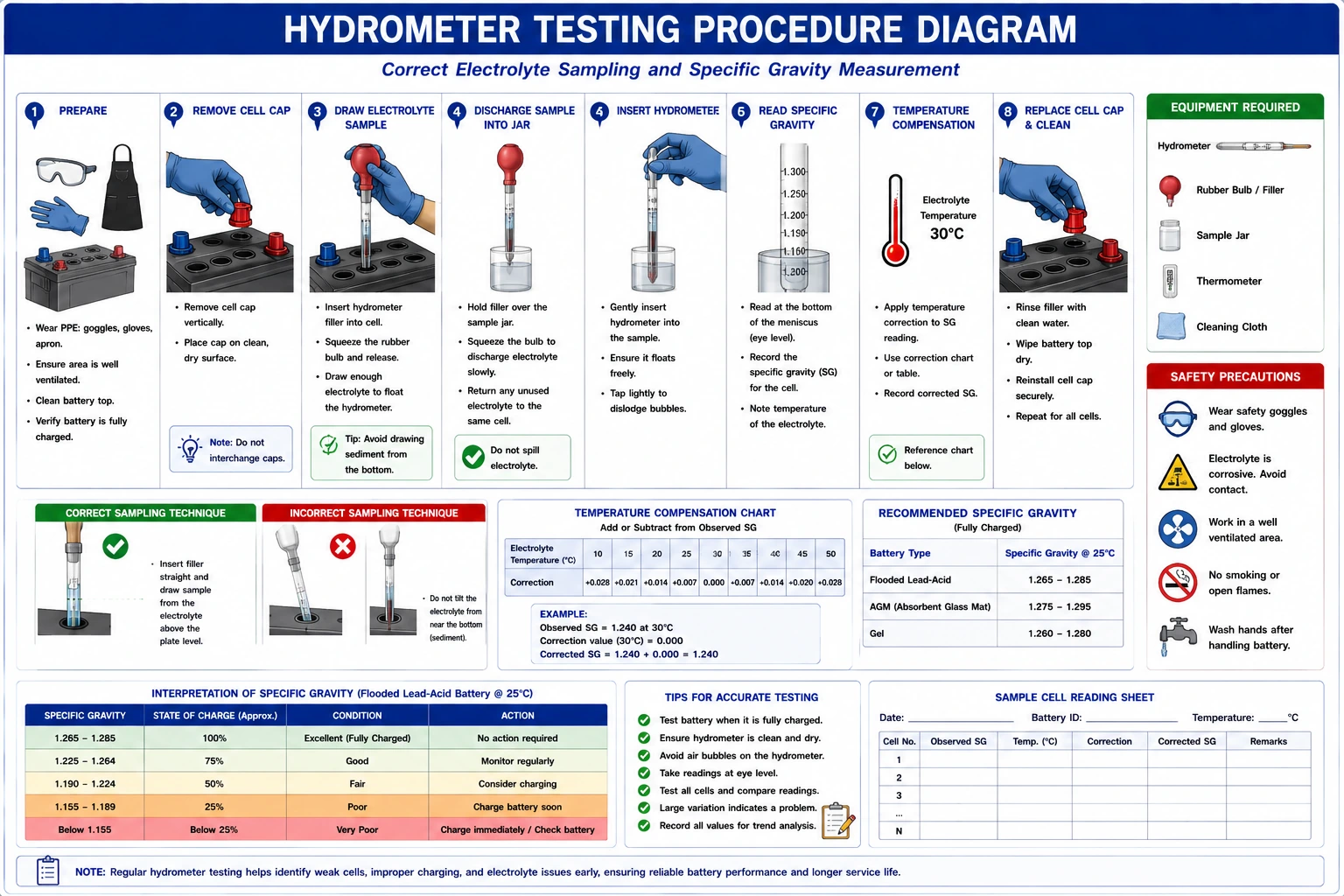
In solar photovoltaic (PV) systems that use flooded lead-acid batteries, maintaining battery health is essential for ensuring reliable energy storage, maximizing battery lifespan, and improving overall renewable solar system performance. One of the most effective methods for evaluating the condition and charging status of a flooded lead-acid battery is testing the electrolyte using a hydrometer.
A hydrometer is a simple but highly valuable diagnostic tool that measures the specific gravity of the battery electrolyte. Since the specific gravity of the electrolyte changes according to the battery’s state of charge, hydrometer testing provides direct insight into battery performance and charging conditions. Unlike voltage measurements, which can sometimes be influenced by recent charging or discharging activity, hydrometer readings provide a more accurate assessment of the actual charge level of individual battery cells.
Regular hydrometer testing helps identify undercharged batteries, overcharged batteries, weak cells, sulfation issues, and potential battery failures before they affect solar electricity generation. This procedure is widely used during battery maintenance, troubleshooting, performance evaluation, and preventive maintenance programs in off-grid, hybrid, industrial, and backup power solar systems.
Electrolyte testing using a hydrometer is an important maintenance practice for flooded lead-acid batteries and contributes significantly to renewable energy technology reliability.
This comprehensive guide explains hydrometer testing principles, required tools, step-by-step procedures, interpretation of results, safety precautions, common mistakes, and best practices.
Understanding Battery Electrolyte
In flooded lead-acid batteries, the electrolyte is a mixture of:
- Sulfuric acid (H₂SO₄)
- Water
During charging and discharging cycles, the concentration of sulfuric acid changes.
As a result:
- Specific gravity increases during charging
- Specific gravity decreases during discharging
This relationship allows battery condition to be evaluated using a hydrometer.
What is a Hydrometer?
A hydrometer is a measuring instrument used to determine the specific gravity of liquids.
For solar battery maintenance, a battery hydrometer measures the density of the electrolyte inside flooded lead-acid batteries.
The instrument typically consists of:
- A transparent tube
- A float scale
- A rubber bulb for drawing electrolyte samples
The float rises or falls depending on electrolyte density, providing a specific gravity reading.
Why Hydrometer Testing is Important
Hydrometer testing provides valuable information about battery health.
Benefits include:
- Determining state of charge
- Identifying weak cells
- Detecting sulfation
- Verifying charging effectiveness
- Supporting preventive maintenance
- Improving battery reliability
It remains one of the most accurate methods for evaluating the flooded lead-acid battery condition.
Objectives of Hydrometer Testing
The primary objectives include:
State of Charge Verification
- Determining battery charge levels.
Cell Comparison
- Comparing individual cell performance.
Fault Detection
- Identifying damaged or deteriorated cells.
Maintenance Planning
- Supporting corrective maintenance decisions.
Performance Optimization
- Improving battery efficiency and lifespan.
Which Batteries Can Be Tested with a Hydrometer?
Hydrometer testing is suitable for:
Flooded Lead-Acid Batteries
Examples include:
- Tubular batteries
- Deep-cycle batteries
- Industrial lead-acid batteries
- Solar storage batteries
Batteries That Cannot Be Tested with a Hydrometer
Hydrometer testing is generally not possible for:
- AGM Batteries
- Gel Batteries
- Lithium-Ion Batteries
- Lithium Iron Phosphate (LiFePO4) Batteries
- Sealed Maintenance-Free Batteries
These batteries do not allow direct electrolyte access.
Understanding Specific Gravity
Specific gravity is the ratio of electrolyte density compared to pure water.
- Pure water has a specific gravity of 1.000
- Fully charged lead-acid battery electrolyte typically ranges from 1.260 to 1.280
Depending on battery design and manufacturer specifications.
Relationship Between Specific Gravity and State of Charge
As battery charge decreases:
- Sulfuric acid concentration decreases
- Electrolyte becomes less dense
- Specific gravity decreases
As battery charge increases:
- Sulfuric acid concentration increases
- Electrolyte becomes denser
- Specific gravity increases
Typical State of Charge Reference Values
State of Charge | Specific Gravity |
100% Charged | 1.265 – 1.280 |
75% Charged | 1.225 – 2.240 |
50% Charged | 1.190 – 1.200 |
25% Charged | 1.155 – 1.170 |
Discharged | Below 1.120 |
Actual values may vary depending on manufacturer specifications.
Tools Required for Hydrometer Testing
1. Battery Hydrometer
The primary instrument used for testing.
2. Safety Goggles
Protect eyes from electrolyte splashes.
3. Acid-Resistant Gloves
Protect hands from sulfuric acid exposure.
4. Distilled Water
May be needed if electrolyte levels are low.
5. Clean Cloth or Wipes
Used for cleaning battery surfaces.
6. Battery Maintenance Log
Used for recording readings and observations.
Safety Precautions Before Testing
Battery electrolyte contains sulfuric acid, which can cause injury.
Before testing:
- Wear Appropriate PPE
Required PPE includes:
- Safety goggles
- Acid-resistant gloves
- Protective clothing
Ensure Adequate Ventilation
Hydrogen gas may be present during charging.
Avoid Open Flames
Keep sparks, flames, and smoking materials away from batteries.
Use Proper Tools
Only use battery maintenance tools designed for the task.
Pre-Test Inspection
Before taking readings:
- Inspect Battery Condition
Look for:
- Cracks
- Leakage
- Corrosion
- Damaged terminals
Verify Electrolyte Level
Ensure electrolyte covers battery plates. Low electrolyte levels may affect results.
Check Battery Temperature
Battery temperature affects specific gravity readings.
Step-by-Step Procedure for Hydrometer Testing
Step 1 – Disconnect Charging Sources if Required
Follow manufacturer recommendations regarding testing conditions. Allow battery conditions to stabilize if necessary.
Step 2 – Open Battery Vent Caps
Carefully remove vent caps from flooded battery cells. Place caps in a clean location.
Step 3 – Insert the hydrometer into the electrolyte
Place the hydrometer nozzle into the electrolyte. Ensure sufficient immersion depth.
Step 4 – Draw Electrolyte into the Hydrometer
Squeeze and release the bulb slowly. Fill the hydrometer until the float rises freely. Avoid introducing air bubbles.
Step 5 – Read the Specific Gravity
Hold the hydrometer vertically. Record the float reading at eye level. Ensure accurate measurement.
Step 6 – Record the Reading
Document:
- Cell number
- Specific gravity value
- Date and time
- Temperature
Accurate records support trend analysis.
Step 7 – Return Electrolyte to the Cell
Carefully return the sample to the same battery cell. Never transfer electrolytes between cells.
Step 8 – Repeat for All Cells
Test each cell individually. Compare readings between cells.
Step 9 – Replace Vent Caps
Secure all battery caps after testing.
Interpreting Hydrometer Readings
Hydrometer readings provide important information.
Uniform Readings
If all cells show similar readings:
- The battery is generally healthy
- Charge distribution is balanced
Low Readings Across All Cells
May indicate:
- Undercharging
- Extended discharge condition
One Cell Significantly Lower Than Others
May indicate:
- Weak cell
- Sulfation
- Internal damage
Further investigation is required.
High Readings
May indicate:
- Overcharging
- Electrolyte concentration issues
Temperature Compensation
Specific gravity readings are temperature-dependent.
Higher temperatures:
- Lower electrolyte density
Lower temperatures:
- Increase electrolyte density
Many hydrometers include temperature compensation scales. Always refer to manufacturer recommendations.
Identifying Battery Problems Through Hydrometer Testing
Sulfation
Symptoms:
- Persistently low specific gravity
- Reduced battery capacity
Cell Imbalance
Symptoms:
- Significant differences between cell readings
Undercharging
Symptoms:
- Low readings across all cells
Overcharging
Symptoms:
- Excessively high readings
- Electrolyte loss
Internal Cell Damage
Symptoms:
- Abnormal readings in one or more cells
Conclusion
Testing the electrolyte for its state of charge using a hydrometer is a fundamental maintenance procedure for flooded lead-acid batteries used in solar PV systems. By accurately measuring electrolyte specific gravity, technicians can evaluate battery charge levels, identify weak cells, detect charging issues, and assess overall battery health before serious performance problems occur.
Hydrometer testing remains one of the most reliable methods for monitoring flooded battery performance and supporting efficient solar electricity generation. Furthermore, following maintenance guidelines and safety recommendations promoted by the Ministry of New and Renewable Energy helps ensure safe, compliant, and effective battery management practices.
By conducting regular hydrometer testing, maintaining accurate inspection records, applying temperature corrections where necessary, identifying abnormal readings promptly, and implementing corrective actions when required, solar installers, EPC contractors, battery technicians, and maintenance professionals can optimize solar panel system cost, improve renewable solar system reliability, extend battery service life, and ensure the long-term success of residential, commercial, industrial, and off-grid solar energy projects.
FAQs
Q1. What is the purpose of a hydrometer in battery maintenance?
Ans: A hydrometer measures the specific gravity of battery electrolyte, allowing technicians to determine the battery’s state of charge and overall condition.
Q2. Which batteries can be tested using a hydrometer?
Ans: Hydrometer testing is suitable for flooded lead-acid batteries that provide access to the electrolyte through removable vent caps.
Q3. Can lithium batteries be tested with a hydrometer?
Ans: No. Lithium batteries do not contain an accessible liquid electrolyte and cannot be tested using a hydrometer.
Q4. Why are specific gravity readings important?
Ans: Specific gravity readings indicate the concentration of sulfuric acid in the electrolyte, which directly relates to the battery’s state of charge.
Q5. What does a low specific gravity reading indicate?
Ans: Low specific gravity may indicate a discharged battery, undercharging, sulfation, or potential battery deterioration.

Developers fear unfair state-specific levies will make solar more expensive
Developers in India are concerned that state-specific levies on solar projects could increase costs, slow adoption, and impact the growth of renewable energy across residential, commercial, and industrial sectors.

Introducing the ESS-2000-24V Hybrid Solar Inverter: Smart Power for Modern Homes & Businesses
The ESS-2000-24V Hybrid Solar Inverter delivers intelligent power management for homes and businesses. With advanced solar charging, lithium battery support, and seamless backup, it ensures uninterrupted, efficient, and clean energy for modern users.

How to Prepare Battery Terminals and Install Interconnection Cables
Proper battery terminal preparation and cable installation are essential for safe and efficient battery bank operation. This guide explains the complete installation process for solar projects.

What Is Global Tilted Irradiation (GTI) in Solar Energy? Explained Simply
Solar panel wattage and ratings decide how much electricity you generate. This guide explains panel output, efficiency, and how to choose the right solar panel for your needs.
Renewable Energy Hits New Heights: 440 GW Capacity in 2023
Learn how global renewable energy capacity is set to surpass 440 GW in 2023, marking record growth and a major shift toward clean, sustainable power.

How to Assess Customer Requirements Before Solar Installation
Understanding customer requirements is essential before installing a solar plant. This guide explains key assessment methods such as energy analysis, site survey, and feasibility evaluation.
Solar Inverters India: How to Choose the Best for Your Solar System
India’s solar market offers a wide range of inverters, making selection challenging. This guide explains key factors to consider, helping users choose the right inverter for residential, commercial, and industrial solar projects effectively.

Solar Microgrid Solutions: Smart, Reliable & Scalable Power Systems
Solar microgrid solutions provide smart, reliable, and scalable power by integrating solar energy, battery storage, and intelligent control systems. These systems ensure uninterrupted electricity for industries, campuses, communities, and remote locations while reducing grid dependency and energy costs.