
When planning a solar project, most people focus on panels, inverters, and the solar panel system cost. But one of the most critical factors that decides how much power your plant will actually generate is solar radiation. Two important terms often used by engineers and designers are GHI (Global Horizontal Irradiance) and DNI (Direct Normal Irradiance).
Understanding the difference between GHI and DNI helps in accurate system sizing, performance prediction, and estimating solar energy installation cost, solar installation charges, and long-term electricity savings.
What Is Solar Radiation and Why It Matters
Solar radiation is the sunlight energy that reaches the Earth’s surface. This energy directly affects how much solar electricity a plant can generate over a day, month, or year.
Solar radiation data is used to calculate:
- Expected solar power output
- Required solar panel area per kW
- System efficiency
- Plant feasibility
- Cost of solar per kWh installed
Without correct radiation values, even the best technology may fail to deliver expected performance.
What Is GHI (Global Horizontal Irradiance)?
GHI represents the total solar radiation received on a flat horizontal surface. It includes:
- Direct sunlight coming straight from the sun
- Diffuse sunlight scattered by clouds, dust, and atmosphere
GHI is the most commonly used value for rooftop and ground-mounted solar plants because most panels are installed in a fixed tilt facing the sun.
GHI is widely used to estimate:
- Solar energy for home use
- Residential and commercial generation
- Average cost of solar panels on a house
- Overall plant productivity and total cost of solar installation
What Is DNI (Direct Normal Irradiance)?
DNI measures only the direct sunlight coming from the sun in a straight line, falling on a surface that is always perpendicular to the sun’s rays.
DNI is mainly important for:
- Solar tracking systems
- Concentrated solar power (CSP) plants
- High-precision industrial solar projects
DNI values are usually higher in dry, clear regions and strongly influence the economics of tracking-based projects and high-output solar farms.
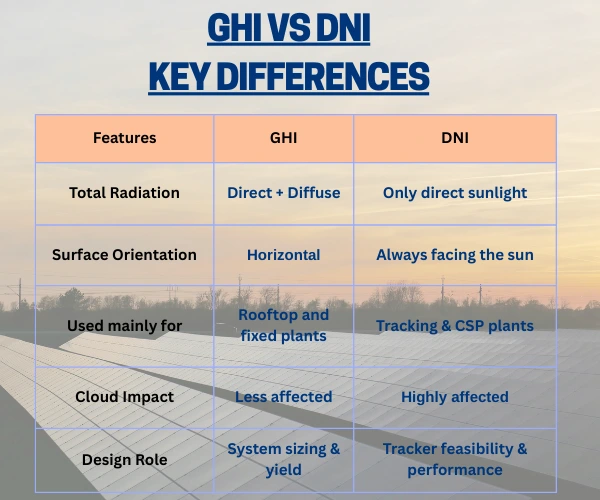
Both values play a major role in deciding the cost of solar panels, inverter sizing, and battery design.
Why GHI Is More Common for Rooftop Solar
Most solar panel in rooftop installations are fixed-tilt systems. They rely on both direct and scattered light, making GHI the most practical and accurate radiation metric.
GHI helps engineers calculate:
- Required plant capacity
- Energy yield
- Inverter loading
- Solar roof installation cost
- Expected ROI
It directly affects planning for home roof solar panels cost, subsidies, and financial models.
Why DNI Is Critical for Advanced Solar Plants
DNI becomes important when:
- Single-axis or dual-axis trackers are used
- Solar concentrators are installed
- Utility-scale plants are designed
High DNI locations can justify higher investments by increasing annual generation and lowering long-term solar installation cost per kWh.
How GHI vs DNI Affects Solar Project Economics
Radiation values influence:
- Panel orientation and tilt
- Tracking vs fixed decision
- Battery size
- Energy export potential
- Solar energy installation cost
- Solar module price per watt
- System efficiency
- Long-term savings
Higher radiation improves plant output, making renewable solar projects more profitable and making solar energy economical.
Role of GHI vs DNI in Site Assessment
Before any solar project is approved, engineers analyze radiation data to understand:
- Seasonal variations
- Cloud impact
- Long-term stability
- Feasibility of trackers
This ensures realistic expectations on solar electricity, accurate yield modeling, and optimized renewable energy technology deployment.
Why Understanding GHI vs DNI Helps Investors and Consumers
Whether you are evaluating subsidised solar panels for home, industrial plants, or solar farms, knowing GHI and DNI ensures:
- Correct performance estimation
- Fair cost evaluation
- Better technology choice
- Realistic ROI forecasting
It directly supports informed decisions on government solar subsidy schemes, solar plant planning, and installation investments.
Conclusion
GHI vs DNI are not just technical terms; they are the foundation of accurate solar system design. GHI supports most rooftop and fixed installations, while DNI drives advanced tracking and concentrated systems. Understanding both helps optimize performance, reduce financial risk, and design smarter solar projects.
At Smart Roof Solar, we use advanced radiation analysis tools to design high-efficiency systems that deliver real-world results, optimized layouts, and reliable long-term solar performance.
FAQs
Q1. Can a solar system work efficiently in low DNI areas?
Ans: Yes, fixed-tilt systems perform well in low DNI regions as they rely mainly on GHI.
Q2. Does higher GHI always mean more electricity generation?
Ans: Generally, yes, but actual output also depends on panel efficiency, temperature, and system design.
Q3. Is solar radiation the same throughout the year?
Ans: No, it varies seasonally due to sun angle, day length, and weather patterns.
Q4. Do solar radiation values affect panel degradation?
Ans: Indirectly, yes, higher radiation often means higher temperatures, which can impact long-term performance.
Q5. How accurate are satellite-based solar radiation models?
Ans: They are highly reliable for feasibility studies, with minor deviations from on-site measurements.
Solar Panel Efficiency and Temperature: What You Need to Know
The stronger the sun, the higher the temperature and more energy your solar panels produce, right? No.
Higher Electricity Bills in Haryana as Fuel Surcharge Rises
Haryana consumers are facing higher electricity bills after the Haryana Electricity Regulatory Commission (HERC) approved a fuel surcharge hike for DHBVN and UHBVN areas. The increase reflects rising fuel and power purchase costs, directly impacting domestic, commercial, and industrial users across the state.
How to Calculate Savings from Rooftop Solar Solutions: A Complete Guide
Calculating savings from rooftop solar solutions is essential for planning your investment. This guide explains how to estimate cost reduction, return on investment, and long-term financial benefits for residential, commercial, and industrial solar projects.

How to Check Battery Location for Solar PV Systems
A complete guide to solar PV battery location assessment, helping installers select safe and efficient locations for battery storage systems.
Solar Microgrids: All you need to know
Discover how solar batteries store excess energy, maximize your solar system’s efficiency, and provide reliable power during outages. Learn about the types, benefits, lifespan, and maintenance tips to make the most of your solar investment.
Understanding Solar Battery Specifications: Capacity, Voltage & Efficiency Explained
Solar batteries are essential for energy storage and backup in PV systems. This guide explains key specifications like capacity, voltage, efficiency, and depth of discharge to help you choose the right battery.

SmartRoof Solar Associate Program – Easy Way to Earn with Solar Referrals
Join the SmartRoof Solar Associate Program. Refer solar leads, earn rewards, and support clean energy growth in your community.
Grid-Connected Solar PV System Startup Guide
A complete guide to starting up a grid-connected solar PV system, including commissioning, grid synchronization, electrical safety checks, and operational verification.