
Flat rooftops offer an excellent opportunity for installing solar photovoltaic (PV) systems, especially in urban areas where space is limited. However, unlike sloped roofs, flat roofs require careful planning in terms of design, mounting structures, tilt angle, and load management to ensure optimal solar electricity generation.
For installers and EPC professionals, understanding flat roof installation techniques is essential for achieving efficiency, safety, and cost optimization. Poper rooftop design and mounting selection play a key role in successful solar PV installations.
This blog provides a complete guide to solar installation on flat roofs, including design considerations, mounting types, and best practices.
Why Choose Flat Roofs for Solar Installation?
Flat roofs are widely used for solar energy for home use and commercial systems due to:
- Flexibility in panel orientation
- Easy access for maintenance
- Efficient space utilization
- Scalability for future expansion
These advantages make flat roofs ideal for renewable solar installations.
Key Design Considerations for Flat Roof Solar Systems
1. Tilt Angle Optimization
Flat roofs require mounting structures to achieve optimal tilt.
- Ideal tilt angle depends on location
- Proper tilt improves solar electricity generation
2. Orientation of Panels
Panels should ideally face south in India for maximum sunlight exposure.
3. Roof Load Capacity
Assess whether the roof can handle:
- Weight of panels
- Mounting structures
- Ballast (if used)
4. Shadow Analysis
Avoid shading from:
- Nearby buildings
- Water tanks
- Trees
Shading reduces system efficiency.
5. Wind Load Consideration
- Flat roof systems must withstand strong winds.
- Proper mounting and ballast design are required.
6. Drainage and Waterproofing
- Ensure installation does not block drainage or damage waterproofing.
Types of Mounting Systems for Flat Roofs
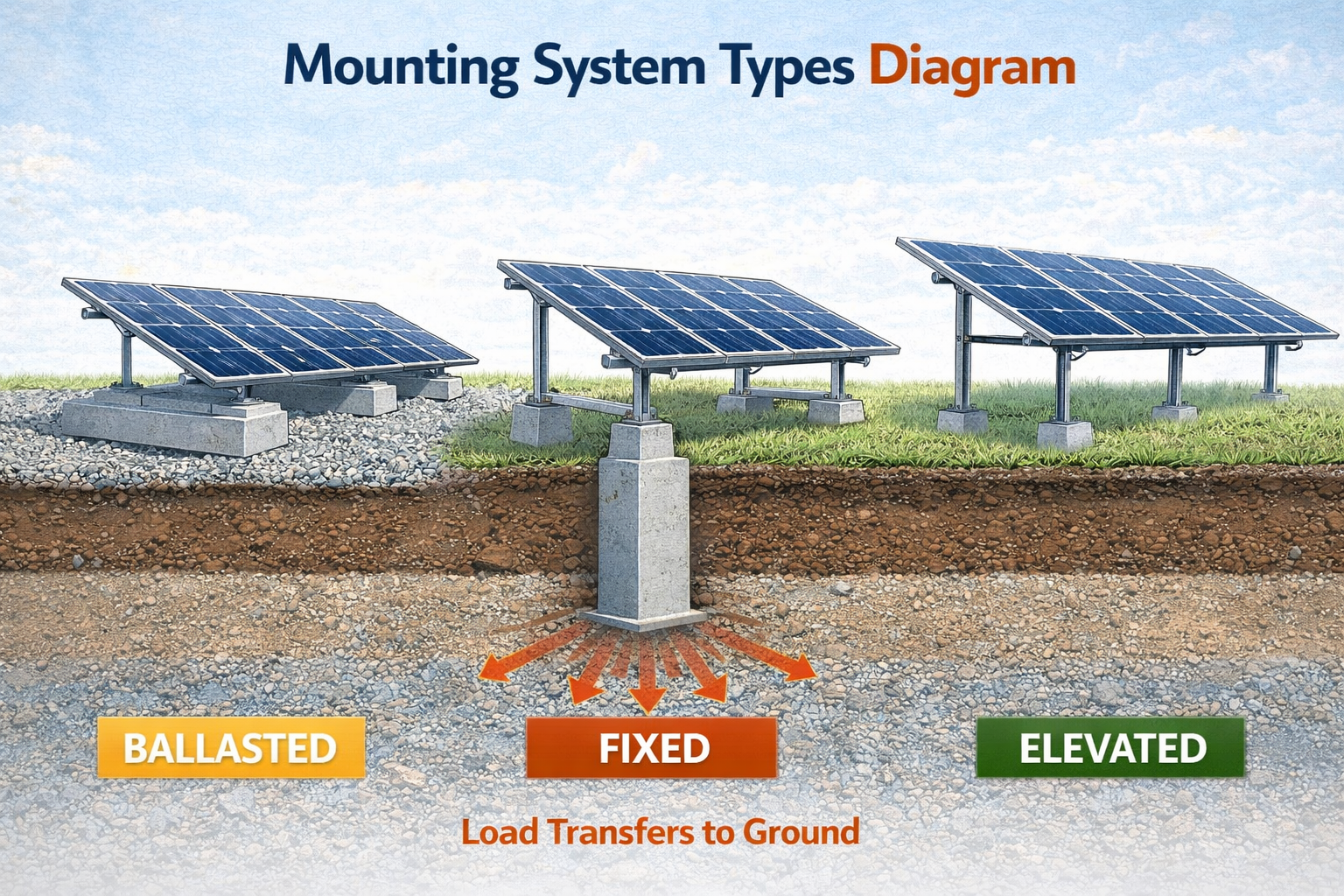
1. Ballasted Mounting System
Description
- Uses weighted blocks to hold panels without drilling into the roof.
Advantages
- No roof penetration
- Easy installation
- Suitable for sensitive rooftops
Applications
- Residential and commercial solar panels in rooftop installations
2. Fixed Tilt Mounting System
Description
- Panels are mounted at a fixed tilt angle using structures.
Advantages
- Simple design
- Cost-effective
3. Adjustable Tilt Mounting System
Description
- Allows adjustment of panel angle based on seasons.
Advantages
- Improved energy output
- Flexible operation
4. Elevated Mounting System
Description
- Panels are installed at a height above the roof.
Advantages
- Better airflow
- Space utilization below panels
Steps for Installing Solar Panels on Flat Roofs
Step 1 – Site Assessment
Evaluate:
- Roof condition
- Load capacity
- Shading
Step 2 – System Design
Determine:
- Panel layout
- Tilt angle
- Mounting type
Step 3 – Structural Analysis
- Ensure the roof can support the system load.
Step 4 – Installation of Mounting Structure
- Fix or place the mounting system as per design.
Step 5 – Panel Installation
- Mount solar panels securely.
Step 6 – Electrical Wiring
- Connect panels, inverter, and other components.
Step 7 – Testing and Commissioning
- Ensure proper functioning of the solar plant.
Best Practices for Flat Roof Solar Installation
1. Optimize Tilt and Orientation
- Maximize solar electricity generation.
2. Ensure Proper Spacing
- Avoid shading between panel rows.
3. Use High-Quality Mounting Structures
- Ensure durability and safety.
4. Maintain Roof Integrity
- Avoid damage to the waterproofing.
5. Ensure Proper Ventilation
- Prevent overheating of panels.
6. Follow Safety Standards
- Adhere to guidelines from the Ministry of New and Renewable Energy.
Impact on Solar Panel System Cost
Flat roof installations affect:
- Mounting structure cost
- Installation complexity
- Maintenance requirements
- Cost of solar per kWh installed
Proper design helps reduce the overall solar energy installation cost.
Conclusion
Solar installation on flat roofs offers a flexible and efficient solution for generating solar electricity, especially in urban environments. By understanding design considerations, selecting the right mounting systems, and following best practices, installers can ensure safe and high-performing solar PV systems.
Proper design and installation techniques are essential for successful rooftop solar projects. Additionally, compliance with guidelines from the Ministry of New and Renewable Energy ensures safety and reliability.
With the right approach, solar professionals can optimize solar panel system cost, enhance solar electricity generation, and contribute to sustainable solar energy for home use and large-scale renewable solar solutions.
FAQs
Q1. Can solar panels be installed on flat roofs?
Ans: Yes, flat roofs are ideal for solar installations with proper mounting systems.
Q2. Which mounting system is best for flat roofs?
Ans: Ballasted mounting systems are commonly used as they do not require drilling.
Q3. What is the ideal tilt angle for flat roof solar panels?
Ans: It depends on the location, but is typically close to the latitude angle.
Q4. How does shading affect flat roof solar systems?
Ans: Shading reduces energy output and system efficiency.
Q5. Is roof strength important for solar installation?
Ans: Yes, the roof must support the weight of panels and mounting structures.
India Raises Solar Purchase Obligation (SPO) to 8%: A Complete Guide
The Solar Purchase Obligation (SPO) in India is set to increase to 8%, pushing companies to adopt more solar energy. This guide explains the implications for businesses, compliance strategies, and how organizations can align with renewable energy targets.
Rajasthan Rooftop Solar Subsidy: What Homeowners Need to Know
Rajasthan homeowners can save big with the 2025 rooftop solar subsidy. Learn about the updated rates, eligibility criteria, and benefits to make your switch to solar more affordable.

New IREDA Loan Scheme for Solar Rooftop Projects: Benefits, Eligibility & Interest Rates
India’s renewable energy push gets a major boost with the new IREDA loan scheme for solar rooftop projects. This scheme offers low-interest financing, simplified approvals, and better support for residential, commercial, and industrial consumers. Here’s a detailed look at its benefits, eligibility, interest rates, and how to apply for funding.
How to Maintain Solar Power System for Homes, Industries & Commercial Buildings
A solar power generating system converts sunlight into electricity for residential, industrial, and commercial use. This blog explains the components, working, and benefits of solar systems, helping you understand how to harness solar energy efficiently and sustainably.
Solar PV Mounting Structures: Types & Installation Guide
A complete guide to solar mounting structures types in PV systems, covering fixed tilt, tracking, and rooftop installations for installers.

Solar Loans, Subsidies & EMI Plans: Financing Made Easy
Explore solar loans, government subsidies, and flexible EMI plans to make installing solar panels affordable and hassle-free.
Solar Panel Unpacking Guide: Do’s & Don’ts on Site
A practical solar panel unpacking guide covering safe handling, on-site precautions, and key do’s and don’ts to avoid module damage.

Law Change Makes It Hard to Receive Compensation for Solar Developers
A recent law change creates hurdles for solar developers seeking compensation, impacting project viability.