Switching to solar energy has become one of the smartest business decisions in India today. With rising electricity tariffs, long-term energy uncertainty, and stronger sustainability calls from global supply chains, commercial and industrial (C&I) companies are actively moving toward renewable solar solutions.
And while the government solar subsidy scheme is available for households, it is important to note that there is no subsidy for commercial solar power plant in India. Still, the number of commercial installations is rising faster than ever, because the financial benefits are far greater than the subsidy itself.
This blog explains why industries, factories, warehouses, schools, hospitals, hotels, malls, and corporate buildings are shifting to solar, even without subsidy, and how solar helps reduce solar installation charges, improve ROI, and drastically cut electricity bills.
Why No Subsidy for Commercial Solar Power Plant?
Government subsidies like PM Surya Ghar, rooftop residential subsidies, and state-level schemes are designed only for homes.
They aim to:
- Reduce household electricity burden
- Promote solar electricity adoption in residential areas
- Support small-scale rooftop installations
Since commercial solar power plant falls under large-scale and high-consumption categories, they are not covered under the government solar subsidy scheme.
But here’s the key point:
- Commercial plants still offer the fastest payback and highest ROI, often better than subsidised home systems.
This is why industries happily invest, despite having no subsidy support.
Why Solar Makes Business Sense for Commercial & Industrial Buildings
Even without subsidy, businesses benefit far more from installing solar because of lower tariffs, better financial numbers, and long-term security.
1. Electricity Cost Reduction by 60-80%
Commercial electricity tariffs in India range between ₹8-₹14/unit.
With solar, the cost of solar per kWh installed comes down to just ₹3-₹5 per unit (levelized over 25 years).
This huge gap makes solar extremely profitable.
2. Fastest Payback Period (3-5 Years)
Because industries consume large power throughout the day, most solar energy is used instantly.
This results in:
- Maximum savings
- Faster payback
- Higher lifetime returns
Even though subsidised solar panels for home exist, commercial solar power plant enjoys better ROI due to higher savings.
3. Hedge Against Rising Tariffs
Tariffs go up every year. Solar provides predictable power costs for 25 years, making solar energy economical for long-term stability.
4. Accelerated Depreciation Benefits (40% Allowed)
Industries can claim accelerated depreciation, which reduces taxable income.
This itself reduces the total cost of solar installation by 15–20%.
5. ESG & Sustainability Compliance
Many industries now require:
- Green supply chain certification
- Carbon reduction
- Renewable energy sourcing
Solar helps meet all these sustainability requirements.
Space Needed for a Commercial Solar Power Plant
The solar panel area per kW requirement varies with technology:
- Monocrystalline panels: 80-100 sq. ft./kW
- Polycrystalline panels: 100-120 sq. ft./kW
- High-efficiency N-Type panels: 65-85 sq. ft./kW
A 100 kW system typically needs 6,000-8,000 sq. ft. rooftop space.
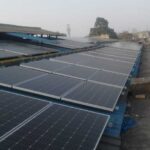
Large solar farms, commercial roofs, and industrial sheds are ideal for mounting a solar panel in rooftop setups.
Factors Affecting the Total Cost of Solar Installation
Several elements directly impact solar installation cost per kWh and the modular smart solar panel price:
1. Type of Solar Panel
- Mono PERC / N-Type TopCon
- Bifacial modules
- Imported vs Made-in-India
2. Type of Inverter
- String inverter
- Central inverter
- Hybrid inverter
3. Site Conditions
- Height of sheet roof
- Cable distance
- Panel orientation
- Type of mounting structure
4. Brand Selection
- Premium brands increase the cost of solar panels, but offer better efficiency.
- All these impact the final solar panel system cost for industries.
Expected Generation from Commercial Solar Power Plants
A good-quality commercial solar power plant generates around:
- 1400-1600 units per kW per year across India
So a:
- 100 kW system → 1.4-1.6 lakh units annually
- 500 kW system → 7-8 lakh units annually
- 1 MW system → 14-16 lakh units annually
This directly lowers industrial bills and supports renewable energy and solar energy adoption.
ROI for Commercial Solar Power Plants in India
Investment
- ₹36,000-₹50,000 per kW depending on region and brand.
Annual Savings
- ₹8-₹14 per unit saved (commercial tariffs)
Payback
- 3-5 years typically, depending on usage, load curve, and area.
- After payback, industries enjoy 20+ years of almost free solar electricity.
- This makes solar one of the strongest investment tools for any industrial unit.
Why Solar Is Still Profitable Without Subsidy
Industries save far more through:
- Huge energy cost reduction
- No diesel generator usage
- Reduced peak demand charges
- Lower operational costs
- Accelerated depreciation benefits
In fact, the absence of subsidy avoids complications and ensures faster approvals.
Commercial setups get the maximum benefit from renewable solar adoption because their usage is daytime-heavy, perfect for solar.
Conclusion: Commercial Solar Power Plant = Long-Term Financial Power
Even though there is no subsidy for commercial solar power plants, the financial benefits are much stronger and long-lasting.
From electricity savings, tariff protection, and sustainability compliance to the fastest ROI, solar is now the smartest investment businesses can make.
If you want to know the actual solar installation charges, total cost of solar installation, or the ideal plant size for your building, Smart Roof Solar is here to help.
Why Choose Smart Roof Solar?
- Premium A-grade modules
- Best-in-class engineering & structure
- Accurate performance estimation
- On-time delivery and end-to-end project execution
- Trusted by top industrial clients
- Strong after-sales O&M team
Whether you want a 100 kW, 500 kW, or 1 MW commercial solar power plant, we design it uniquely for your site & maximise your returns.
FAQs
Q1. Is subsidy available for commercial solar power plant in India?
Ans: No, only households receive subsidies under national schemes.
Q2. What is the typical ROI for commercial solar?
Ans: Most commercial plants recover the cost in 3-5 years.
Q3. What is the per kW cost of commercial solar installation?
Ans: ₹36,000-₹50,000 per kW depending on brand and site conditions.
Q4. Do industries need net metering?
Ans: Yes, commercial consumers can apply for net metering subject to the state’s regulations.
Q5. What is the main advantage for industries using solar?
Ans: Massive electricity savings and long-term tariff stability.