
Industrial Solar Plants with Diesel Generator Backup: What You Need to Know
Many industries in Delhi/NCR (Kundali, Sonipat, Faridabad, Bahudargarh, Manesar, Bawal, Ghaziabad, Greater Noida etc) have to still depend on the Diesel Generator sets for running factories for few hours daily. What happens if the discom supply is disrupted during the sunny hours when the sun is still out generating the power?
Grid tied solar plants or On-grid solar systems will run when the Discom power is available as the solar inverters have in built feature which commands the solar system to generate power when it can sense that the supply is available from other sources. Such a feature is built in solar inverters as the solar power is an intermittent source of electricity supply which provides variable output depending on the solar intensity at that moment. Hence if suddenly the clouds cover the sun, the solar generation will dip making the system unstable.
Therefore, solar has to always run in conjunction with any other dependable and stable source of supply like Discom power, DG power or the batteries.
Rooftop Solar with DG
As the batteries are quite expensive and need to be replaced periodically, most factories depend on the DGs for the back up power. Solar can be connected to the DG panel directly as it is connected to the LT panel of the Discom supply in the factories. Certain protections require to be built in based on the DG sizing however. Also, the factory load that can be served by solar should never be more than the DG supply which means that the primary supply source will always remain the DG.
So, the size of solar plant cannot be more than that of the DG size as the solar alone cannot take the factory or plant’s load.
Solar will help to reduce the diesel consumption during the DG hours as the DG will run at lower loads and even idle loads depending on the system design. For the system to work smoothly, if there are multiple DGs, they should be synchronized (manually or automatically) before they are put in sync with the rooftop solar system.
Suggested Articles

Environmental Hazards in Solar PV Installations Guide
A complete guide to identifying and mitigating safety hazards in solar PV systems, including risk assessment, hazard control, preventive measures, and workplace safety practices.
Solar ROI vs Payback Period Explained for Commercial & Industrial Projects
Compare payback period and ROI for solar systems. Discover how businesses should evaluate solar investments effectively.
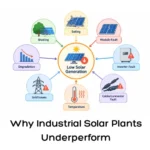
Why Industrial Solar Plants Underperform
Understand what happens when an industrial solar plant underperforms, how it affects energy generation and cost savings, and how monitoring, diagnostics, and preventive maintenance can improve performance.
Is Your Solar PV Rooftop System Safe & Protected?
Worried about the safety of your solar rooftop system? Explore key tips, maintenance practices, and protection strategies to keep your Solar PV system secure and efficient
What Does 1 kWp Mean in Solar Power Systems?
1 kWp is a standard unit used to measure the capacity of a solar power system under ideal conditions. This guide explains what 1 kWp means, how much energy it produces, and why it matters for system sizing.
How to Improve Solar Panel Performance for Optimal Energy Output
Performance degradation in solar panels reduces energy output over time. This guide explains how to factor in degradation when calculating annual yields, ensuring accurate estimates for residential, commercial, and industrial solar installations.
Affordable Solar Systems and Plants for Small and Medium Enterprises
Learn how SMEs can harness solar energy through tailored solar systems and plants to reduce electricity bills, improve sustainability, and boost efficiency.

What Is Solar Panel Efficiency? Meaning & Impact on Power Generation
Solar panel efficiency refers to how effectively a solar panel converts sunlight into usable electricity. This guide explains what solar panel efficiency means, why it matters, and how it directly impacts your solar system’s power output, space requirements, and overall performance.