
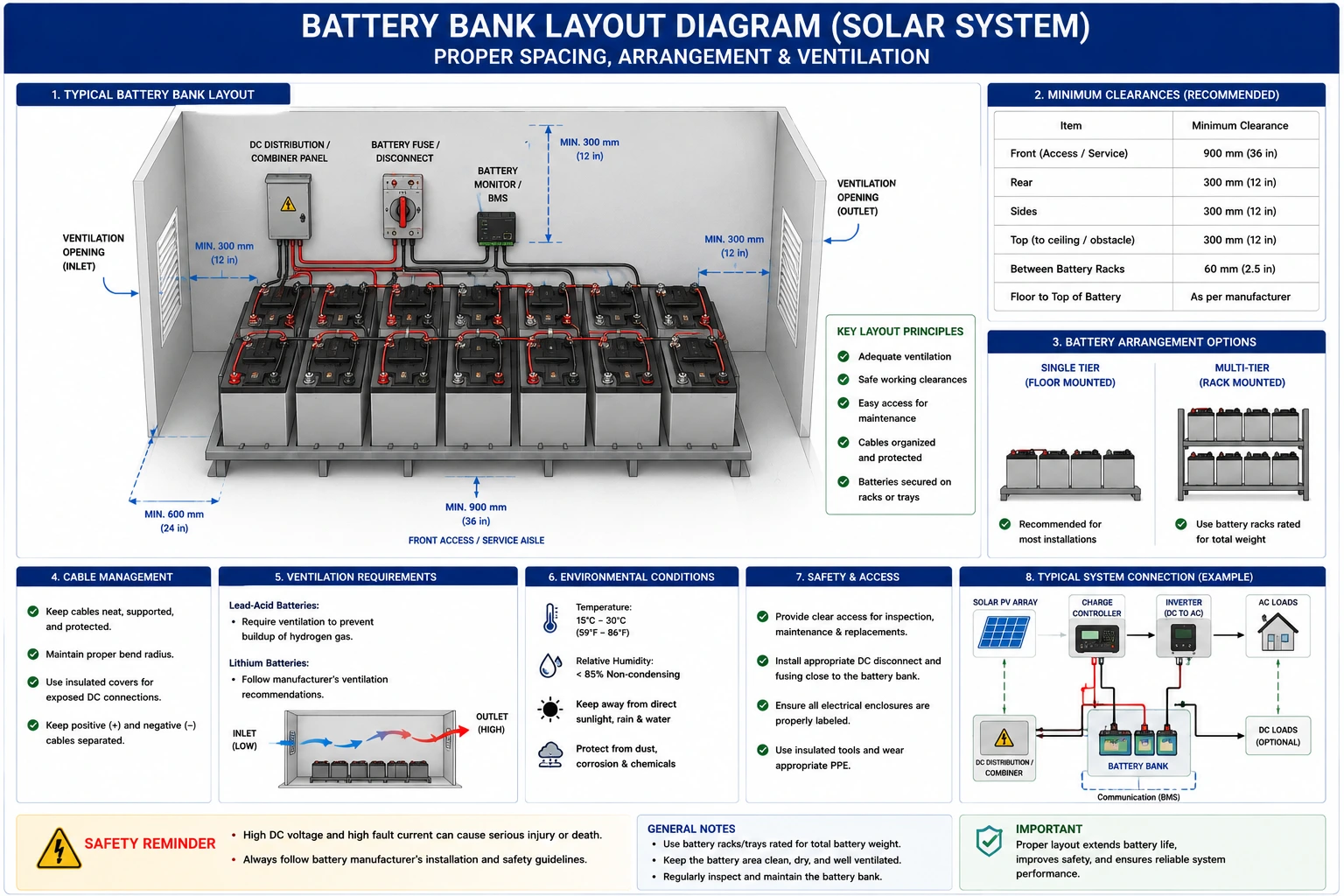
Battery storage systems are one of the most important components of modern solar photovoltaic (PV) systems. They store excess solar electricity generated during the day and provide backup power during grid failures or nighttime operation. Whether used in residential rooftop systems, commercial solar plants, or off-grid renewable solar projects, proper battery bank location confirmation and installation are essential for ensuring safety, efficiency, and long-term reliability.
Improper battery placement or incorrect installation practices can lead to overheating, poor ventilation, corrosion, reduced battery lifespan, and increased solar installation charges. Therefore, installers must carefully assess the battery bank location and follow standard installation procedures.
Proper battery handling and installation are essential parts of renewable energy technology and solar energy for home use.
This blog provides a complete step-by-step guide to confirming battery bank location and installing batteries in solar PV systems, including site selection factors, installation methods, safety precautions, and best practices.
Importance of Battery Banks in Solar PV Systems
Battery banks help:
- Store excess solar electricity
- Provide backup during outages
- Improve energy reliability
- Support off-grid and hybrid solar systems
They are widely used in:
- Solar energy for home use
- Commercial solar plants
- Renewable energy and solar energy projects
Why Proper Battery Bank Location Matters
The correct battery bank location helps:
- Improve battery efficiency
- Increase battery lifespan
- Enhance safety
- Simplify maintenance
- Reduce solar installation cost per kWh
Improper location may cause:
- Overheating
- Moisture damage
- Gas accumulation
- Reduced performance
Key Factors to Confirm Battery Bank Location
1. Proper Ventilation
Battery rooms must have adequate airflow to:
- Dissipate heat
- Prevent gas buildup in lead-acid batteries
Poor ventilation affects battery performance and increases maintenance costs.
2. Temperature Control
The installation area should be:
- Cool
- Dry
- Protected from direct sunlight
High temperatures reduce battery life and increase the total cost of solar installation.
3. Structural Strength
The installation surface must support the total battery weight safely.
4. Accessibility
The battery bank should allow:
- Easy inspection
- Maintenance access
- Safe cable routing
5. Protection from Water and Moisture
Avoid locations exposed to:
- Rainwater
- Leakage
- Flooding
- Excessive humidity
6. Safety Clearance
Maintain sufficient spacing around batteries for:
- Cooling
- Inspection
- Emergency handling
7. Distance from Inverter and Electrical Equipment
Minimize cable length to reduce:
- Voltage drop
- Power loss
- Solar energy installation cost
Types of Batteries Commonly Used in Solar Projects
1. Lead-Acid Batteries
- Economical
- Require ventilation and maintenance
2. Lithium-Ion Batteries
- High efficiency
- Longer lifespan
- Compact design
3. Tubular Batteries
- Common for residential backup systems
4. Gel Batteries
- Sealed and maintenance-free
Tools and Materials Required
Tools
- Insulated spanners
- Torque wrench
- Multimeter
- Hydraulic crimping tool
- Cleaning brush
Materials
- Battery stands
- Interconnection cables
- Terminal lugs
- Anti-corrosion grease
- Spill containment trays
Step-by-Step Process to Confirm Battery Bank Location
Step 1 – Review Design Drawings
Understand:
- Battery arrangement
- Ventilation requirements
- Cable routing
Step 2 – Inspect Installation Area
Check for:
- Structural stability
- Ventilation
- Water protection
Step 3 – Verify Space Availability
Ensure enough room for:
- Maintenance
- Air circulation
- Future expansion
Step 4 – Confirm Safety Conditions
Ensure the area is away from:
- Flammable materials
- Excessive heat sources
- High-traffic zones
Step 5 – Check Electrical Accessibility
Ensure proper routing for:
- Battery cables
- Grounding conductors
- Disconnect switches
Step-by-Step Battery Installation Procedure
Step 1 – Prepare Battery Stand
- Install and level the battery stand
- Verify structural strength
Step 2 – Install Spill Containment System
- Particularly important for lead-acid batteries.
Step 3 – Position Batteries Carefully
- Follow the layout drawings
- Maintain proper spacing
Step 4 – Inspect Battery Condition
Check for:
- Physical damage
- Terminal corrosion
- Leakage
Step 5 – Prepare Battery Terminals
- Clean terminals
- Apply anti-corrosion grease
Step 6 – Install Battery Interconnection Cables
- Follow correct polarity
- Use proper cable sizing
Step 7 – Tighten Connections Properly
- Use the torque wrench according to the manufacturer’s specifications.
Step 8 – Install Protective Covers
- Protect terminals from accidental contact.
Step 9 – Verify Grounding
- Ensure proper earthing and bonding.
Step 10 – Perform Electrical Testing
Check:
- Voltage
- Polarity
- Continuity
- Connection tightness
Conclusion
Confirming the correct battery bank location and installing batteries properly are essential steps in ensuring the safety, efficiency, and long-term reliability of solar PV systems. By selecting suitable installation areas, maintaining ventilation, following proper wiring practices, and implementing safety measures, installers can significantly improve battery performance and system reliability.
Proper battery installation is fundamental for renewable solar systems and solar energy for home use. Additionally, adherence to standards established by the Ministry of New and Renewable Energy ensures safe and standardized installation practices.
With correct planning and installation methods, solar professionals can optimize solar panel system cost, improve solar electricity storage efficiency, and support sustainable renewable energy technology adoption.
FAQs
Q1. Why is battery bank location important?
Ans: It affects ventilation, safety, and battery lifespan.
Q2. What is the ideal environment for battery installation?
Ans: A cool, dry, and well-ventilated location.
Q3. Why is spill containment necessary?
Ans: It protects against acid leakage and environmental damage.
Q4. Does proper battery installation affect solar panel system cost?
Ans: Yes, it reduces maintenance and replacement expenses.
Q5. What safety precautions are necessary during installation?
Ans: Use PPE, insulated tools, and ensure proper ventilation.
Solar Inverter Inspection & Maintenance Guide
A complete guide to solar inverter inspection and maintenance, including visual inspections, performance checks, fault diagnosis, cleaning, and preventive maintenance to maximize efficiency and reliability.
India and IMT-GT JBC Sign MoU to Boost Energy Efficiency in Southeast Asia
The first meeting of the G20 Energy Transitions Working Group was held in Bengaluru, India, and was a success, with participants sharing a consensus on the priority areas of energy security and diversified supply chains.

Delhi Government Pledges to Boost Renewable Energy Generation
Delhi, the capital city of India, is moving towards a greener future with an ambitious plan to generate an additional 6,000 MW of electricity using renewable energy sources.
1 MW Solar Power Plant Cost in Madhya Pradesh | A Complete Industrial Solar Guide
A detailed guide on the cost of setting up a 1 MW solar power plant in Madhya Pradesh. Learn about pricing, EPC components, land requirements, subsidies, and expected payback for commercial and industrial users.
1 MW Solar Plant Cost in Uttar Pradesh | A Complete Guide
Planning to install a 1 MW solar power plant in Uttar Pradesh? This guide covers 2025 pricing, subsidy details, ROI, and savings for industries and businesses.

Corporate Safety Policies for Solar PV Workplaces
A complete guide to establishing and following safe work procedures in solar PV systems, ensuring worker safety during installation, testing, commissioning, operation, and maintenance.
Solar Inverter Stand Installation: Step-by-Step Guide
A step-by-step guide to solar inverter stand installation as per drawings and manuals, ensuring proper alignment, stability, and safety.
How to Test Current Output of Solar PV Strings
A complete guide to solar PV string current testing, including current measurement, comparison of string outputs, fault identification, and troubleshooting techniques for optimal system performance.