The state of Haryana is quickly becoming one of India’s top solar hubs, driven by progressive renewable energy policies, the PM Surya Ghar Muft Bijli Yojana, and increasing awareness among industries and institutions.
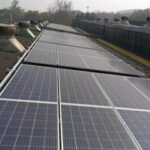
A 1 MW solar power plant in Haryana is a powerful step toward energy independence and long-term cost savings. Whether installed for an industrial unit, educational campus, or large commercial complex, this capacity ensures reliable green energy at one of the lowest costs per unit of electricity.
At Smart Roof Solar, we help industries and institutions design, build, and maintain large-scale solar plants that deliver optimal performance while adhering to all government guidelines and subsidy frameworks.
What is a 1 MW Solar Power Plant?
A 1 MW (megawatt) solar power plant produces approximately 1,50,000 units of electricity per month, depending on site irradiation and system quality.
This capacity is typically used by industrial estates, cold storages, data centers, large institutions, and manufacturing facilities with an annual consumption of over 15 lakh units.
Quick Overview:
1 MW = 1,000 kW = 1,000,000 Wp
Average daily generation: 4,500–5,000 units
Annual generation: 14-16 lakh units
Solar panel area per kW: 80-100 sq. ft.
Total area required: 80,000-1,00,000 sq. ft.
By choosing solar, consumers can drastically reduce grid dependence, control long-term power costs, and contribute to renewable energy and solar energy goals under India’s net-zero mission.
1 MW Solar Power Plant Cost in Haryana
1 MW solar power plant cost in Haryana varies depending on module efficiency, inverter quality, and site conditions.
Capacity | Estimated Cost (excluding GST) |
100 kW in Haryana | Starting from ₹24,00,000* |
200 kW in Haryana | Starting from ₹47,00,000* |
300 kW in Haryana | Starting from ₹35,25,000* |
400 kW in Haryana | Starting from ₹47,00,000* |
500 kW in Haryana | Starting from ₹1,25,00,000* |
600 kW in Haryana | Starting from ₹1,44,00,000* |
700 kW in Haryana | Starting from ₹1,64,50,000* |
800 kW in Haryana | Starting from ₹1,88,00,000* |
900 kW in Haryana | Starting from ₹2,16,00,000* |
1 MW in Haryana | Starting from ₹2,35,00,000* |
*Prices quoted are indicative starting rates for the above mentioned solar installations may vary based on project-specific requirements, including ground mount or tin-shed structures, RC installation types, additional accessories like DG sync, safety rails, etc. Final pricing will be confirmed upon detailed site evaluation and project scope assessment.
These estimates include solar installation charges, mounting structures, inverters, DC/AC cabling, earthing systems, and commissioning costs.
Over time, the cost of solar per kWh installed comes down to just ₹3.5–₹4 per unit, making solar economical and sustainable for commercial use.
Power Generation and Payback Period
A 1 MW solar plant in Haryana can generate up to 1.5 million units of electricity annually, depending on sunlight conditions and design efficiency.
Financial Highlights:
- Annual generation: 14-16 lakh units
- Annual savings: ₹1.2-₹1.6 crore (at ₹8-₹10 per unit tariff)
- Payback period: 3.5-4.5 years
- System lifespan: 25+ years
After the payback period, the electricity generated is almost free, with only minor O&M expenses (roughly ₹3-₹4 lakh/year).
Ideal Users of a 1 MW Solar Power Plant
This system is perfect for:
- Industrial parks and manufacturing plants
- Large educational institutions and universities
- Cold storage and agro-processing units
- Shopping malls, hotels, and hospitals
- Government and public sector buildings
Such consumers benefit the most due to consistent high energy consumption and favorable solar installation cost per kWh over time.
Environmental and Social Benefits
- Carbon reduction: ~1,200–1,400 tonnes annually
- Green credits: Qualifies for RECs (Renewable Energy Certificates)
- Sustainability: Meets ESG compliance and CSR goals
- Community impact: Reduces grid load, supporting Haryana’s renewable energy mission
By switching to solar, institutions can proudly align with renewable solar goals and demonstrate their commitment to renewable energy technology and sustainability.
O&M and Monitoring
At Smart Roof Solar, we offer 360° Operation & Maintenance (O&M) services to ensure consistent generation.
Our monitoring system tracks real-time performance and issues alerts for preventive maintenance, keeping downtime minimal.
Read our blog to know more – Solar O&M Services & Maximum Power Output – Smart Roof Solar
Why Choose Smart Roof Solar
- Expertise in industrial-scale projects up to 1 MW and beyond
- Complete assistance with government solar subsidy schemes
- Transparent pricing and a detailed breakdown of the solar module price per watt
- Compliance with HAREDA and HERC regulations
- Dedicated support for O&M, training, and performance reporting
Whether you’re planning a rooftop or ground-mounted solar system, we ensure making solar energy economical while maintaining top-notch quality and safety standards.
Conclusion
A 1 MW solar power plant in Haryana is not just a clean energy investment; it’s a long-term asset that provides cost savings, reliability, and sustainability.
With Smart Roof Solar, you gain access to cutting-edge engineering, reliable after-sales support, and expert assistance in navigating subsidies and net metering procedures.
Make your transition to solar electricity seamless, efficient, and future-ready. Contact Smart Roof Solar today to explore customized solar solutions for your business.
FAQs
Q1. What is the payback period for a 1 MW solar project?
Ans: Most 1 MW systems recover their cost within 3.5 to 4.5 years through energy savings.
Q2. How much can businesses save annually with a 1 MW solar setup?
Ans: Savings can range between ₹1.2 crore and ₹1.6 crore annually based on electricity tariffs.
Q3. Can a 1 MW solar system be grid-connected?
Ans: Yes, it can be fully grid-tied under Haryana’s net metering policy for energy credit adjustments.
Q4. How long does it take to install a 1 MW solar power plant?
Ans: Typically, 3-4 months from site survey to final commissioning, depending on project scope.
Q5. Can a 1 MW plant operate with a diesel generator (DG sync)?
Ans: Yes, hybrid integration allows smooth DG synchronization for uninterrupted power.