
Industrial rooftops can provide valuable space for solar power generation. Large factories, warehouses, manufacturing units, and commercial buildings often have enough roof area to install significant solar capacity.
However, having a large roof does not automatically mean that every part of it is suitable for solar panels.
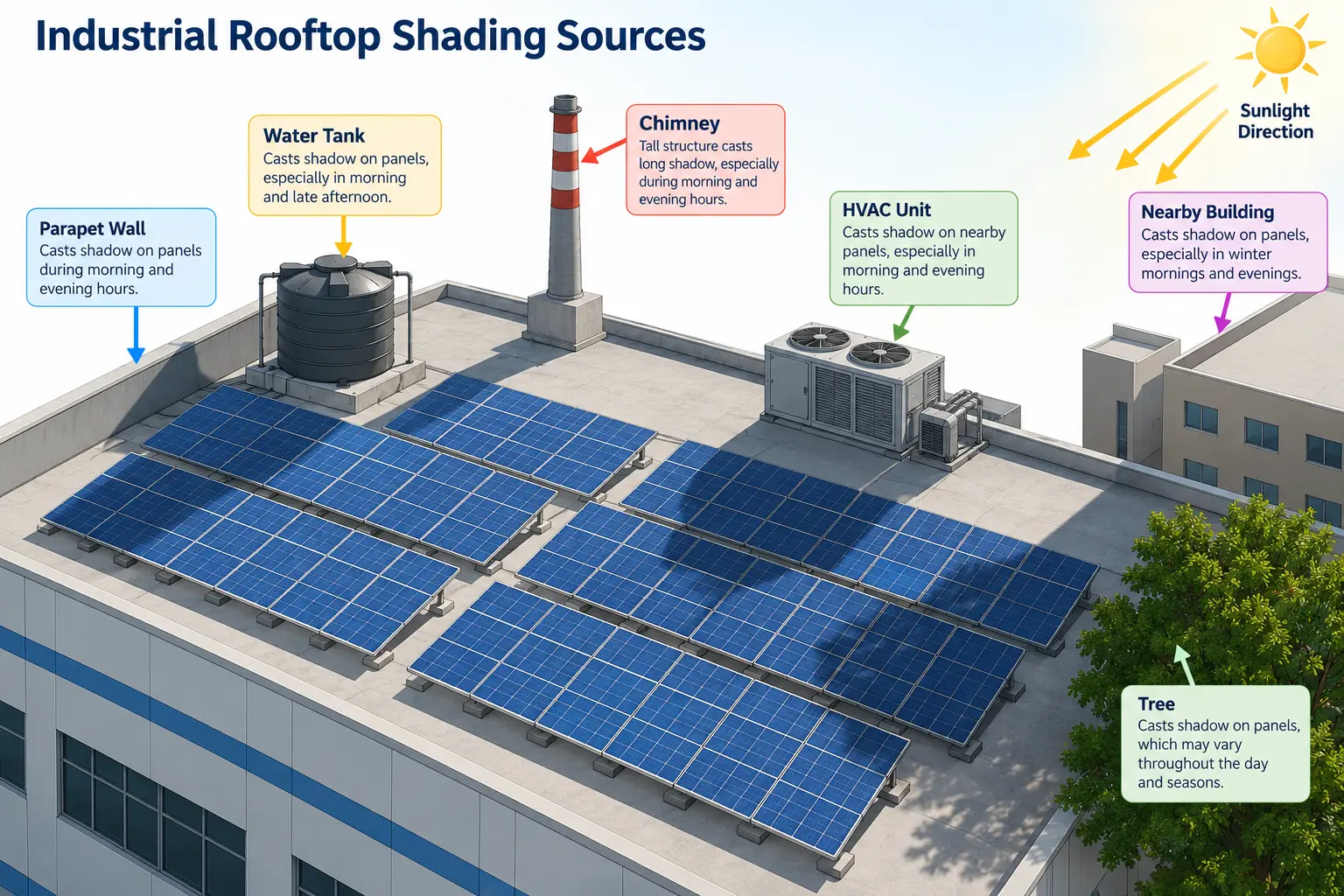
Shading is one of the important factors that can reduce rooftop solar generation. Shadows from nearby buildings, trees, water tanks, chimneys, parapet walls, HVAC equipment, pipes, and other rooftop structures can prevent sunlight from reaching the solar modules.
For a C&I solar project, understanding and controlling shading is therefore essential for achieving the expected energy generation and protecting the project’s financial returns.
What Is Shading in a Rooftop Solar Plant?
Shading occurs when an object blocks some of the sunlight that would otherwise reach a solar module.
There are two broad types of shading:
External Shading
This comes from objects outside the solar array, such as:
- Nearby buildings
- Trees
- Towers
- Chimneys
- Utility structures
- Adjacent industrial facilities
Rooftop or Self-Shading
This can be caused by objects and arrangements on the same roof, including:
- Parapet walls
- Water tanks
- HVAC units
- Ventilation equipment
- Solar module rows
- Elevated structures
- Pipes and ducts
Solar modelling software can simulate both external shading and row-to-row self-shading to estimate their impact on energy production.
Why Does Shading Reduce Solar Generation?
Solar modules convert sunlight into electricity. When part of a module receives less sunlight, its electrical output can be affected.
The effect is not always proportional to the physical size of the shadow.
For example, a relatively small shadow falling across part of a module can have a much larger effect on the electrical output of the module or string, depending on where the shade falls and how the module is electrically configured. NREL research has demonstrated that partial shading can have a disproportionately large impact on PV power production.
This is why simply saying “only a small part of the panel is shaded” can be misleading.
How Bypass Diodes Help
Modern PV modules generally contain bypass diodes that help reduce the impact of partial shading.
A module is divided electrically into sections, and bypass diodes can allow current to bypass a shaded section under certain conditions.
This helps limit the impact of shading, but it does not eliminate shading losses.
When a bypass diode operates, part of the module’s voltage contribution can be lost. Therefore, the module may continue producing electricity, but at reduced output.
The exact response depends on the module design, cell configuration, bypass-diode arrangement, and shading pattern.
Common Sources of Shading on Industrial Rooftops
Industrial roofs are often more complicated than residential rooftops.
1. Parapet Walls
High parapet walls around the roof can cast shadows on the first rows of solar modules, particularly when the sun is at a low angle.
2. Water Tanks
Water tanks and their supporting structures can create moving shadows throughout the day.
3. HVAC and Ventilation Equipment
Industrial facilities often have large cooling systems, exhaust fans and ventilation equipment. Their locations must be considered before finalising the module layout.
4. Chimneys and Exhaust Structures
Tall chimneys can cast long shadows, particularly during morning and evening hours.
5. Nearby Buildings
A neighbouring factory or newly constructed building can change the shading pattern of an existing solar installation.
6. Solar Module Rows
Modules can also shade other modules when rows are placed too closely together or when the mounting geometry is not properly designed.
This is known as self-shading. NREL’s modelling tools account for row-to-row shading because module spacing, tilt, and array geometry influence the available sunlight.
Why Shading Changes During the Day
Shadows are not stationary.
The position of the sun changes continuously, causing the size and location of shadows to change throughout the day.
A rooftop may therefore experience:
- Morning Shading → Low/No Shading Around Midday → Afternoon Shading
The pattern also changes throughout the year because the sun’s position changes with the seasons. Therefore, a rooftop that looks relatively shade-free during a quick midday site visit may still experience significant shading during other hours.
Detailed shading studies should consider different times of the day and different seasons. Solar modelling tools can generate time-based shading information to evaluate this effect.
How Shading Affects C&I Solar Generation
The impact of shading can appear in several ways.
Lower Module Output
Shaded modules receive less sunlight and therefore may produce less electricity.
Lower String Output
If affected modules are connected within a string, the electrical characteristics of the string can be influenced.
Lower Inverter Generation
If a shaded section is connected to a particular inverter, inverter-wise generation may show lower output compared with other similar inverters.
Lower Overall Plant Generation
When shading affects a significant portion of the array or occurs for many hours, the combined effect can reduce the plant’s annual energy generation.
This can ultimately affect the savings expected from the solar project.
Shading and Solar Plant Performance Ratio
Shading is one of the losses that can contribute to lower solar plant performance.
If the plant receives adequate solar irradiation but generates less electricity because part of the array is regularly shaded, the effect may appear in performance monitoring and PR trends.
However, PR should not be used alone to identify shading. Irradiation, inverter data, string performance, weather conditions, and other losses should also be considered.
How to Identify Shading Before Installation
Shading should ideally be assessed during the solar site survey and design stage, rather than after the modules have been installed.
The assessment should identify:
- Roof obstructions
- Building heights
- Parapet walls
- Trees
- Nearby structures
- Equipment locations
- Potential future construction
- Module orientation
- Module tilt
- Row spacing
A 3D shading analysis can then be used to study how shadows move across the proposed solar array.
This allows designers to identify highly shaded areas and optimise the layout before installation.
How Can Industrial Rooftop Shading Be Reduced?
Complete elimination of shading may not always be possible. The objective is to minimise avoidable shading while maintaining a practical and safe plant layout.
Possible measures include:
- Selecting less-shaded roof areas
- Optimising module orientation
- Adjusting row spacing
- Maintaining appropriate clearance from obstructions
- Avoiding unnecessary placement near tall structures
- Considering shading in inverter/string design
- Reassessing the layout when major rooftop equipment changes
- Monitoring known shaded sections
The design should also balance shading reduction against roof utilisation, cable lengths, structural requirements, maintenance access and overall solar installation cost.
How to Monitor Shading After Installation
Shading problems can sometimes become visible through plant performance data.
Useful indicators include:
- Lower generation from a particular inverter
- Lower string current
- Repeated output reduction during certain hours
- Seasonal generation patterns
- Module-level monitoring where available
- Thermal or electrical inspection when required
If a previously normal section begins underperforming, the O&M team should also check whether a new structure, equipment, or tree growth has introduced additional shading.
Shading and Solar Project Economics
Shading is not only a technical issue. It can also affect the financial performance of a solar investment.
The relationship is straightforward:
- Shading → Lower Solar Generation → More Grid Electricity Consumption → Lower Savings → Potentially Longer Payback
This is particularly important for C&I facilities where solar energy is commonly used to reduce electricity purchased from the grid.
A slightly smaller but well-designed solar plant can sometimes provide better long-term value than maximising the number of panels on a heavily shaded area.
Practical Shading Assessment Checklist
Before and after installing an industrial rooftop solar plant, check:
- Nearby buildings
- Trees and vegetation
- Parapet walls
- Water tanks
- HVAC equipment
- Chimneys
- Pipes and ducts
- Rooftop structures
- Future construction possibilities
- Morning and afternoon shadows
- Seasonal shading
- Row-to-row self-shading
- Inverter-wise performance
- String-wise output
- Shading-related generation losses
Conclusion
Shading is one of the most important factors to consider when designing and operating an industrial rooftop solar plant. Unlike a simple obstruction that blocks a small visible area, partial shading can sometimes create a much larger electrical impact because of the way PV modules and strings operate.
For C&I businesses, the best approach is to identify shading before installation through a detailed site survey and appropriate solar modelling. Parapet walls, water tanks, HVAC systems, chimneys, nearby buildings and even the arrangement of solar module rows should all be considered.
After installation, inverter-wise and string-level monitoring can help identify unusual performance and determine whether shading may be contributing to generation losses.
For businesses investing in solar energy, solar roof panels or a large rooftop solar plant, the goal should not simply be to install the maximum possible number of modules. The better objective is to create a well-designed, low-loss solar system that produces reliable solar electricity throughout its operating life.
A properly planned shading assessment can therefore protect both sides of the investment: technical performance and financial returns. When shading is understood, modelled and managed from the beginning, an industrial rooftop can deliver much greater value from its available solar resource.
FAQs
Q1. How does shading affect industrial rooftop solar generation?
Ans: Shading reduces the sunlight reaching affected PV modules and can cause electrical losses that are sometimes greater than the physical area of the shadow suggests.
Q2. What are common sources of shading on industrial rooftops?
Ans: Parapet walls, water tanks, HVAC systems, chimneys, pipes, nearby buildings, trees and other rooftop structures are common sources.
Q3. Does a small shadow always cause a small loss?
Ans: No. Partial shading can have a disproportionately large effect depending on its location, electrical configuration, and the affected cells or modules.
Q4. Do bypass diodes eliminate shading losses?
Ans: No. Bypass diodes can reduce the impact of shading on parts of a module, but they do not eliminate the associated energy loss.
Q5. Can shading change during the day?
Ans: Yes. As the sun moves across the sky, the direction and length of shadows change. Seasonal changes can also alter the shading pattern.
Demystifying Battery Backup: Everything You Need to Know
Battery backup is essential for uninterrupted power at home and in industries. This guide explains different types of battery backup systems, how they work, their benefits, and tips to choose the right one for reliable energy storage.
China’s Solar Industry Poised for Continued Growth in 2023 and Beyond
China’s solar industry is set for continued growth in 2023 and beyond, driving global renewable energy expansion and technological advancements.

How to Check Materials Received on Site for Solar PV Projects: Complete Inspection Checklist
Ensuring the quality of materials received at site is critical for successful solar PV installation. This guide provides a detailed inspection checklist to verify solar components before installation.
How to Improve Energy Efficiency and Save Electricity Costs
Learn how energy conservation and efficiency can help you save electricity, cut costs, and make your home or business more sustainable
Yes, I Have Installed an Optimized Solar PV Rooftop System at My Premises
A solar power generating system converts sunlight into electricity for residential, industrial, and commercial use. This blog explains the components, working, and benefits of solar systems, helping you understand how to harness solar energy efficiently and sustainably.
India’s Solar Capacity Growth Slows Down in Q1 2023
India’s solar capacity growth slowed in Q1 2023. Explore the factors behind the slowdown and its impact on the country’s renewable energy progress.
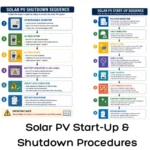
Solar PV Start-Up and Shutdown Procedures
A complete guide to demonstrating safe start-up and shutdown procedures for solar PV systems, covering pre-start checks, equipment sequencing, isolation, inverter operation, and system verification.
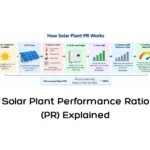
Solar Plant Performance Ratio (PR) Explained
A complete guide to solar plant performance ratio (PR), explaining its calculation, key influencing factors, industry benchmarks, and role in evaluating the performance of commercial and industrial solar plants.