What Is an Array Junction Box in Solar PV Modules? | Complete Guide
An Array Junction Box in solar, AJB, is used to connect the photovoltaic strings in parallel. The combined DC power is fed to the photovoltaic inverter. It includes photovoltaic string protection, overvoltage protection and a DC output switch isolator. The AJB can be customized for different configurations, based on the number of strings of solar panel modules used in the layout. AJB have the following component
- Enclosure
- PV fuses
- Surge Protection Device
- DC Disconnector/Isolator
- Cable Glands/Connectors
1. Enclosure:
The combiner box enclosures are usually made of thermoset (eg. GRP or polyester), or thermoplastic (polycarbonate) material, and come with IP65 protection. Enclosures come in various sizes, based on the number of input strings. The protection features required also contribute to the changes in the enclosure needed. Enclosure should be fire-resistant with self-extinguishing property. It should be UV-resistant and halogen–free and should also have a good mechanical impact resistance, preferably greater than IK 08.
2. PV fuse:
PV fuse or photovoltaic fuse, of the range 1A to 32A are easily available in market. The PV fuses are used for overcurrent protection.
PV fuse selection:-
Nsr = No. of PV modules in series per PV string
Npl = No. of PV strings in parallel per PV sub-array
Isc = Short-circuit current of one module at Standard Test Conditions (STC)
Voc = Open circuit voltage of one PV module at STC
Calculations to verify volts and amps:
• Fuse voltage rating ≥ 1.20 x Voc x Nsr
• Fuse amp rating ≥ 1.56 x Isc
For Example:-
Let’s assume that
No. of PV module in strings are: – 20 nos. (Nsr )
No. of PV string in parallel per PV sub array = 16 (Npl)
Isc = 8.6 Amp
Voc=37.2 V
Fuse amp rating ≥1.56*8.6 A ≥13.41 A
As per the standard fuse available in market, a 15A fuse should be used here.
Voltage rating of Fuse ≥1.2*37.2*20 V ≥ 892.8 V
As per the standard fuse available in market, a 1000 V DC fuse should be used to meet this requirement.
3. Surge Protection Device:
SPD or Surge Protection Device is used in the AJB/SCB. It protects electrical and electronic equipment from the power surges and voltage spikes. SPD diverts the excess voltage and current from transient or surge into ground through earthing system.
Selection Of SPDs according to the voltage protection level Vp:
Every SPD has a maximum voltage protection level specified for operation & diverts the excess energy in ground. The protection voltage level of SPD is usually kept at 20% less than dielectric strength & greater than operating voltage of PV system.
4. DC Disconnector /Isolator:
DC Disconnector/Isolator is a switch used to disconnect the power supply between PV string & inverter. It is recommended to be placed before the inverter, to disconnect the DC side of the system when required.
Selection criteria for PV isolator
Initial conditions for specifying PV disconnectors:
Nsr = No. of PV module in series per PV string
Npl= No. of PV string in parallel per PV sub-array
Isc = Short-circuit current of one PV module at Standard Test Conditions
Voc = Open circuit voltage of one PV module at STC
• Circuit breaker voltage rating ≥ 1.20 x Voc x Nsr Volt
• PV Output current rating ≥ 1.56 x Isc x Npl Amp
For example:- Let’s we assume that
No. of PV module in strings are = 20 nos. ( Nsr )
No. of PV string in parallel per PV sub array = 16 ( Npl)
Isc = 8.6 Amp
Voc=37.2 V
Circuit breaker voltage ≥ 1.20*37.2*20 Volt ≥892.8 Volt
As per standard available circuit breakers in market, it should be 1000 V DC Disconnector.
Current rating of isolator ≥1.56 x Isc x Npl Amp ≥1.56*8.6*16 Amp ≥214.65 Amp
As per standard available circuit breakers in market, it should be 225 Amp isolator.
5. Cable Glands/Connectors:
Every solar system is outdoor type, so AJB component should be IP65 protected & UV protected. There are two options with cable entry in AJB.
1. Cable Gland
2. MC4 connector.
Cable glands require the sealing arrangement after the connection inside AJB to outside systems is done. MC4 Connectors have the male female socket for connection, and hence do not require sealing to maintain the IP protection. MC4 connectors have the limitation of current capacity. In low rating, 30 A for string level MC4 is the best option. In case of AJB, output rating of more than 30Amp cable gland is suitable.
Suggested Articles

Solar Inverter Wire Connection Inspection Guide
A complete guide to inspecting solar inverter wire connections, identifying damaged cables, loose terminals, and ensuring safe, efficient, and reliable solar PV system operation.
C&I Solar Installation Company: Complete Guide for Commercial & Industrial Solar Projects in India
Ground mounted solar systems are ideal for commercial and industrial projects with available land. This guide explains cost, land requirement, installation process, and ROI in India.
Solar PV AC or DC: How Solar Electricity Is Generated
Total solar PV power represents the combined power output of a solar photovoltaic system. This guide explains its meaning, calculation, and how it directly impacts solar performance, efficiency, and long-term energy generation.
End of Rooftop Solar Subsidy for Industrial & Commercial Consumers: What You Need to Know
The rooftop solar subsidy for industrial and commercial consumers is coming to an end. This guide explains the implications for businesses, updated policies, and strategies to adopt solar power without relying on subsidies.
How to Inspect and Maintain Solar Arrays
A complete guide to solar array inspection and maintenance, helping improve system reliability, energy output, and long-term performance through routine inspections and preventive care.

Everything You Should Know About Solar Batteries
Discover how solar batteries store excess energy, maximize your solar system’s efficiency, and provide reliable power during outages. Learn about the types, benefits, lifespan, and maintenance tips to make the most of your solar investment.
Financing made easy for the Rooftop Solar Projects
Switching to solar is easier than ever with flexible financing options. This guide explains how to fund your rooftop solar project through loans, subsidies, and government schemes to make clean energy more affordable and sustainable.
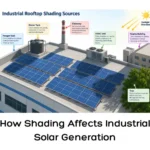
How Shading Affects Industrial Solar Generation
Understand how shading from nearby buildings, rooftop equipment, trees, and other obstructions affects industrial rooftop solar generation, and explore practical ways to minimize energy losses and improve plant performance.