
Solar photovoltaic (PV) systems have become an important part of the global transition toward clean and sustainable energy. From rooftop systems for homes and businesses to large commercial, industrial, and utility-scale solar power plants, photovoltaic technology provides a reliable way to convert sunlight into solar electricity. However, while solar energy offers significant environmental and economic benefits, PV installations also involve several hazards that must be identified, assessed, and controlled throughout their lifecycle.
A solar PV project involves much more than installing solar modules. Workers may be required to perform activities such as site assessment, structural installation, cable routing, electrical termination, inverter installation, commissioning, testing, troubleshooting, cleaning, preventive maintenance, and battery servicing. Each activity can introduce different risks.
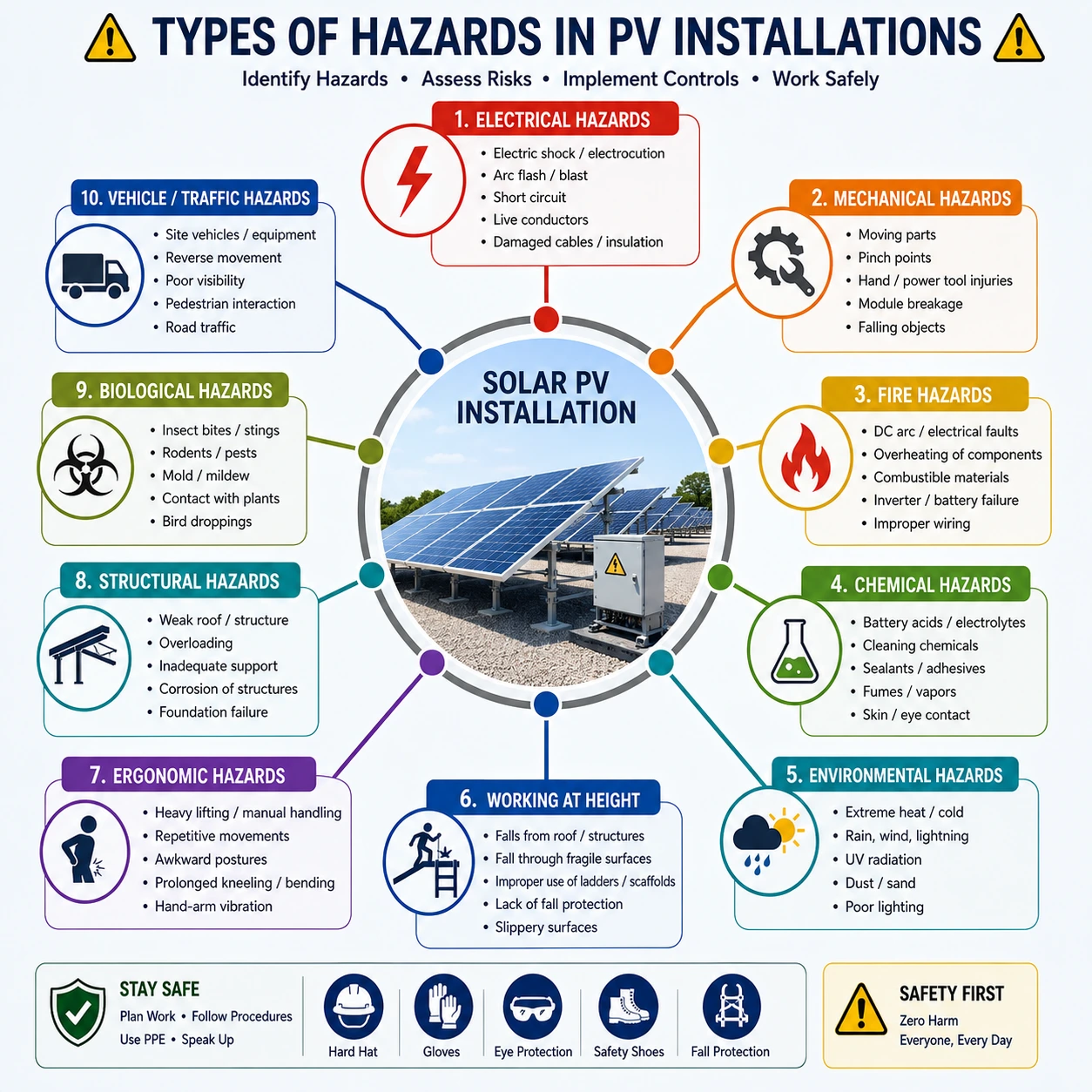
The hazards associated with PV installations may be electrical, mechanical, environmental, chemical, fire-related, ergonomic, or related to working at height. Some hazards exist during installation, while others become more significant during operation and maintenance. For example, workers installing rooftop modules may face fall hazards, whereas technicians working on an operating PV array may face DC electrical hazards. Battery-based systems introduce additional chemical and thermal risks.
Understanding the different types of hazards is therefore essential for anyone working on a solar panel system. Hazard identification should be carried out before work begins and should continue throughout the project. A well-designed safety program combines risk assessment, engineering controls, administrative procedures, Personal Protective Equipment (PPE), training, supervision, and regular inspections.
This guide provides a comprehensive overview of the major types of hazards associated with photovoltaic installations, their potential consequences, preventive measures, and best practices for maintaining a safe solar PV workplace.
What Are Hazards in a PV Installation?
A hazard is any condition, activity, substance, or situation that has the potential to cause:
– Injury or illness
– Electric shock
– Fire
– Equipment damage
– Environmental harm
– Property damage
– Production losses
– Project delays
PV installations contain multiple systems operating together, including electrical, mechanical, structural, and energy-storage components. Consequently, hazard identification should consider the entire installation rather than focusing only on the PV modules.
Why Is Hazard Identification Important in Solar PV Systems?
Identifying hazards before an accident occurs allows appropriate control measures to be implemented.
Effective hazard identification can help:
– Protect workers and contractors.
– Prevent injuries and fatalities.
– Reduce equipment damage.
– Minimize fire risks.
– Improve installation quality.
– Reduce system downtime.
– Improve maintenance planning.
– Support regulatory compliance.
– Increase the reliability of solar electricity generation.
It can also reduce avoidable maintenance and replacement expenses associated with a solar plant.
Major Types of Hazards Associated with PV Installations
The importance of each category varies depending on the size, location, design, and operating conditions of the PV installation.
1. Electrical Hazards
Electrical hazards are among the most significant risks in photovoltaic installations.
PV modules generate DC electricity when exposed to sunlight. The generated power passes through cables, connectors, combiner boxes, isolators, and inverters before being converted to AC electricity.
Potential hazards include:
– Electric shock
– DC arc formation
– Arc flash
– Short circuits
– Incorrect polarity
– Damaged insulation
– Loose connections
– Poor grounding
– Unexpected energization
– Faulty protective devices
Mitigation Measures
Workers should:
– Identify all electrical energy sources.
– Follow approved isolation procedures.
– Use appropriate electrical PPE.
– Verify electrical conditions before starting work.
– Use correctly rated equipment.
– Maintain proper grounding and bonding.
– Inspect cables and connectors regularly.
– Follow applicable Lockout/Tagout procedures.
2. Working-at-Height Hazards
Many rooftop PV installations require workers to operate at significant heights.
Potential risks include:
– Falls from roof edges
– Falls through fragile roof surfaces
– Ladder accidents
– Scaffolding failures
– Dropped tools
– Slipping on inclined roofs
A fall from height can result in serious injury or fatality.
Mitigation Measures
Appropriate measures may include:
– Guardrails
– Fall-arrest systems
– Properly secured ladders
– Safe access systems
– Certified anchor points
– Appropriate footwear
– Work-at-height training
Work should be suspended when weather conditions create unacceptable risks.
3. Mechanical Hazards
Mechanical hazards arise from equipment, tools, structures, and moving components.
Examples include:
– Sharp metal edges
– Pinch points
– Rotating machinery
– Moving components
– Drilling equipment
– Cutting tools
– Mounting structures
Mitigation Measures
Workers should:
– Use appropriate tools.
– Wear suitable gloves and PPE.
– Maintain safe distances.
– Install machine guards where applicable.
– Follow manufacturer instructions.
4. Fire Hazards
Solar PV systems can present fire risks when electrical faults, damaged components, or improper installation practices create excessive heat or arcing.
Potential causes include:
– Loose electrical connections
– Damaged cables
– Incorrectly rated equipment
– DC arcing
– Overloaded circuits
– Faulty batteries
– Poor ventilation
Mitigation Measures
– Use correctly rated electrical equipment.
– Maintain proper cable management.
– Inspect connections regularly.
– Maintain protective devices.
– Keep combustible materials away from electrical equipment.
– Provide appropriate fire detection and extinguishing arrangements.
5. Chemical Hazards
Chemical hazards are particularly relevant to PV projects involving batteries, cleaning agents, and certain maintenance materials.
Potential risks include:
– Battery electrolyte exposure
– Chemical burns
– Harmful fumes
– Cleaning-agent exposure
– Corrosive substances
Mitigation Measures
– Follow Safety Data Sheet (SDS) instructions.
– Use appropriate chemical-resistant PPE.
– Maintain ventilation.
– Store chemicals correctly.
– Provide spill-response arrangements.
– Train workers in safe chemical handling.
6. Battery-Related Hazards
Energy-storage systems introduce additional risks depending on battery chemistry and system design.
Potential hazards include:
– High electrical current
– Short circuits
– Electrolyte leakage
– Thermal runaway
– Overheating
– Fire
– Explosion risk in certain battery technologies
– Toxic or corrosive substances
Mitigation Measures
– Follow manufacturer instructions.
– Maintain suitable ventilation where required.
– Inspect battery terminals and enclosures.
– Use appropriate PPE.
– Keep unauthorized personnel away from battery areas.
– Maintain suitable fire and emergency-response provisions.
7. Environmental and Weather-Related Hazards
PV installations are generally exposed to outdoor conditions.
Environmental hazards may include:
– Extreme heat
– Heavy rain
– Flooding
– Lightning
– Strong winds
– Dust
– Snow and ice
– High humidity
– Corrosive coastal environments
Potential Effects
Environmental conditions may affect both worker safety and system performance.
For example:
– Extreme heat can cause heat stress.
– Dust can reduce module output.
– Flooding can damage electrical equipment.
– High winds can destabilize materials.
– Lightning can damage electrical systems.
Mitigation Measures
– Monitor weather conditions.
– Provide suitable drainage.
– Use weather-resistant equipment.
– Suspend outdoor work during dangerous conditions.
– Maintain modules and equipment regularly.
8. Thermal Hazards
Solar PV equipment can become hot during operation.
Potentially hot components include:
– PV modules
– Inverters
– Cables
– Electrical connections
– Batteries
– Transformers
Excessive heat can result in:
– Burns
– Reduced equipment efficiency
– Accelerated component aging
– Insulation degradation
Mitigation Measures
– Allow equipment to cool before maintenance where appropriate.
– Maintain ventilation.
– Monitor operating temperatures.
– Avoid touching potentially hot surfaces without suitable protection.
9. Manual Handling and Ergonomic Hazards
Solar modules, batteries, mounting structures, and other components can be heavy or difficult to handle.
Improper lifting can cause:
– Back injuries
– Muscle strains
– Sprains
– Crush injuries
Mitigation Measures
– Use mechanical lifting equipment when appropriate.
– Plan lifting operations.
– Use team lifting for suitable loads.
– Train workers in safe lifting techniques.
– Avoid carrying loads beyond individual capabilities.
10. Slip, Trip, and Fall Hazards
Poor housekeeping can create everyday hazards at solar project sites.
Common causes include:
– Loose cables
– Packaging material
– Tools
– Debris
– Uneven surfaces
– Wet floors
– Poorly organized work areas
Mitigation Measures
– Maintain good housekeeping.
– Keep access routes clear.
– Organize cables properly.
– Remove waste promptly.
– Clean spills immediately.
11. Biological and Wildlife Hazards
Outdoor solar installations may encounter:
– Snakes
– Insects
– Rodents
– Birds
– Other wildlife
Animals can also damage electrical infrastructure by chewing cables or nesting near equipment.
Mitigation Measures
– Conduct regular inspections.
– Maintain vegetation.
– Protect exposed cables.
– Use appropriate wildlife-management measures.
– Avoid direct interaction with potentially dangerous animals.
12. Construction and Structural Hazards
During installation, workers may be exposed to hazards associated with:
– Mounting structures
– Foundations
– Excavation
– Drilling
– Structural lifting
– Unsecured materials
Improperly installed structures can create risks during both construction and operation.
Mitigation Measures
– Follow approved structural drawings.
– Verify foundations.
– Use appropriate lifting equipment.
– Inspect mounting structures.
– Tighten fasteners according to applicable specifications.
– Prevent unauthorized modification of structural components.
13. Noise Hazards
Certain construction and maintenance activities may produce high noise levels.
Sources may include:
– Drilling machines
– Generators
– Power tools
– Heavy machinery
– Construction equipment
Prolonged exposure can contribute to hearing damage.
Mitigation Measures
– Assess workplace noise.
– Maintain equipment properly.
– Use hearing protection when required.
– Limit exposure duration where appropriate.
14. Transportation and Vehicle Hazards
Large solar projects may involve:
– Trucks
– Forklifts
– Cranes
– Earthmoving equipment
– Service vehicles
Potential risks include:
– Vehicle collisions
– Reversing accidents
– Falling loads
– Pedestrian injuries
Mitigation Measures
– Establish designated vehicle routes.
– Use trained operators.
– Maintain pedestrian separation.
– Use spotters where appropriate.
– Follow site traffic rules.
15. Confined-Space Hazards
Some PV projects may include enclosed areas such as:
– Battery rooms
– Underground cable areas
– Electrical equipment rooms
– Certain utility or service spaces
Potential hazards may include:
– Poor ventilation
– Oxygen deficiency
– Toxic gases
– Restricted movement
– Difficult emergency access
Mitigation Measures
Entry into a confined space should only occur under an approved procedure, with appropriate risk assessment, atmospheric testing, authorization, ventilation, rescue arrangements, and trained personnel where applicable.
16. Arc-Flash and Fault-Current Hazards
Electrical faults can release significant energy in a very short period.
Potential effects include:
– Severe burns
– Flying debris
– Pressure waves
– Temporary blindness
– Hearing damage
– Equipment destruction
Mitigation Measures
– Conduct appropriate electrical risk assessments.
– Maintain equipment.
– Use suitable protective devices.
– Follow safe switching procedures.
– Maintain appropriate clearances.
– Use task-appropriate PPE.
Hazard Identification Process for PV Installations
A systematic hazard identification process can be divided into the following steps.
Step 1: Inspect the Site
Examine:
– Roof condition
– Ground conditions
– Electrical equipment
– Access routes
– Weather conditions
– Nearby hazards
Step 2: Identify Hazards
Categorize hazards as:
– Electrical
– Mechanical
– Chemical
– Environmental
– Fire
– Structural
– Ergonomic
– Biological
Step 3: Assess Risk
Evaluate:
– Likelihood
– Severity
– Exposure
– Number of people potentially affected
Step 4: Implement Controls
Use the hierarchy of controls:
- Elimination
- Substitution
- Engineering controls
- Administrative controls
- PPE
Step 5: Communicate the Risks
Workers should be informed about:
– Identified hazards
– Required controls
– Emergency procedures
– PPE requirements
– Restricted areas
Step 6: Monitor and Review
Hazards should be reassessed whenever:
– Work conditions change.
– Equipment is modified.
– An incident occurs.
– A near miss occurs.
– New activities begin.
Hierarchy of Hazard Controls
The hierarchy of controls provides a structured method for reducing risk.
1. Elimination
- Remove the hazard entirely where feasible.
2. Substitution
- Replace a hazardous material, process, or method with a safer alternative.
3. Engineering Controls
- Separate workers from the hazard through physical or technical measures.
4. Administrative Controls
- Use procedures, training, signs, schedules, permits, and supervision.
5. Personal Protective Equipment
- Use PPE as the final layer of protection where risks remain.
PPE should not be treated as the only method of hazard control.
Role of Personal Protective Equipment
Depending on the task and risk assessment, PV workers may require:
– Safety helmets
– Safety footwear
– Electrical insulating gloves
– Safety glasses
– Face shields
– Fall-arrest harnesses
– High-visibility clothing
– Hearing protection
– Chemical-resistant gloves
– Arc-rated PPE where required
PPE must be correctly selected, inspected, maintained, and used.
Hazard Identification During Different Stages of a Solar Project
During Site Assessment
Identify:
– Roof condition
– Terrain
– Access limitations
– Electrical infrastructure
– Weather exposure
– Flooding risk
– Nearby hazards
During Installation
Focus on:
– Working at height
– Electrical work
– Lifting operations
– Tools
– Structural assembly
– Material handling
During Commissioning
Focus on:
– Energization
– Electrical testing
– Incorrect connections
– Grounding
– Inverter operation
– Protection systems
During Operation and Maintenance
Focus on:
– Electrical faults
– Damaged modules
– Cable deterioration
– Hot spots
– Inverter faults
– Battery condition
– Vegetation
– Dust
– Wildlife
Conclusion
Photovoltaic installations provide clean and sustainable solar electricity, but they also involve a wide range of hazards that must be properly identified and controlled. Electrical shock, arc flash, working at height, fire, battery risks, chemical exposure, extreme weather, mechanical hazards, manual handling, structural risks, wildlife, vehicle movement, and other workplace hazards can affect solar professionals throughout the project lifecycle.
The first step toward effective safety management is recognizing that hazards vary according to the location, system configuration, equipment, work activity, and environmental conditions. A rooftop solar installation may place greater emphasis on fall protection and electrical safety, while a utility-scale solar plant may require extensive controls for electrical systems, vehicles, heavy equipment, environmental conditions, and large-scale maintenance operations.
A robust hazard management process should therefore begin with a site-specific assessment and continue through installation, commissioning, operation, maintenance, troubleshooting, and decommissioning. Organizations should prioritize elimination and engineering controls wherever practical, supported by administrative controls, training, supervision, and appropriate PPE.
Solar professionals should make hazard identification an integral part of every task rather than treating safety as a separate activity. Organizations should also align their procedures with applicable electrical, occupational safety, environmental, and manufacturer requirements.
Effective hazard identification and mitigation ultimately protects the most important asset, the people working on the project, while also protecting expensive PV equipment and maintaining reliable energy production. By controlling hazards proactively, solar companies can reduce downtime and avoidable maintenance expenses, improve system reliability, optimize solar installation cost, support a lower cost of solar per kWh installed, and maximize the long-term value of renewable energy and solar energy.
Whether the system is designed for solar energy for home use, a commercial rooftop, an industrial facility, or a large utility-scale project, understanding and controlling the different types of hazards associated with PV installations is fundamental to building safe, efficient, reliable, and sustainable solar power systems.
FAQs
Q1. What are the main types of hazards associated with PV installations?
Ans: The major hazards include electrical, mechanical, fire, chemical, battery-related, environmental, thermal, structural, ergonomic, biological, vehicle, noise, confined-space, and working-at-height hazards.
Q2. Which is the most serious hazard in a solar PV installation?
Ans: Electrical hazards are among the most serious because PV modules can produce DC electricity whenever exposed to sunlight. However, fall hazards, fire, battery hazards, and other risks can also result in severe injuries depending on the project.
Q3. Why are PV systems dangerous even when the inverter is switched off?
Ans: PV modules can continue producing DC electricity when exposed to sunlight. Therefore, switching off an inverter does not necessarily eliminate electrical energy throughout the PV array.
Q4. What hazards are associated with rooftop solar installations?
Ans: Common rooftop hazards include falls from height, fragile roof surfaces, electrical shock, dropped objects, extreme weather, heat exposure, and unsafe ladder or access conditions.
Q5. What are the common environmental hazards in solar installations?
Ans: Environmental hazards include extreme heat, high winds, lightning, heavy rainfall, flooding, dust, snow, humidity, vegetation, wildlife, and corrosive coastal conditions.

How to Safely Install Solar Panels on Metal and Asbestos Rooftops
Discover how solar systems can be installed on metal sheds and asbestos roofs, making factories more energy-efficient and sustainable

Basics of Electricity and Electric Terms and Laws Required for Renewable Energy – Complete Guide
Understanding the basics of electricity is essential for anyone working in renewable energy and solar power systems. From voltage and current to Ohm’s Law and power calculations, strong electrical fundamentals ensure safe and efficient solar installations. This complete guide explains key electrical terms, units, formulas, and laws required for renewable energy professionals, students, and solar PV installers.
Safety Hazard Identification & Mitigation in Solar PV
A complete guide to identifying and mitigating safety hazards in solar PV systems, including risk assessment, hazard control, preventive measures, and workplace safety practices.
How DISCOMs Implement Net Metering for Solar Power Plants
Discover the process of net metering implementation by DISCOMs for solar power plants. Understand the benefits, billing mechanism, and how it maximizes solar energy utilization.
Should You Replace Solar Panels with Solar Shingles?
Discover how solar batteries store excess energy, maximize your solar system’s efficiency, and provide reliable power during outages. Learn about the types, benefits, lifespan, and maintenance tips to make the most of your solar investment.
Solar PV Mounting Structures: Types & Installation Guide
A complete guide to solar mounting structures types in PV systems, covering fixed tilt, tracking, and rooftop installations for installers.
How Are Solar PV Modules Made? Complete Guide to the Manufacturing Process
Choosing the right solar panels can be confusing with so many options in the market. This guide simplifies solar panel selection by comparing types, efficiency ratings, and cost factors. Whether for your home, business, or industry, learn how to make an informed decision and maximize the return on your solar investment.
Industrial Solar Plants with Diesel Generator Backup: What You Need to Know
Discover how industries can efficiently run rooftop solar plants alongside diesel generators (DG). Learn the benefits, setup tips, and hybrid system strategies to ensure uninterrupted power and maximize energy savings.