
In any solar photovoltaic (PV) system, the module support and racking frame form the structural backbone that holds solar panels securely in place. These components ensure that panels are positioned at the correct tilt and orientation, directly impacting solar electricity generation, durability, and overall system efficiency.
Improper installation of racking systems can lead to misalignment, structural instability, and increased solar installation charges. Precise installation of module supports is essential for achieving reliable and efficient renewable solar systems.
This blog provides a complete step-by-step guide to installing module support and racking frames, aligned with industry practices and training standards.
What are Module Supports and Racking Frames?
Module supports and racking frames are structural components that hold solar panels and distribute their load to the mounting system or roof.
They include:
- Rails
- Beams
- Clamps
- Connectors
These components ensure that solar panels remain securely fixed under various environmental conditions.
Importance of Proper Installation
Correct installation ensures:
- Accurate panel alignment
- Resistance to wind and environmental loads
- Long-term durability
- Efficient solar electricity generation
- Reduced maintenance and solar energy installation cost
Improper installation can increase solar panel system cost due to repairs and inefficiencies.
Types of Racking Systems
1. Roof-Mounted Racking
- Used for residential and commercial rooftops
- Includes flat and sloped roof systems
2. Ground-Mounted Racking
- Installed on open land
- Requires strong foundation
3. Elevated Racking Systems
- Raised structures for better airflow and space utilization
4. Tracking Racking Systems
- Move panels to follow the sun
- Increase energy output
Materials Used in Racking Frames
1. Galvanized Steel
- Strong and durable
- Corrosion-resistant
2. Aluminum
- Lightweight
- Easy to install
3. Stainless Steel
- Used for fasteners and connectors
- High durability
Tools and Materials Required
Tools
- Measuring tape
- Spirit level
- Torque wrench
- Spanners and wrenches
- Drilling machine
Materials
- Rails and beams
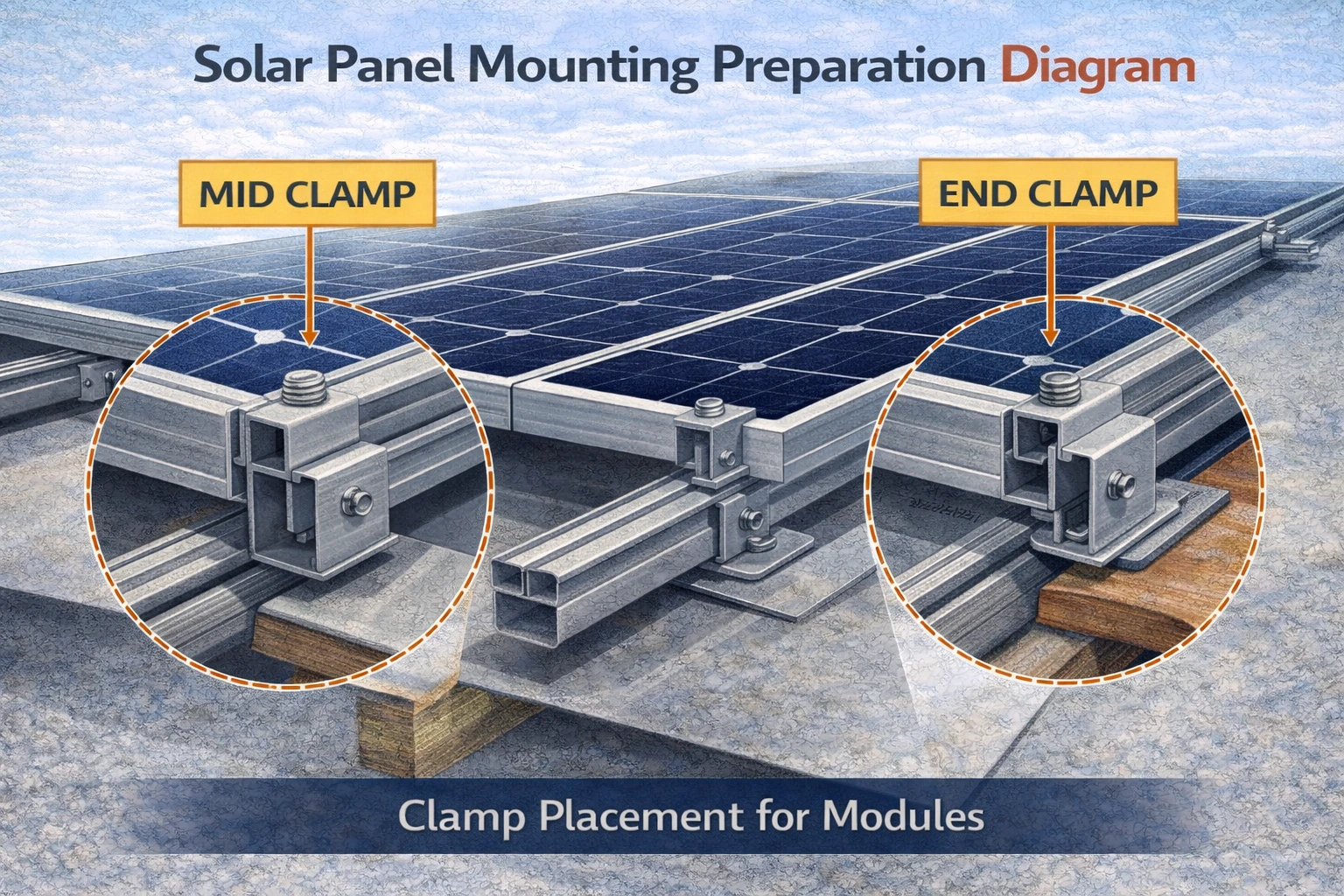
- Clamps (end and mid clamps)
- Fasteners (nuts, bolts, washers)
- Connectors
Pre-Installation Preparation
1. Site Assessment
Evaluate:
- Roof or ground condition
- Structural strength
- Shading and orientation
2. Review Design Documents
Study:
- Layout drawings
- General Arrangement (GA)
- Structural specifications
3. Material Inspection
Ensure all components are free from defects.
4. Safety Planning
Prepare PPE and safety measures.
Step-by-Step Installation Process
Step 1 – Install Mounting Base
- Ensure posts or roof attachments are properly fixed
- Verify alignment and stability
Step 2 – Position Rails
- Place rails on mounting supports
- Maintain proper spacing
Step 3 – Fix Rails to Supports
- Secure rails using bolts and connectors
- Ensure proper tightening
Step 4 – Align the Racking Frame
- Use spirit level
- Ensure straight and uniform alignment
Step 5 – Install Cross Members (if required)
- Add additional support structures
- Improve stability
Step 6 – Install Clamps
- Fix end clamps and mid clamps
- Prepare for panel mounting
Step 7 – Tighten All Fasteners
- Use torque wrench
- Ensure secure connections
Step 8 – Check Tilt Angle and Orientation
- Adjust for optimal sunlight exposure
Step 9 – Final Inspection
- Verify alignment, stability, and spacing
- Ensure readiness for panel installation
Quality Checks
1. Alignment
- Ensure rails are straight and evenly spaced.
2. Structural Stability
- Check for movement or looseness.
3. Fastener Tightness
- Verify proper torque application.
4. Corrosion Protection
- Ensure coatings are intact.
5. Tilt Accuracy
- Confirm correct angle for maximum efficiency.
Conclusion
The installation of module support and racking frames is a fundamental step in solar PV systems that ensures stability, efficiency, and long-term performance. By following structured installation methods, using appropriate tools, and ensuring quality checks, installers can achieve reliable and cost-effective solar solutions.
Proper mounting and alignment are essential for successful renewable solar installations. Additionally, compliance with standards set by the Ministry of New and Renewable Energy ensures safety and reliability.
With the right practices, solar professionals can optimize solar panel system cost, enhance solar electricity generation, and contribute to sustainable solar energy for home use and large-scale renewable solar solutions.
FAQs
Q1. What is the role of racking frames in solar PV systems?
Ans: They support solar panels and ensure proper alignment and stability.
Q2. What materials are used in racking systems?
Ans: Galvanized steel, aluminum, and stainless steel.
Q3. Why is alignment important in racking installation?
Ans: It ensures maximum sunlight exposure and system efficiency.
Q4. How does racking installation affect solar panel system cost?
Ans: Proper installation reduces maintenance and improves efficiency, lowering costs.
Q5. Are safety measures necessary during installation?
Ans: Yes, they ensure safe and efficient project execution.

Cut Factory Electricity Bills with Solar Energy: Smart Power Saving Guide for Industries in India
Discover how solar energy helps factories in India reduce electricity bills, improve ROI, and achieve long-term industrial power savings.
Series & Parallel Wiring in Solar Modules: Installer Guide
A practical guide to solar module interconnection using series and parallel wiring, covering setup, calculations, and best practices for installers.
Essential Tools for PV System Testing Guide
A complete guide to battery bank enclosure and rack installation, including site verification, setup procedures, and safety practices for solar PV systems.

Financing made easy for the Rooftop Solar Projects
Switching to solar is easier than ever with flexible financing options. This guide explains how to fund your rooftop solar project through loans, subsidies, and government schemes to make clean energy more affordable and sustainable.

Difference Between an On-Grid Inverter and a Hybrid Solar Inverter
Confused between an on-grid inverter and a hybrid solar inverter? This blog explains their differences, advantages, and which solar inverter is right for you.

Ground Mounted Solar Systems: Complete Guide for Commercial & Industrial Projects in India
Ground mounted solar systems are ideal for commercial and industrial projects with available land. This guide explains cost, land requirement, installation process, and ROI in India.

Solar Microgrid Solutions: Smart, Reliable & Scalable Power Systems
Solar microgrid solutions provide smart, reliable, and scalable power by integrating solar energy, battery storage, and intelligent control systems. These systems ensure uninterrupted electricity for industries, campuses, communities, and remote locations while reducing grid dependency and energy costs.
India and IMT-GT JBC Sign MoU to Boost Energy Efficiency in Southeast Asia
The first meeting of the G20 Energy Transitions Working Group was held in Bengaluru, India, and was a success, with participants sharing a consensus on the priority areas of energy security and diversified supply chains.