
The success of a solar photovoltaic (PV) installation depends not only on high-quality equipment and proper system design but also on the skill and workmanship of the installation team. Even the most advanced solar modules, inverters, batteries, and mounting systems can underperform or fail if they are installed incorrectly. For this reason, verifying workmanship and demonstrating proficiency in using installation tools are critical requirements during solar PV project execution, commissioning, and quality inspections.
Workmanship verification ensures that all installation activities comply with project specifications, engineering drawings, manufacturer recommendations, and industry standards. Similarly, tool proficiency demonstrates that installers possess the practical skills necessary to safely and accurately complete mechanical, electrical, and testing activities.
Whether the project involves a residential rooftop system, commercial solar installation, industrial solar plant, or utility-scale renewable solar project, quality workmanship directly impacts system performance, safety, reliability, and operational lifespan. Poor workmanship can increase maintenance costs, reduce energy production, and significantly affect solar panel system cost over the life of the project.
Solar installers must demonstrate technical competence, proper tool handling, and adherence to quality standards to ensure safe solar electricity generation and successful renewable energy technology deployment.
This comprehensive guide explains how to verify workmanship, evaluate tool proficiency, assess installation quality, and implement best practices for solar PV projects.
Understanding Workmanship in Solar PV Projects
Workmanship refers to the quality, accuracy, and professionalism demonstrated during installation activities.
In solar projects, workmanship includes:
- Mechanical installation quality
- Electrical installation quality
- Cable management
- Equipment mounting
- Grounding and bonding
- Testing and commissioning practices
Good workmanship ensures that systems perform safely and efficiently throughout their service life.
Why Workmanship Verification is Important
Workmanship verification helps ensure:
- Compliance with design specifications
- Safe system operation
- Proper equipment performance
- Reduced maintenance requirements
- Long-term reliability
Poor workmanship may result in:
- Electrical faults
- Water ingress
- Equipment damage
- Fire hazards
- Reduced energy production
Importance of Tool Proficiency in Solar Installations
Solar installation involves numerous specialized tools.
Installers must demonstrate proficiency in:
- Measuring tools
- Mechanical tools
- Electrical tools
- Testing instruments
- Safety equipment
Proper tool usage improves:
- Installation accuracy
- Worker safety
- Project quality
- Productivity
Areas Where Workmanship Must Be Verified
1. Solar Module Installation
Inspectors should verify:
- Correct module orientation
- Proper mounting
- Secure clamping
- Absence of physical damage
Modules should comply with layout drawings and manufacturer instructions.
2. Mounting Structure Installation
Verify:
- Structural alignment
- Torque compliance
- Corrosion protection
- Proper anchoring
Poor structural workmanship can affect system safety and durability.
3. Cable Installation
Inspect:
- Cable routing
- Conduit installation
- Cable support systems
- Bend radius compliance
Proper cable management improves safety and maintenance accessibility.
4. Electrical Terminations
Verify:
- Tight connections
- Correct polarity
- Proper lug installation
- Connector integrity
Poor terminations are a common cause of system failures.
5. Grounding and Bonding
Check:
- Ground conductor installation
- Bonding connections
- Anti-oxidant application
- Continuity verification
Grounding workmanship directly impacts system safety.
6. Equipment Installation
Inspect:
- Inverters
- Combiner boxes
- Battery systems
- Monitoring equipment
Equipment should be mounted securely and according to specifications.
Key Indicators of Good Workmanship
A high-quality solar installation typically demonstrates:
- Accurate alignment
- Neat cable management
- Secure mounting
- Proper labeling
- Correct torque application
- Effective grounding
- Clean work areas
- Complete documentation
Common Signs of Poor Workmanship
Inspectors should watch for:
- Loose connections
- Exposed conductors
- Damaged cables
- Misaligned structures
- Improper grounding
- Missing labels
- Incomplete documentation
- Poor housekeeping
Tools Commonly Used in Solar PV Projects
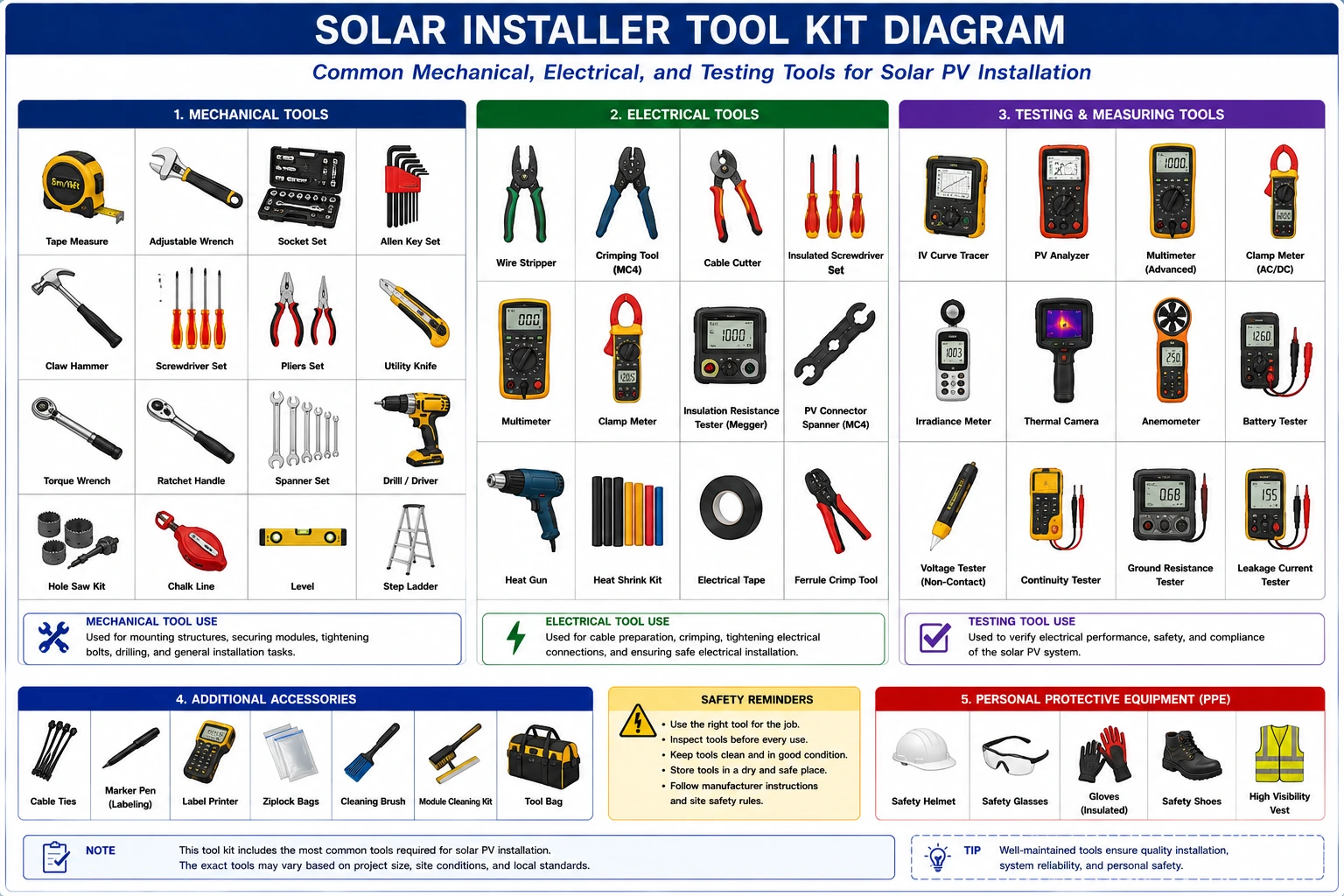
To demonstrate proficiency, installers must understand the correct use of various tools.
Mechanical Installation Tools
Torque Wrench
- Used to apply specified tightening torque.
Applications:
- Module clamps
- Structural bolts
- Equipment mounting
Spanner Set
- Used for tightening and loosening fasteners.
Socket Wrench Set
- Commonly used during structure assembly.
Spirit Level
- Verifies horizontal and vertical alignment.
Measuring Tape
- Used for layout verification and positioning.
Electrical Installation Tools
Wire Stripper
- Removes insulation from conductors without damaging wires.
Cable Cutter
- Provides clean conductor cuts.
Crimping Tool
Used for:
- Cable lugs
- Connectors
- MC4 terminations
Proper crimping is essential for electrical reliability.
Screwdriver Set
Used for equipment installation and terminations.
Testing and Commissioning Tools
Digital Multimeter
Measures:
- Voltage
- Current
- Resistance
- Continuity
Clamp Meter
Measures AC and DC current safely.
Insulation Resistance Tester
Used for insulation testing.
Earth Resistance Tester
Measures grounding system performance.
Solar PV Analyzer
Provides advanced system performance measurements.
Demonstrating Tool Proficiency
Installers should demonstrate competence in:
Correct Tool Selection
Choosing the appropriate tool for each task.
Using incorrect tools can:
- Damage equipment
- Reduce installation quality
- Increase safety risks
Safe Tool Handling
Workers should:
- Follow safety procedures
- Inspect tools before use
- Use insulated tools where required
Proper Tool Operation
Installers should understand:
- Tool functions
- Operating procedures
- Measurement techniques
Tool Maintenance
Verify that tools are:
- Clean
- Calibrated
- Functional
- Properly stored
Workmanship Verification During Mechanical Installation
Inspectors should verify:
Structural Alignment
Check:
- Plumbness
- Levelness
- Structural spacing
Torque Compliance
Verify torque values using calibrated torque wrenches.
Fastener Installation
Inspect:
- Bolt engagement
- Locking mechanisms
- Corrosion protection
Workmanship Verification During Electrical Installation
Inspect:
Cable Routing
Ensure cables are:
- Supported properly
- Protected from damage
- Neatly organized
Terminations
Verify:
- Correct conductor preparation
- Proper crimping
- Secure tightening
Labeling
Check identification labels for:
- Cables
- Equipment
- Safety warnings
Workmanship Verification During Commissioning
Review:
Testing Records
Verify completion of:
- Continuity testing
- Insulation resistance testing
- Grounding verification
- Performance measurements
System Documentation
- Ensure all reports are complete and accurate.
Methods for Assessing Installer Competency
Installer proficiency may be evaluated through:
Practical Demonstrations
- Workers perform assigned installation tasks.
Tool Handling Assessments
- Inspectors observe tool usage.
Safety Compliance Checks
- Verify adherence to site safety requirements.
Quality Inspections
- Evaluate completed installation work.
Conclusion
Verifying workmanship and demonstrating proficiency in using tools are fundamental requirements for delivering safe, efficient, and reliable solar PV installations. Quality workmanship ensures that modules, mounting structures, electrical systems, and monitoring equipment are installed according to design specifications, while tool proficiency enables installers to perform tasks accurately and safely.
Installer competency and adherence to quality standards play a vital role in successful solar electricity generation and renewable energy technology implementation. Furthermore, following guidelines and recommendations promoted by the Ministry of New and Renewable Energy helps maintain consistency, safety, and quality across solar projects.
By conducting regular workmanship inspections, ensuring proper tool usage, maintaining calibrated equipment, documenting quality activities, and investing in continuous training, solar installers, EPC contractors, and project managers can optimize solar panel system cost, improve renewable solar system reliability, reduce maintenance requirements, and support the long-term success of residential, commercial, industrial, and utility-scale solar PV installations.
FAQs
Q1. Why is workmanship verification important in solar PV projects?
Ans: Workmanship verification ensures that installation activities comply with engineering drawings, manufacturer instructions, safety requirements, and quality standards.
Q2. What tools should solar installers be proficient in using?
Ans: Installers should be skilled in using torque wrenches, multimeters, clamp meters, crimping tools, insulation testers, earth resistance testers, and various mechanical installation tools.
Q3. How can poor workmanship affect a solar PV system?
Ans: Poor workmanship can lead to electrical faults, equipment damage, reduced energy production, safety hazards, and increased maintenance costs.
Q4. Why is tool calibration important?
Ans: Calibrated tools provide accurate measurements and help ensure compliance with installation and testing requirements.
Q5. What are the signs of good workmanship in solar installations?
Ans: Proper alignment, secure mounting, neat cable management, correct labeling, effective grounding, accurate testing, and complete documentation are indicators of good workmanship.
Single Line Diagram (SLD) in Solar PV Systems: Complete Guide to Design, Symbols & Reading
Learn how to fetch a Bill of Material (BOM) for a solar PV system directly from design documents like SLD, layout, and GA drawings. This step-by-step guide helps installers and EPCs ensure accurate material estimation and efficient project execution.
How to Improve Energy Efficiency and Save Electricity Costs
Learn how energy conservation and efficiency can help you save electricity, cut costs, and make your home or business more sustainable
Sequential Troubleshooting for Grid Power Interruptions in Solar PV Systems
A complete guide to sequential troubleshooting in solar PV systems, helping identify and resolve faults during grid power supply interruptions through systematic testing and diagnosis.
Solar System Grounding Conductor Size Guide
A complete guide to determining grounding conductor size for solar PV systems, ensuring safe, compliant, and reliable installations.

Solar Microgrid Solutions: Smart, Reliable & Scalable Power Systems
Solar microgrid solutions provide smart, reliable, and scalable power by integrating solar energy, battery storage, and intelligent control systems. These systems ensure uninterrupted electricity for industries, campuses, communities, and remote locations while reducing grid dependency and energy costs.
How to Clean and Maintain Solar Power System for Maximum Efficiency
Regular cleaning of your solar power system is essential to maintain maximum efficiency and energy output. Dust, bird droppings, and pollution can reduce performance by up to 20%. This blog explains the right cleaning methods, schedules, and safety tips for residential, industrial, and commercial solar systems.
Solar Cable Guide | Types, Sizing & Specifications for PV Systems
Solar cables play a critical role in ensuring efficient and safe power transmission in PV systems. This guide explains cable types, specifications, sizing methods, and best practices for selecting the right solar cables.

India and Japan Strengthen Renewable Energy Cooperation
India and Japan have initiated a partnership under the Asia Energy Transition Initiative (AETI) to support India’s clean energy transition. India has set an ambitious target of achieving net-zero by 2070, while Japan aims to achieve the same by 2050.