
Proper labeling is a fundamental requirement in every solar photovoltaic (PV) installation. Whether it is a residential rooftop system, commercial solar plant, industrial solar project, or utility-scale renewable energy facility, accurate labeling ensures that all equipment, circuits, cables, disconnects, batteries, inverters, and safety devices can be easily identified throughout the system’s operational life.
Solar PV systems contain multiple interconnected electrical components operating at potentially hazardous voltages. During installation, commissioning, inspection, maintenance, troubleshooting, emergency response, and future system upgrades, clear and accurate labels help technicians and operators work safely and efficiently. Incorrect, missing, damaged, or illegible labels can lead to wiring errors, maintenance delays, equipment damage, safety incidents, and regulatory non-compliance.
As solar projects become larger and more complex, proper identification of equipment and electrical circuits becomes increasingly important. Verifying labeling is therefore a critical activity during commissioning, quality inspections, preventive maintenance programs, and system audits.
Proper labeling and identification of solar PV components contribute significantly to safe solar electricity generation and effective renewable energy technology management.
This comprehensive guide explains the importance of solar PV labeling, types of labels used in solar installations, verification procedures, inspection requirements, documentation methods, safety considerations, and industry best practices.
Why Solar PV System Labeling is Important
Solar PV systems may operate for more than 25 years and involve numerous electrical and mechanical components.
Proper labeling helps:
- Improve safety
- Facilitate maintenance
- Simplify troubleshooting
- Support emergency response
- Ensure regulatory compliance
- Reduce operational errors
Accurate labeling remains essential throughout the life of the system.
Objectives of Label Verification
The primary objectives include:
Safety Assurance
- Ensuring personnel can identify hazards and electrical equipment correctly.
Equipment Identification
- Making components easy to locate and recognize.
Maintenance Support
- Reducing the time required for inspections and repairs.
Regulatory Compliance
- Meeting applicable standards and project requirements.
System Documentation Validation
- Confirming consistency between installed equipment and project drawings.
Components That Require Labeling in Solar PV Systems
Many components require proper identification.
1. Solar PV Modules
Module labels typically include:
- Manufacturer details
- Model number
- Electrical ratings
- Certification information
2. PV Strings
String labels help identify:
- String numbers
- Circuit designations
- Array locations
3. DC Cables and Conduits
Labels indicate:
- Circuit function
- Voltage information
- Source and destination
4. DC Combiner Boxes
Combiner boxes should display:
- Equipment identification
- Voltage ratings
- Safety warnings
5. Solar Inverters
Inverter labels commonly include:
- Equipment designation
- Input and output ratings
- Manufacturer information
6. AC Distribution Equipment
Labeling should identify:
- Circuit functions
- Breaker designations
- Load connections
7. Disconnect Switches
Disconnect labels should clearly indicate:
- Equipment purpose
- Operating instructions
- Safety warnings
8. Battery Banks
Battery labels should include:
- Voltage ratings
- Battery type
- Safety information
9. Grounding Systems
- Grounding conductors and equipment should be clearly identified.
10. Emergency Shutdown Devices
- Emergency shutdown controls require highly visible identification.
Types of Labels Used in Solar PV Systems
Several label categories are commonly used.
Equipment Labels
- Used for identifying specific equipment.
Examples include:
- Inverter labels
- Combiner box labels
- Battery enclosure labels
Warning Labels
- Used to indicate potential hazards.
Examples:
- Electrical shock hazards
- High voltage warnings
- Arc flash warnings
Circuit Identification Labels
- Used to identify electrical circuits and connections.
Operational Labels
- Provide operating instructions for equipment.
Safety Labels
- Communicate emergency procedures and precautions.
Information Typically Included on Solar Labels
Labels may contain:
- Equipment names
- Circuit numbers
- Voltage ratings
- Current ratings
- Hazard warnings
- Manufacturer information
- Emergency shutdown instructions
The exact requirements depend on system design and applicable standards.
Characteristics of Effective Solar PV Labels
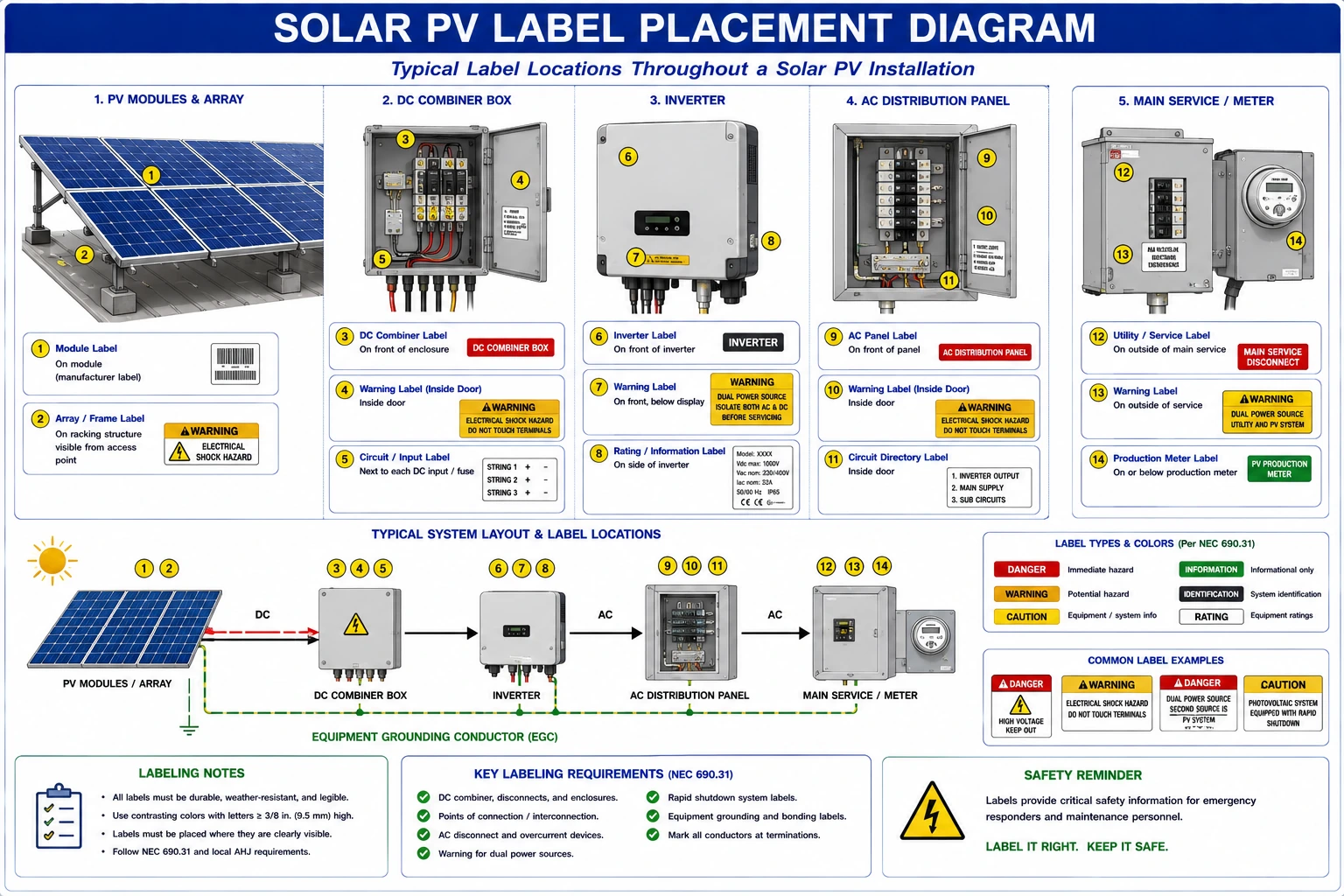
Labels should possess several important qualities.
Durable Construction
Labels must withstand:
- Sunlight exposure
- Rain
- Dust
- Temperature variations
Legibility
- Information should remain readable throughout the equipment’s lifespan.
Secure Attachment
- Labels should remain firmly attached to equipment.
Weather Resistance
- Outdoor labels should resist fading and deterioration.
Standardized Format
- Consistent labeling improves system understanding and maintenance.
Step-by-Step Procedure for Verifying Solar PV System Labeling
Step 1 – Review Project Documentation
Before field inspection:
Review:
- Electrical drawings
- Single-line diagrams
- Equipment schedules
- Labeling specifications
These documents provide the basis for verification.
Step 2 – Inspect Equipment Identification Labels
Verify that each component is properly identified.
Check:
- Equipment names
- Asset numbers
- Circuit references
Labels should match project documentation.
Step 3 – Verify Warning Labels
Inspect all required safety labels.
Examples include:
- High voltage warnings
- Shock hazard labels
- Emergency shutdown notices
Ensure labels are visible and legible.
Step 4 – Verify Cable and Conduit Labels
Check cable identification markings.
Verify:
- Circuit designations
- Source identification
- Destination identification
Labels should be consistent throughout the installation.
Step 5 – Inspect Disconnect Labels
Confirm that disconnected devices are clearly marked.
Verify:
- Equipment served
- Operating instructions
- Safety warnings
Step 6 – Verify Battery System Labels
Inspect battery-related labels.
Confirm:
- Voltage ratings
- Battery chemistry identification
- Safety precautions
Step 7 – Verify Inverter Labels
Check inverter identification and rating labels.
Verify:
- Equipment designation
- Manufacturer information
- Electrical ratings
Step 8 – Compare Labels with Drawings
Ensure consistency between:
- Installed labels
- Project drawings
- Single-line diagrams
Any discrepancies should be documented.
Step 9 – Verify Label Condition
Inspect labels for:
- Fading
- Peeling
- Physical damage
- Missing information
Damaged labels should be replaced.
Step 10 – Document Inspection Findings
Record:
- Verified labels
- Missing labels
- Damaged labels
- Corrective actions required
Proper documentation supports maintenance and compliance activities.
Benefits of Proper Solar PV Labeling
Improved Safety
- Personnel can quickly identify hazards and equipment.
Faster Maintenance
- Clear identification reduces troubleshooting time.
Better Documentation
- Supports asset management and record keeping.
Reduced Operational Errors
- Minimizes incorrect switching and maintenance activities.
Regulatory Compliance
- Supports inspection and certification requirements.
Conclusion
Verifying the labeling of a solar PV system is an essential quality assurance, safety, and compliance activity that ensures every component within the installation can be accurately identified throughout its operational life. Proper labeling improves maintenance efficiency, supports troubleshooting, enhances personnel safety, facilitates emergency response, and contributes to the reliable operation of renewable solar systems.
Clear equipment identification and safety labeling are important elements of effective solar electricity generation and renewable energy technology management. Additionally, following labeling practices and quality standards promoted by the Ministry of New and Renewable Energy helps ensure safe, compliant, and professional solar PV installations.
By implementing systematic label verification procedures, maintaining accurate documentation, replacing damaged labels promptly, following standardized naming conventions, and conducting routine inspections, solar installers, EPC contractors, inspectors, operators, and maintenance teams can optimize solar panel system cost, improve renewable solar system reliability, reduce operational risks, and ensure the long-term success of residential, commercial, industrial, and utility-scale solar energy projects.
FAQs
Q1. Why is labeling important in solar PV systems?
Ans: Labeling helps identify equipment, improve safety, simplify maintenance, support troubleshooting, and ensure compliance with project requirements and regulations.
Q2. Which components in a solar PV system require labeling?
Ans: Commonly labeled components include PV modules, strings, cables, conduits, combiner boxes, inverters, disconnect switches, batteries, grounding systems, and emergency shutdown devices.
Q3. What should be checked during label verification?
Ans: Inspectors should verify label accuracy, visibility, durability, placement, consistency, and compliance with project documentation.
Q4. How often should solar PV labels be inspected?
Ans: Labels should be verified during commissioning and routinely inspected during preventive maintenance activities.
Q5. What should be done if a label is missing or damaged?
Ans: The issue should be documented, and the label should be replaced promptly using approved materials and specifications.

Solar ROI vs Payback Period Explained for Commercial & Industrial Projects
Compare payback period and ROI for solar systems. Discover how businesses should evaluate solar investments effectively.

Basics of Electricity and Electric Terms and Laws Required for Renewable Energy – Complete Guide
Understanding the basics of electricity is essential for anyone working in renewable energy and solar power systems. From voltage and current to Ohm’s Law and power calculations, strong electrical fundamentals ensure safe and efficient solar installations. This complete guide explains key electrical terms, units, formulas, and laws required for renewable energy professionals, students, and solar PV installers.
China’s Solar Industry Poised for Continued Growth in 2023 and Beyond
China’s solar industry is set for continued growth in 2023 and beyond, driving global renewable energy expansion and technological advancements.
Why Solar Energy Makes Sense for the Healthcare Industry
Explore how the healthcare industry can leverage solar energy to reduce electricity bills, enhance reliability, and support green initiatives.
Solar Industry Faces Growing Losses from Underperforming Equipment
According to the Raptor Maps’ Global Solar Report, the amount of power loss due to equipment anomalies has nearly doubled from 1.61% in 2019 to 3.13% in 2022. This trend is expected to continue, with anomaly-driven power loss potentially growing to almost 6% by 2025.

Solar Installation Cost in Haryana: Pricing, Savings & Subsidy Guide
Solar installation cost in Haryana varies by system size, components, and subsidy eligibility. This guide explains per-kW pricing, government incentives, and how much owners can save with rooftop solar in 2025, helping you choose the right system at the right budget.

CAPEX or OPEX? How to Choose the Best Solar Ownership Model
Choosing between the CAPEX and OPEX models can greatly impact your solar savings and ownership benefits. This guide explains both models to help you make the right decision.
Should You Switch to Solar in India? Complete Guide
India has become a hot-selling solar market and people are interested in installing solar systems in their homes as well as in industries and factories.