
In solar photovoltaic (PV) systems, proper identification of electrical cables and conduits is essential for ensuring safety, maintenance efficiency, and regulatory compliance. As solar installations become larger and more complex, organized labeling systems help installers, operators, and maintenance teams quickly identify circuits, cable routes, voltage levels, and system components.
Improper or missing labels can lead to wiring confusion, maintenance delays, safety hazards, incorrect troubleshooting, and increased solar installation charges. Therefore, proper labeling of conduits and cables is a critical part of every renewable solar project.
Cable management and identification practices are essential for safe solar electricity generation and long-term operational reliability.
This blog provides a complete guide to proper labeling of conduits and cables in solar PV systems, including standards, labeling methods, safety practices, and best practices for installers and EPC professionals.
Importance of Proper Labeling in Solar PV Systems
Proper labeling helps:
- Improve electrical safety
- Simplify troubleshooting
- Reduce maintenance time
- Prevent wiring errors
- Support emergency response
- Ensure regulatory compliance
- Optimize solar panel system cost
Improper labeling can increase:
- Downtime
- Repair costs
- Solar installation cost per kWh
Why Cable and Conduit Identification Matters
In solar PV systems, multiple types of cables and conduits are installed for:
- DC solar circuits
- AC power distribution
- Earthing systems
- Communication wiring
- Battery interconnections
Without proper identification, maintenance teams may accidentally disconnect the wrong circuit or misidentify voltage sources.
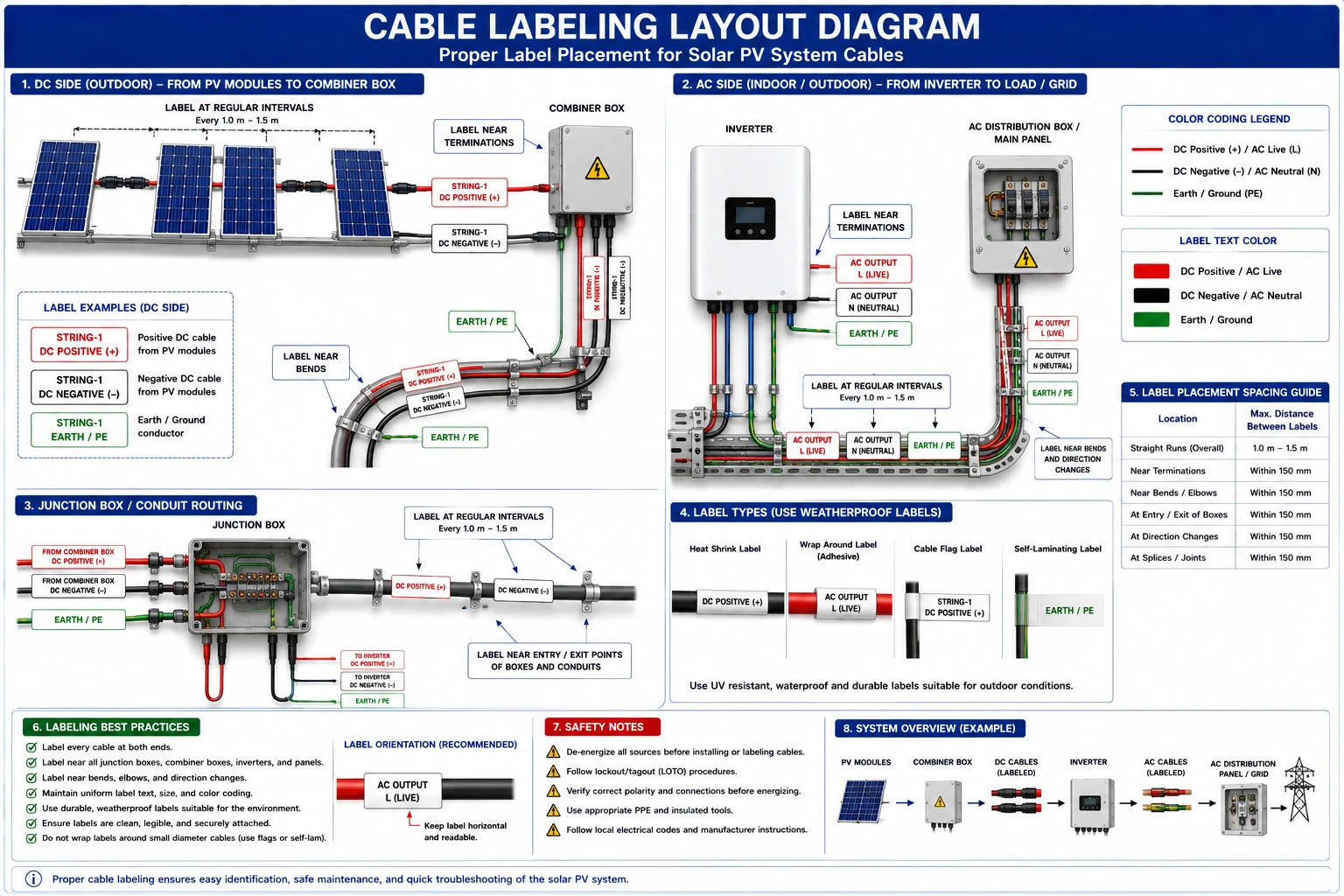
Components That Require Labeling
1. DC Solar Cables
Used between:
- Solar modules
- Combiner boxes
- Inverters
2. AC Power Cables
Used for inverter output and utility connections.
3. Earthing/Grounding Conductors
Used for equipment safety and lightning protection.
4. Cable Conduits
Protect and route electrical cables.
5. Junction Boxes and Combiner Boxes
Require identification labels for incoming and outgoing circuits.
6. Battery Cables
Used in hybrid and off-grid solar systems.
Objectives of Cable and Conduit Labeling
1. Safety Identification
Warns personnel about live circuits and voltage levels.
2. Easy Maintenance
Helps technicians quickly identify cable routes and functions.
3. Faster Troubleshooting
Reduces downtime during fault diagnosis.
4. Regulatory Compliance
Supports inspection and certification requirements.
5. Improved System Organization
Maintains neat and professional installations.
Information Included in Cable Labels
Cable labels should include:
- Cable identification number
- Circuit name
- Source and destination points
- Voltage level
- AC/DC indication
Example:
- DC String 1 – Combiner Box A to Inverter 1
Information Included in Conduit Labels
Conduit labels typically include:
- Circuit type
- Cable category
- Voltage information
- Direction indicators
Types of Labels Used in Solar PV Systems
1. Printed Labels
Generated using industrial label printers.
Advantages:
- Durable
- Professional appearance
- Easy readability
2. Heat Shrink Labels
Installed around cable insulation.
Benefits:
- Long-lasting
- Weather resistant
3. Engraved Labels
Used for panels and combiner boxes.
4. Self-Adhesive Vinyl Labels
Commonly used for indoor labeling.
5. Warning and Safety Labels
Used to indicate:
- High voltage
- Electrical hazards
- Emergency shutdown points
Standards for Cable and Conduit Labeling
Proper labeling should comply with:
- Electrical safety regulations
- Utility interconnection standards
- Local installation codes
Installers should follow recommendations from the Ministry of New and Renewable Energy.
Best Practices for Proper Labeling
1. Use Durable Labels
Labels should resist:
- UV exposure
- Heat
- Moisture
- Dust
2. Maintain Consistent Naming Convention
Use uniform labeling format throughout the project.
3. Label Both Ends of Cables
Improves troubleshooting and maintenance.
4. Separate AC and DC Identification
Clearly differentiate AC and DC circuits.
5. Use Readable Font Size
Labels should remain visible from a safe distance.
6. Include Warning Labels
Important for electrical safety compliance.
Step-by-Step Procedure for Cable and Conduit Labeling
Step 1 – Review Electrical Drawings
Study:
- Single Line Diagram (SLD)
- Cable routing layout
- Equipment schedules
Step 2 – Identify Cable Routes and Circuits
Determine:
- Source points
- Destination points
- Cable functions
Step 3 – Prepare Labeling Format
Define naming convention for:
- DC strings
- AC feeders
- Grounding cables
Step 4 – Print or Prepare Labels
Use durable labeling materials suitable for the installation environment.
Step 5 – Install Labels on Cables
Place labels:
- Near cable terminations
- At intermediate points if requires
Step 6 – Label Conduits and Junction Boxes
Clearly identify conduit contents and direction.
Step 7 – Verify Label Accuracy
Cross-check labels with drawings and system layout.
Step 8 – Document Labeling Information
Maintain updated cable schedules and labeling records.
Labeling Color Coding Practices
DC Solar Cables
Function | Common Color |
Positive (+) | Red |
Negative (-) | Black |
AC Power Cables
Function | Common Color |
Phase R | Red |
Phase Y | Yellow |
Phase B | Blue |
Neutral | Black or Light Blue |
Earth | Green |
Conclusion
Proper labeling of conduits and cables is a critical part of safe and organized solar PV system installation. By following standard labeling practices, maintaining consistent identification methods, and using durable labeling materials, installers can significantly improve operational safety and maintenance efficiency.
Proper electrical identification is fundamental to renewable solar systems and solar energy for home use. Additionally, compliance with standards recommended by the Ministry of New and Renewable Energy ensures safe and standardized solar installation practices.
With proper labeling systems, solar professionals can optimize solar panel system cost, improve solar electricity generation reliability, and support efficient renewable energy technology deployment across residential, commercial, and industrial projects.
FAQs
Q1. Why is cable labeling important in solar PV systems?
Ans: It improves safety, maintenance, and troubleshooting efficiency.
Q2. What information should cable labels include?
Ans: Cable ID, circuit name, voltage level, and source/destination points.
Q3. Why should both ends of a cable be labeled?
Ans: To simplify maintenance and fault identification.
Q4. Does proper labeling affect solar panel system cost?
Ans: Yes, it reduces maintenance time and troubleshooting expenses.
Q5. What type of labels are suitable for outdoor solar installations?
Ans: UV-resistant and weatherproof labels are recommended.
Solar Installation Corrosion Protection & Weatherproofing Guide
A complete guide to solar corrosion protection and weatherproofing, covering methods to prevent seepage and structural damage in solar installations.
Industrial Solar Plants with Diesel Generator Backup: What You Need to Know
Discover how industries can efficiently run rooftop solar plants alongside diesel generators (DG). Learn the benefits, setup tips, and hybrid system strategies to ensure uninterrupted power and maximize energy savings.

UP Government Incentive: Stamp Duty Exemption for Solar Land
Uttar Pradesh offers stamp duty exemption on land for solar projects, encouraging investment and growth in renewable energy.

Breakthrough in Solar Technology: 33.2% Efficient Perovskite-Silicon Cell
Scientists achieve a breakthrough in solar technology with a perovskite-silicon tandem cell reaching a record 33.2% efficiency for higher energy output.
Charge Controller Troubleshooting Guide for Solar PV Systems
A complete guide to troubleshooting charge controllers in solar PV systems, including fault diagnosis, electrical testing, error identification, and corrective maintenance for reliable system performance.

1 MW Solar Plant for Industry: Cost, Generation & Payback
A detailed guide on 1 MW solar plant for industry covering installation cost, area requirement, power generation, ROI, and long-term savings in India.
Are Colleges and Schools ready to take up Solar challenge?
Adopting solar energy can help schools and colleges reduce electricity costs and promote sustainability. This guide explores how educational institutions can implement rooftop solar projects, the benefits, and what steps are needed to take on the solar challenge effectively.

How to Fetch the BOM of a Solar PV System from Design Documents: Step-by-Step Guide for Installers & EPCs
Learn how to prepare a detailed Bill of Material (BOM) for solar PV systems using design documents like SLDs and layouts. This step-by-step guide helps installers ensure accurate material planning, reduce errors, and improve project execution.