
When people install a solar system, they usually focus on panel wattage, price, or available space. But there is one technical factor that silently decides how well a solar plant actually performs in the real world, Solar Performance Ratio (PR).
Whether you are planning a small solar panel in rooftop system or a large commercial plant, understanding PR helps you judge the true quality of your installation. It directly affects solar electricity generation, total cost of solar installation, solar energy installation cost recovery, and long-term returns.
What Is Solar Performance Ratio (PR)?
Solar Performance Ratio is a measurement that shows how efficiently a solar power plant converts available sunlight into usable electrical energy.
It compares:
Actual energy produced by the system vs Theoretical energy possible from available sunlight
- PR is expressed as a percentage.
- Example: If a plant has a PR of 80%, it means 80% of available solar energy is being successfully converted into electricity.
- PR is independent of location, making it a fair way to compare system quality across cities, rooftops, and plant sizes.
Why Solar Performance Ratio Is So Important
Many people believe higher panel wattage guarantees better results. In reality, a system with poor design can produce less energy even with expensive panels.
Performance Ratio impacts:
- Actual solar electricity output
- Monthly savings
- System reliability
- Cost of solar per kWh installed
- Payback period
- Long-term profitability
A well-designed system improves generation without increasing solar installation charges.
What Does a Good Performance Ratio Look Like?
In Indian conditions:
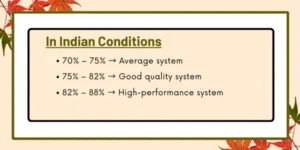
Anything above 80% reflects strong engineering, quality materials, and professional installation.
This is especially critical when calculating average cost of solar panels on a house, solar plant viability, and making solar energy economical.
What Losses Does Performance Ratio Include?
Performance Ratio accounts for all real-world system losses such as:
- Temperature losses
- Dust and pollution
- Shading losses
- Cable losses
- Inverter conversion losses
- Module mismatch
- Degradation over time
These losses explain why actual solar electricity is always lower than lab-rated panel output.
Proper system design directly improves PR without increasing solar panel system cost.
Factors That Improve or Reduce Performance Ratio
1. Quality of Solar Modules
- Panels with stable output, better temperature coefficients, and low degradation deliver higher PR and stronger long-term returns.
- This protects investments made toward solar module price per watt and reduces lifetime cost.
2. Installation Engineering
PR is strongly influenced by:
- Panel tilt and orientation
- Shadow-free layout
- Cable sizing
- Mounting quality
Good engineering improves output without increasing solar roof installation cost.
3. Inverter and Electrical Design
- Efficient inverters, proper DC-AC ratio, and low cable losses improve PR and system stability.
- This directly impacts solar electricity production and total cost of solar installation recovery.
4. Operation & Maintenance
- Regular cleaning, thermal checks, monitoring, and earthing maintenance preserve high PR throughout the plant life.
- Neglecting O&M reduces PR and increases the effective solar installation cost per kWh.
How Performance Ratio Affects Solar Generation
PR is used in generation calculation:

A system with better PR produces more electricity from the same sunlight and same rooftop area.
This means:
- More savings
- Faster ROI
- Higher asset value
- Lower home roof solar panels cost per unit generated
Why PR Matters Financially
High PR leads to:
- Faster break-even
- Higher lifetime generation
- Lower degradation
- Better system warranty compliance
- Stronger bankability
It plays a key role when estimating:
- Solar energy for home use viability
- Industrial feasibility
- Government approval documents
- Project financing reports
How Engineers Calculate Performance Ratio
PR is calculated as:
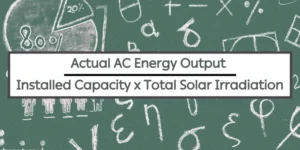
Advanced monitoring software tracks PR daily, monthly, and yearly.
PR is one of the main indicators used in:
- Asset performance audits
- Insurance assessments
- EPC performance guarantees
- Solar plant benchmarking
How Performance Ratio Supports Sustainable Solar Growth
A high PR ensures:
- Reduced carbon footprint
- Better use of natural sunlight
- Improved renewable system reliability
- Stronger investor confidence
This supports India’s shift toward renewable energy and solar energy, renewable solar infrastructure, and advanced renewable energy technology.
Conclusion
Solar Performance Ratio reveals the true quality of a solar power system. It shows how well your system converts sunlight into usable electricity and determines the real return on your investment.
At Smart Roof Solar, we design plants with a strong focus on engineering quality, monitoring, and long-term performance so every project delivers high PR, stable output, and reliable solar savings.
FAQs
Q1. Is Performance Ratio the same as system efficiency?
Ans: No, PR measures real-world system performance, while efficiency refers only to component-level conversion.
Q2. Can PR be improved after solar installation?
Ans: Yes, PR can increase through better maintenance, cleaning schedules, inverter tuning, and shading correction.
Q3. Is a high PR more important than installing larger capacity panels?
Ans: In many cases yes, because a high-PR system generates more usable energy from the same capacity.
Q4. Can PR be used to compare two solar plants of different sizes?
Ans: Yes, PR allows fair comparison regardless of plant capacity or geographic location.
Q5. Is PR included in solar EPC performance guarantees?
Ans: Most professional EPCs include minimum PR commitments in contracts to assure quality delivery.
Rooftop Solar: Reduce Your Electricity Bill and Increase Savings
Discover how installing a rooftop solar system can help you save on electricity bills, reduce peak demand charges, and take advantage of government incentives.

Understanding Solar Cells and Modules: A Complete Guide
Understand solar cells and modules, their functioning, and advantages for residential and commercial solar installations.

Solar Microgrid Solutions: Smart, Reliable & Scalable Power Systems
Solar microgrid solutions provide smart, reliable, and scalable power by integrating solar energy, battery storage, and intelligent control systems. These systems ensure uninterrupted electricity for industries, campuses, communities, and remote locations while reducing grid dependency and energy costs.

Role of PV Solar Installer in India – Responsibilities, Skills, and Industry Importance
PV solar installers play a critical role in India’s rapidly expanding solar energy sector. From rooftop systems to large-scale industrial projects, skilled installers ensure safe, efficient, and compliant solar plant deployment. This guide explains the responsibilities, technical skills, certifications, and career opportunities for PV solar installers in India, along with their growing importance in supporting the nation’s renewable energy transition.

Get a Customized Industrial Solar Quote for Your Manufacturing Unit
Request a customized industrial solar quote in India. Know pricing, savings, payback & EPC scope for your factory solar project.

Battery Inspection in Solar PV Systems Guide
A complete guide to battery inspection in solar PV systems, helping identify performance issues, safety concerns, and maintenance requirements.

Solar Farm Development: Overcoming the Rising Challenge of Wiring Costs
Wiring costs are soaring in solar farms, affecting project budgets and timelines. Learn why infrastructure is becoming a key challenge.

Installation of Solar Cables for Modules and Inverters
A step-by-step guide to solar cable installation for modules, inverters, and other system components to ensure safe and reliable operation.