When people plan a solar system, one of the first things they hear is “high-efficiency panels.” But what does solar panel efficiency actually mean, and how does it impact solar electricity, solar panel system cost, solar energy installation cost, and long-term savings?
Solar panel efficiency decides how much sunlight your panels can convert into usable electricity. It plays a major role in how much area you need, how much power you generate, and how quickly you recover the total cost of solar installation.
What Is Solar Panel Efficiency?
Solar panel efficiency refers to the percentage of sunlight that a solar panel can convert into electrical energy.
For example, if a panel has 20% efficiency, it converts 20% of the sunlight falling on it into usable power.
Higher efficiency means:
- More power from the same rooftop
- Better use of available sunlight
- Higher solar electricity generation
- Optimised solar panel area per kW
This is especially important for rooftops with limited space.
Why Solar Panel Efficiency Matters
Efficiency is not just a technical number, it affects real-world performance and finances.
Higher efficiency helps:
- Generate more power in less space
- Reduce the number of panels needed
- Lower structural and wiring complexity
- Improve return on investment
- Reduce solar roof installation cost per unit generated
This also influences long-term economics like cost of solar per kWh installed, home roof solar panels cost, and average cost of solar panels on a house.
How Solar Panel Efficiency Is Calculated
Efficiency is calculated by dividing the electrical output of a panel by the total sunlight energy falling on it.
It depends on:
- Cell technology
- Manufacturing quality
- Temperature performance
- Light absorption capability
- Internal electrical losses
Modern commercial panels typically range between 18% and 23% efficiency, while advanced modules can exceed this under lab conditions.
Factors That Affect Solar Panel Efficiency
1. Type of Solar Cells Used
Monocrystalline panels usually offer higher efficiency than polycrystalline and thin-film panels.
Higher-efficiency modules often carry a higher solar module price per watt, but they deliver more power from the same roof area.
2. Temperature Performance
High temperatures reduce voltage output. Panels with better temperature coefficients maintain stronger performance in hot climates, helping stabilise solar electricity production.
3. Installation Quality
Panel tilt, orientation, shading control, and airflow all impact how efficiently a panel operates in real conditions.
Good design improves generation without increasing solar installation charges.
4. Soiling and Maintenance
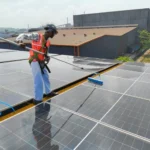
Dust, bird droppings, and pollution block sunlight. Regular cleaning maintains panel efficiency and protects your solar panel system cost investment.
Efficiency vs System Performance: Understanding the Difference
High panel efficiency does not automatically guarantee high energy production.
System output also depends on:
- Inverter efficiency
- Cable losses
- Shadow management
- System layout
- Maintenance practices
This is why efficiency must be combined with strong engineering to truly optimise solar energy installation cost and generation.
How Efficiency Impacts Solar Installation Costs
Efficient panels can reduce:
- Roof space requirements
- Support structure size
- DC cabling length
- Installation complexity
This can optimise:
- Solar installation cost per kWh
- Total cost of solar installation
- Home roof solar panels cost
- Cost of solar panels over plant life
While high-efficiency panels may cost more upfront, they often reduce overall system expenses and improve long-term output.
Solar Efficiency and Sustainability
Higher efficiency supports:
- Faster energy recovery
- Lower land and material use
- Reduced carbon footprint
- Improved project bankability
This strengthens the role of renewable energy and solar energy, renewable solar adoption, and renewable energy technology development.
How to Choose the Right Efficiency Level
The best efficiency choice depends on:
- Available roof or land area
- Power requirement
- Budget
- Local climate
- Expansion plans
In high-space-constraint locations, efficiency becomes more valuable than raw panel price.
Conclusion
Solar panel efficiency defines how effectively your system turns sunlight into electricity. It impacts roof usage, long-term output, financial returns, and system sustainability.
At Smart Roof Solar, we design solar plants that balance high-efficiency modules with smart engineering so every installation delivers reliable performance, optimised cost, and long-term solar value.
FAQs
Q1. Does higher solar panel efficiency mean better performance on cloudy days?
Ans: Not necessarily, low-light performance depends more on cell design and inverter quality than efficiency alone.
Q2. Are high-efficiency solar panels more durable?
Ans: Efficiency does not equal durability; lifespan depends on build quality, glass strength, and environmental resistance.
Q3. Can solar panel efficiency degrade over time?
Ans: Yes, panels slowly lose efficiency each year, typically around 0.3%–0.6% annually.
Q4. Is solar panel efficiency the same as wattage rating?
Ans: No, efficiency measures conversion rate, while wattage reflects total power output based on panel size.
Q5. How does solar panel efficiency affect battery storage sizing?
Ans: Higher efficiency can generate more energy per day, allowing better battery utilisation without increasing storage size.