
In every solar plant, whether it is a small solar panel in rooftop installation or a large utility-scale renewable solar project, the way PV modules are interconnected plays a critical role in system performance. One of the most common configurations used in solar energy systems is the series connection of PV modules.
Understanding how voltage and current behave in a series connection is essential for optimizing solar panel system cost, ensuring inverter compatibility, and reducing cost of solar per kWh installed. String design and electrical configuration are core competencies for solar installers.
This blog explains the effect of series connection on voltage and current, along with its practical implications in solar energy installation cost and system performance.
What is Series Connection in PV Modules?
In a series connection, the positive terminal of one solar module is connected to the negative terminal of the next module.
This creates a string of modules where:
- Voltage adds up
- Current remains the same
Series strings are commonly used in:
- On-grid solar plant installations
- Hybrid systems
- Large commercial renewable energy technology setups
Effect of Series Connection on Voltage
Voltage Addition Principle
If each module has:
Vmpp = 40V; Voc = 48V
And 10 modules are connected in series:
Total Vmpp = 40V × 10 = 400V
Total Voc = 48V × 10 = 480V
Importance for Solar Installers
Higher voltage strings:
- Reduce current losses
- Allow a smaller cable size
- Improve solar electricity transmission efficiency
- Lower total cost of solar installation in the long term
However, installers must ensure:
- Total Voc does not exceed the inverter’s maximum input voltage
- Winter Voc rise is considered
Improper voltage design can increase solar installation charges due to system failure or redesign.
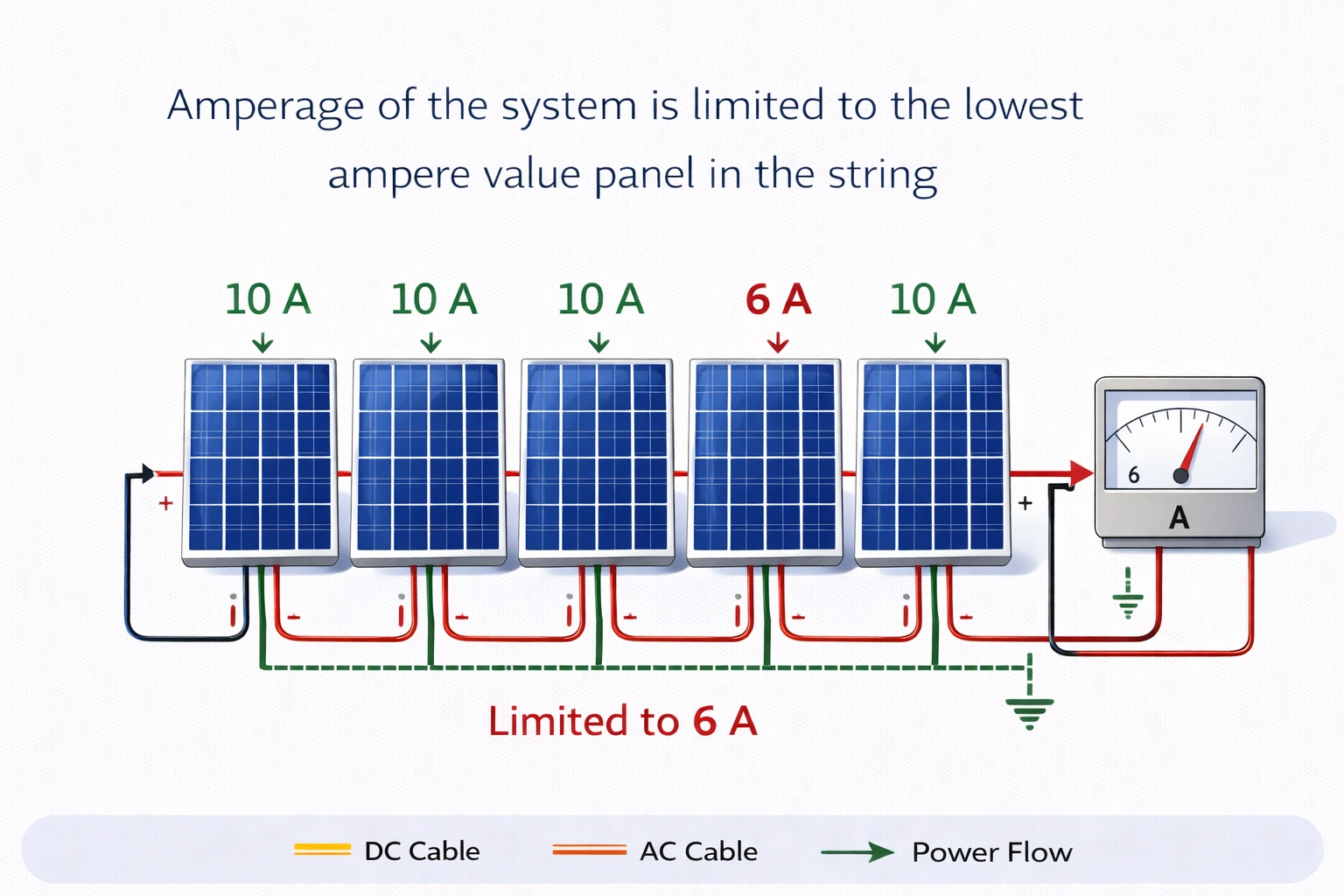
Effect of Series Connection on Current
Current Behavior
In a series string:
- Current remains constant
- It equals the current of one module
If one module produces:
Impp = 13A
Then the entire string current remains: 13A
Important Consideration
If one module is shaded or faulty:
- The entire string current drops
- Solar electricity output decreases
This can increase:
- Cost of solar per kWh installed
- Average cost of solar panels on a house (per usable output)
Practical Example for Rooftop Solar
Suppose:
5 kW solar panel system, each module = 550W
Vmpp = 41V; Impp = 13A
To achieve proper inverter input voltage, the installer may connect 9 modules in series:
- 9 × 41V = 369V
- Current remains 13A
This configuration ensures:
- Compatibility with the inverter MPPT range
- Efficient renewable solar generation
- Optimized solar energy installation cost
Advantages of Series Connection
- Higher DC voltage reduces cable losses
- Suitable for grid-connected systems
- Efficient long-distance DC transmission
- Lower conductor size requirement
- Better system performance in large solar plant setups
This improves smart solar panel price competitiveness and reduces long-term solar installation cost per kWh.
Disadvantages of Series Connection
- Shading on one module affects the entire string
- Mismatch losses if modules differ
- Voltage must stay within inverter limits
Installers must conduct proper:
- Shade analysis
- String sizing calculation
- Voltage verification
Impact on Solar Panel System Cost
Correct series string design:
- Reduces DC cable cost
- Improves inverter efficiency
- Optimizes solar panel system cost
- Enhances solar energy for home use performance
Incorrect design increases:
- Solar installation charges
- Maintenance cost
- Cost of solar per kWh installed
Safety Considerations
High voltage strings require:
- Proper insulation
- DC isolators
- Correct MC4 connectors
- Safe handling during installation
DC voltage in large solar plant systems can exceed 600–1000V, which is hazardous. Safety compliance is critical under renewable energy technology standards and government solar subsidy scheme guidelines.
Comparison: Series vs Parallel (Brief Overview)
Parameter | Series Connection | Parallel Connection |
Voltage | Increases | Same |
Current | Same | Increases |
Best For | Grid Systems | Low-voltage systems |
Conclusion
The series connection of PV modules is a fundamental concept in solar plant design. By increasing voltage while maintaining constant current, series strings enable efficient DC transmission, proper inverter matching, and optimized solar electricity generation.
Mastering string design is essential for professional solar installers. Correct series configuration directly influences solar panel system cost, solar installation charges, and the long-term cost of solar per kWh installed.
A well-designed series connection enhances renewable solar performance, strengthens smart solar panel price positioning, and ensures reliable solar energy for home use, ultimately contributing to the broader growth of renewable energy technology adoption.
FAQs
Q1. Why are solar panels connected in series in rooftop systems?
Ans: Series connection increases voltage to match the inverter input requirements, improving solar electricity efficiency.
Q2. Does a series connection increase solar panel system cost?
Ans: Not directly. It often reduces cable cost and improves efficiency, lowering the long-term cost of solar per kWh installed.
Q3. What happens if one panel in a series fails?
Ans: The entire string current reduces, affecting solar energy output.
Q4. How does a series connection impact solar energy for home use?
Ans: It ensures proper inverter operation and optimized energy generation in grid-connected systems.
Q5. Is a series connection mandatory under the government solar subsidy scheme?
Ans: Most grid-connected subsidised solar panels for home systems use series strings to achieve the required voltage levels.

Solar ROI vs Payback Period Explained for Commercial & Industrial Projects
Compare payback period and ROI for solar systems. Discover how businesses should evaluate solar investments effectively.
How Azimuth Angle Impacts Solar Panel Efficiency for Homes, Industries, and Commercial Buildings
Discover how solar panel azimuth impacts energy generation in homes, industries, and commercial buildings. Maximize efficiency with correct orientation.
Workplace Safety Incident Reporting Guide for Solar PV
A complete guide to establishing and following safe work procedures in solar PV systems, ensuring worker safety during installation, testing, commissioning, operation, and maintenance.

6 Upcoming Renewable Energy Events in India You Should Attend
The World Environment Expo, 2022 is a business platform that allows national and international equipment
Solar Cable Termination: Tools, Steps & Best Practices
A complete guide to cable continuity testing in solar installations, including testing procedures, tools, and safety best practices.
Group Net Metering for Solar Projects: A Smart Way to Maximize Solar Energy Generation
Discover how group net metering allows multiple participants to share solar energy from a single project, reduce electricity bills, and enhance solar efficiency.

SECI Sets Record in Renewable Energy Trading, Surpasses ₹100 Billion
SECI achieves record renewable power trading revenue surpassing ₹100 billion, marking a milestone in India’s clean energy growth and solar market expansion.
Solar PV Module Damage Inspection & Quality Checks in Solar EPC
A practical solar panel unpacking guide covering safe handling, on-site precautions, and key do’s and don’ts to avoid module damage.