
Safe site access is one of the first requirements for any solar photovoltaic (PV) installation, inspection, maintenance, or repair activity. Before workers begin handling solar panels, cables, inverters, batteries, or other equipment, they must be able to enter, move around, and leave the work area safely.
At the same time, tools used during PV work can create their own hazards. Improperly selected, damaged, poorly stored, or incorrectly used tools may result in cuts, falls, electrical shock, equipment damage, or fire. Establishing safe access arrangements and controlling tool-related risks therefore forms an important part of a professional PV installation and maintenance program.
This guide explains how PV workers can access a site safely and minimize potential hazards associated with tools and equipment.
Why Safe Site Access Is Important
Solar PV projects may be installed on rooftops, open land, commercial buildings, industrial facilities, or remote locations. Each environment can present different risks, including:
- Uneven ground
- Slippery surfaces
- Rooftop edges
- Fragile roofing
- Construction debris
- Electrical equipment
- Moving machinery
- Poor lighting
- Extreme weather
- Restricted access routes
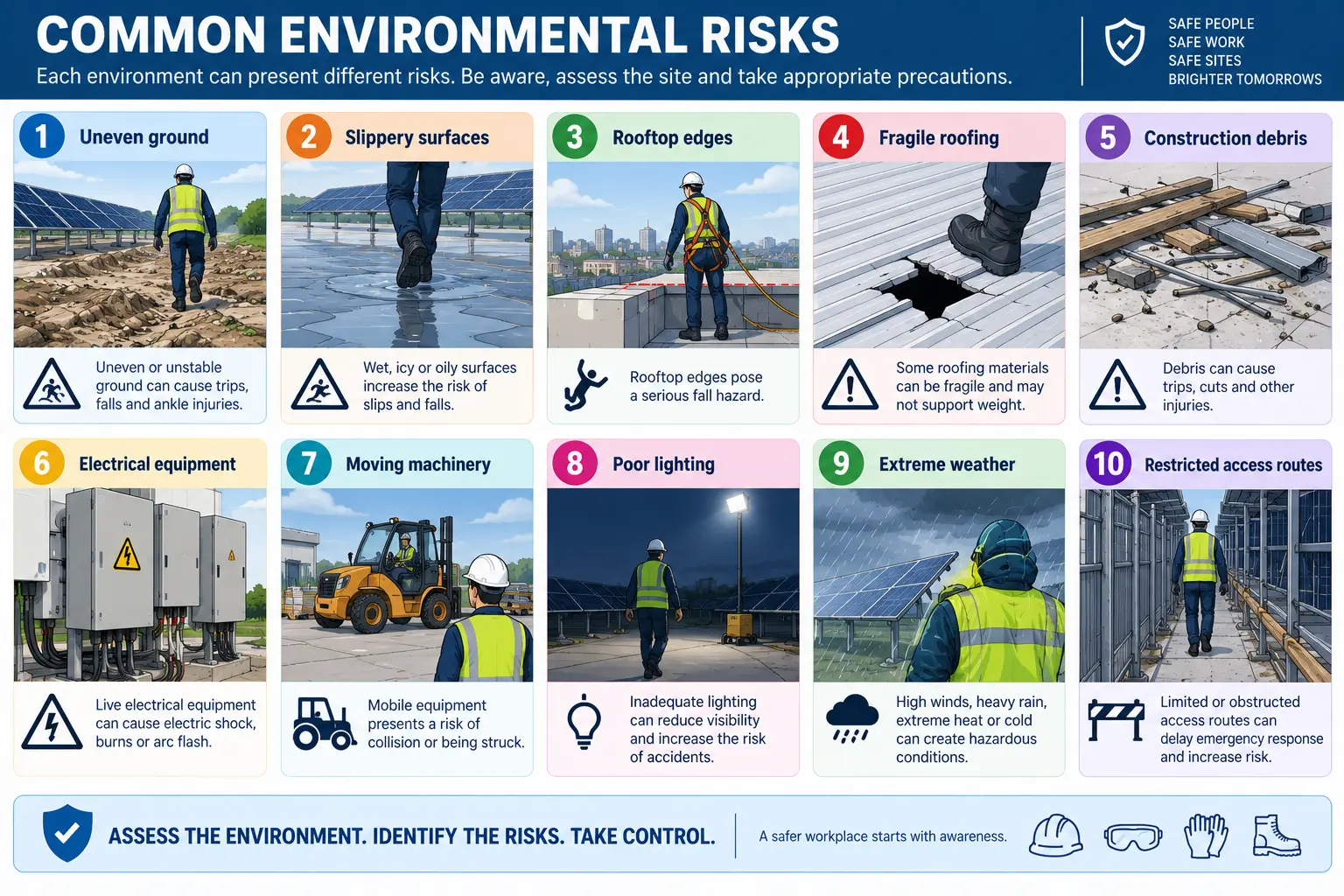
A safe access plan reduces the possibility of slips, trips, falls, collisions, and unnecessary exposure to hazardous equipment.
1. Conduct a Site Assessment Before Entry
Before beginning work, the installer should assess the access route and surrounding work area.
The assessment should consider:
- Entry and exit points
- Ground condition
- Roof condition
- Stairways and ladders
- Electrical hazards
- Obstacles
- Lighting
- Weather conditions
- Emergency escape routes
Workers should be informed about identified hazards before work begins.
2. Use Designated Access Routes
Workers should use designated walkways, stairs, ladders, gates, and access platforms wherever provided.
They should avoid:
- Climbing over equipment
- Walking through restricted areas
- Using unstable structures
- Taking shortcuts through electrical work zones
- Walking across fragile roofing materials
Clear access routes should be maintained throughout the project.
3. Take Extra Care During Rooftop Access
Rooftop PV installation presents a significant fall hazard.
Before accessing a roof, workers should verify that:
- The access equipment is suitable.
- Ladders are stable and properly positioned.
- Fall-protection measures are available where required.
- Roof surfaces are safe to walk on.
- Fragile areas are identified and protected.
- Tools and materials cannot fall from the roof.
Work should be postponed or controlled appropriately during severe weather such as heavy rain, strong winds, or lightning.
4. Keep Access Areas Clean
Poor housekeeping can create unnecessary hazards.
Packaging, cables, tools, module frames, and construction materials should not obstruct walkways.
A clean site helps prevent:
- Trips
- Falls
- Damage to equipment
- Blocked emergency routes
Waste should be removed regularly rather than allowed to accumulate around the installation area.
5. Select the Correct Tools
Using the correct tool for the job is one of the simplest ways to minimize tool hazards.
PV installers may use:
- Insulated screwdrivers
- Cable cutters
- Crimping tools
- Torque wrenches
- Spanners
- Wire strippers
- Multimeters
- Clamp meters
- Drilling equipment
- Testing instruments
Tools should be suitable for the task, environment, and equipment being worked on.
Electrical tools and test instruments must have appropriate ratings for the system being tested.
6. Inspect Tools Before Use
Every tool should be checked before use.
Look for:
- Cracked handles
- Damaged insulation
- Loose components
- Blunt cutting edges
- Broken parts
- Damaged cables
- Defective plugs
- Signs of overheating
Damaged tools should be removed from service until they are properly repaired or replaced.
7. Use Electrical Tools Safely
Electrical work requires additional precautions.
Installers should:
- Use appropriately rated insulated tools.
- Inspect test leads before use.
- Keep electrical tools dry.
- Avoid using damaged equipment.
- Verify the test instrument is suitable for the circuit.
- Follow safe isolation procedures.
A multimeter or other testing device should never be used outside its specified rating.
8. Prevent Tool-Related Falls
Tools can become a major hazard when working at height. Workers should not leave tools near roof edges or on unstable surfaces.
Where appropriate, use:
- Tool belts
- Tool bags
- Tethering systems
- Secure storage containers
Tools should be transported using safe methods rather than carried in a way that prevents workers from maintaining proper balance while climbing.
9. Store Tools Properly
Tools should be returned to designated storage locations after use.
Proper storage:
- Prevents trips
- Protects tools from damage
- Reduces loss
- Keeps sharp objects secured
- Makes tools easier to inspect
Tools should not be left inside electrical panels, on modules, near inverter ventilation openings, or in other unsuitable locations.
10. Minimize Manual Handling Risks
PV modules and installation equipment can be heavy or difficult to handle. Installers should use suitable lifting methods and obtain assistance when necessary.
For larger equipment, mechanical lifting devices may be appropriate.
Workers should avoid:
- Lifting beyond their capability
- Twisting while carrying heavy loads
- Carrying tools while climbing ladders
- Throwing tools or materials between workers
Proper manual handling reduces the risk of strains and dropped equipment.
11. Keep Tools Away From Energized Components
Metal tools can accidentally bridge electrical terminals and create short circuits.
Before electrical work, the relevant equipment should be isolated according to the approved procedure.
Particular care should be taken around:
- PV DC terminals
- Inverter terminals
- Batteries
- AC distribution boards
- Circuit breakers
- Energy-storage systems
Remember that PV modules can continue generating electricity when exposed to sunlight.
12. Maintain Tools and Test Equipment
Regular maintenance ensures tools remain safe and accurate. Test equipment should be checked and, where required, calibrated periodically.
For example, inaccurate electrical measuring equipment can lead to incorrect conclusions about:
- Voltage
- Current
- Continuity
- Insulation
- System faults
Properly maintained tools support safer installation and troubleshooting.
13. Use PPE Alongside Safe Tools
Tools alone cannot eliminate every workplace hazard.
Depending on the activity, installers may require:
- Safety helmet
- Safety glasses
- Protective gloves
- Safety footwear
- Electrical gloves
- Fall-protection equipment
- Appropriate protective clothing
PPE should be selected according to the task-specific risk assessment.
14. Establish an Emergency Access Plan
Every PV worksite should have a clear emergency response arrangement.
Workers should know:
- Emergency exits
- Assembly points
- First-aid locations
- Emergency communication methods
- Access routes for emergency responders
Emergency routes must remain unobstructed throughout the installation.
Safe Site and Tool Checklist
Before starting work, verify:
- Access route inspected
- Walkways clear
- Roof access secured
- Weather conditions checked
- Fall-protection arrangements provided where required
- Tools inspected
- Correct tools selected
- Electrical tools appropriately rated
- Test equipment functional
- Tools securely transported
- Sharp tools stored safely
- Emergency routes clear
- PPE available and used
Conclusion
Safe access and proper tool management are essential components of a professional solar PV installation. Before entering a site, workers should assess access routes, environmental conditions, rooftop risks, electrical hazards, and emergency arrangements. Once inside the work area, walkways should remain clear and designated access routes should always be used.
Tools must be selected according to the task, inspected before use, maintained properly, and stored securely. Electrical tools and test instruments require particular attention because incorrect or damaged equipment can introduce serious electrical hazards. When working at height, tools should also be secured to prevent dropped-object incidents.
These practices are important whether installing solar energy for home use, commercial and industrial systems, or large-scale solar plants. Safe working methods protect personnel, reduce equipment damage, minimize rework, and support reliable solar electricity production.
Ultimately, safe PV work depends on a combination of planned site access, appropriate tools, regular tool inspection, correct storage, electrical safety, PPE, good housekeeping, and emergency preparedness. Following these measures helps create a safer workplace while supporting the efficient and reliable development of renewable energy and solar energy systems.
FAQs
Q1. Why is safe site access important for PV installers?
Ans: Safe access reduces the risk of slips, trips, falls, collisions, and exposure to electrical or environmental hazards before work even begins.
Q2. What are common tool hazards during solar installation?
Ans: Common hazards include cuts, electric shock, short circuits, dropped tools, damaged equipment, incorrect tool use, and trips caused by improperly stored tools.
Q3. How can tools be safely used on rooftops?
Ans: Tools should be carried and stored securely, kept away from roof edges, and tethered where appropriate to prevent falling objects.
Q4. Why should tools be inspected before use?
Ans: Inspection helps identify damaged insulation, broken components, loose parts, or other defects that could cause injury or equipment damage.
Q5. Can ordinary tools be used for electrical PV work?
Ans: Tools should be appropriate for the specific electrical task. Where electrical hazards exist, appropriately rated and insulated tools should be used according to the applicable procedure.
Solar PV Maximum Working Voltage: Limits & Design Guide
A complete guide to maximum working voltage in solar PV systems, covering limits, calculations, and key design considerations.
Top Solar Companies & Suppliers in Delhi/NCR – A Complete Guide
Looking for trusted solar panel suppliers in Delhi/NCR? Explore leading solar companies serving Gurgaon, Noida, Faridabad, Manesar, and Ghaziabad. Compare product quality, technology, and services to choose the right solar partner for your home, business, or factory.
Solar Industry Faces Growing Losses from Underperforming Equipment
According to the Raptor Maps’ Global Solar Report, the amount of power loss due to equipment anomalies has nearly doubled from 1.61% in 2019 to 3.13% in 2022. This trend is expected to continue, with anomaly-driven power loss potentially growing to almost 6% by 2025.
PV Cable & Conduit Labeling Guide: Best Practices for Solar Installations
A complete guide to cable termination in solar installations, including tools, step-by-step methods, and best practices for safe connections.
Inverter Circuit Board Fault Guide for Solar PV Systems
A complete guide to identifying inverter circuit board faults in solar PV systems, recognizing when professional service is required, and following safe maintenance procedures.