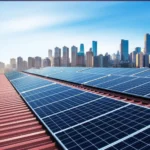
Researchers Propose New Way to Make Nuclear Power Plants Safer
Researchers from the Indian Institute of Technology have proposed a new way to make nuclear power plants safer. They suggest using offshore wind farms to provide backup power in case of a seismic event.
The study on nuclear power plants was published in the journal Nuclear Engineering and Design. The study found that offshore wind farms could provide enough power to keep nuclear reactors running even if the main power grid goes down. This would help to prevent meltdowns, which can occur if nuclear reactors lose their cooling systems.
The researchers tested their idea by conducting a case study at the Madras Atomic Power Station in Chennai. They found that a 15-MW offshore wind farm could provide enough power to keep the plant running for up to 72 hours. This would give the plant enough time to restore power from the main grid or to switch to a backup diesel generator.
The researchers say that their proposal could help to make nuclear power plants safer and more reliable. They believe that it could also help to reduce the cost of nuclear power, as it would no longer be necessary to build expensive backup generators.
The study was funded by the UK India Education Research Initiative and the Commonwealth Scholarship Commission. It is the latest in a series of studies that have explored the potential of using offshore wind farms to provide backup power for nuclear power plants.
In November 2022, a Danish-Indian collaborative study identified fifteen zones for the first offshore wind development project in India. The study was funded by the Danish Ministry of Foreign Affairs and the Indian Ministry of New and Renewable Energy.
The Central Electricity Authority of India (CEA) has estimated that India’s installed wind capacity will reach 100 GW and nuclear capacity 15.5 GW by the financial year 2029-30. The CEA is the apex regulatory body for electricity in India.
The use of offshore wind farms to provide backup power for nuclear power plants is a promising new development. It has the potential to make nuclear power plants safer, more reliable, and more affordable.
Suggested Articles

India and Japan Strengthen Renewable Energy Cooperation
India and Japan have initiated a partnership under the Asia Energy Transition Initiative (AETI) to support India’s clean energy transition. India has set an ambitious target of achieving net-zero by 2070, while Japan aims to achieve the same by 2050.
Safe Work Procedures for Solar PV Systems Guide
A complete guide to establishing and following safe work procedures in solar PV systems, ensuring worker safety during installation, testing, commissioning, operation, and maintenance.

How to Check Solar PV Module Performance
A complete guide to testing solar PV module performance, including voltage and current measurements, power output analysis, and performance verification techniques.
Solar Inverter Hazard Prevention Guide
A complete guide to identifying inverter hazards in solar PV systems and following safe work practices during installation, testing, operation, and maintenance.
Grid-Connected Solar PV System Startup Guide
A complete guide to starting up a grid-connected solar PV system, including commissioning, grid synchronization, electrical safety checks, and operational verification.
Single Line Diagram (SLD) in Solar PV Systems: Complete Guide to Design, Symbols & Reading
Learn how to fetch a Bill of Material (BOM) for a solar PV system directly from design documents like SLD, layout, and GA drawings. This step-by-step guide helps installers and EPCs ensure accurate material estimation and efficient project execution.

Inverter-Wise Solar Generation for C&I Plants
Discover how inverter-wise solar generation monitoring helps commercial and industrial (C&I) solar plants identify underperforming inverters, detect faults early, compare performance, and improve overall energy generation.
Group Net Metering for Solar Projects: A Smart Way to Maximize Solar Energy Generation
Discover how group net metering allows multiple participants to share solar energy from a single project, reduce electricity bills, and enhance solar efficiency.