Researchers Propose New Way to Make Nuclear Power Plants Safer
Researchers from the Indian Institute of Technology have proposed a new way to make nuclear power plants safer. They suggest using offshore wind farms to provide backup power in case of a seismic event.
The study on nuclear power plants was published in the journal Nuclear Engineering and Design. The study found that offshore wind farms could provide enough power to keep nuclear reactors running even if the main power grid goes down. This would help to prevent meltdowns, which can occur if nuclear reactors lose their cooling systems.
The researchers tested their idea by conducting a case study at the Madras Atomic Power Station in Chennai. They found that a 15-MW offshore wind farm could provide enough power to keep the plant running for up to 72 hours. This would give the plant enough time to restore power from the main grid or to switch to a backup diesel generator.
The researchers say that their proposal could help to make nuclear power plants safer and more reliable. They believe that it could also help to reduce the cost of nuclear power, as it would no longer be necessary to build expensive backup generators.
The study was funded by the UK India Education Research Initiative and the Commonwealth Scholarship Commission. It is the latest in a series of studies that have explored the potential of using offshore wind farms to provide backup power for nuclear power plants.
In November 2022, a Danish-Indian collaborative study identified fifteen zones for the first offshore wind development project in India. The study was funded by the Danish Ministry of Foreign Affairs and the Indian Ministry of New and Renewable Energy.
The Central Electricity Authority of India (CEA) has estimated that India’s installed wind capacity will reach 100 GW and nuclear capacity 15.5 GW by the financial year 2029-30. The CEA is the apex regulatory body for electricity in India.
The use of offshore wind farms to provide backup power for nuclear power plants is a promising new development. It has the potential to make nuclear power plants safer, more reliable, and more affordable.
Suggested Articles
The Rise of Clean Energy: Solar Energy Trends in 2023
The solar energy industry is on the rise, as the demand for clean and renewable energy sources continues to increase. 2023 is shaping up to be a big year for the solar energy sector, as new technologies and innovations are expected to drive growth and expand the reach of solar energy.
1 MW Solar Plant for Industry: Cost, Generation & Payback
A detailed guide on 1 MW solar plant for industry covering installation cost, area requirement, power generation, ROI, and long-term savings in India.

Safe Work Area Requirements for Solar PV Systems
A complete guide to establishing and following safe work procedures in solar PV systems, ensuring worker safety during installation, testing, commissioning, operation, and maintenance.

PPE Checklist for Solar Installations: Safety Gear Guide
A complete PPE checklist for solar installations covering essential safety gear required for safe and efficient on-site work.
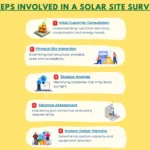
Benefits of Site Survey in Solar PV Installation
Shadow analysis is a critical step in solar site assessment. It helps solar installers identify shading obstacles and optimize panel placement for maximum energy generation.

Solar PV Preventive Maintenance & Logbook Guide
A complete guide to creating a solar PV maintenance schedule and logbook for preventive maintenance, inspections, and accurate maintenance records.

Breakthrough in Solar Technology: 33.2% Efficient Perovskite-Silicon Cell
Scientists achieve a breakthrough in solar technology with a perovskite-silicon tandem cell reaching a record 33.2% efficiency for higher energy output.
What Does 1 kWp Mean in Solar Power Systems?
1 kWp is a standard unit used to measure the capacity of a solar power system under ideal conditions. This guide explains what 1 kWp means, how much energy it produces, and why it matters for system sizing.