
Solar photovoltaic (PV) systems are an important part of the transition toward renewable energy and solar energy. As solar installations continue to expand across residential, commercial, industrial, and utility-scale applications, the number of workers involved in solar installation, commissioning, operation, inspection, maintenance, and troubleshooting is also increasing.
A PV system is designed to generate electricity from sunlight, but working around solar equipment can expose personnel to several hazards. These risks are not limited to electrical hazards. Workers may encounter falls from height, heat stress, sharp components, manual-handling injuries, chemical exposure, burns, weather-related risks, slips and trips, moving equipment, and other workplace hazards.
These risks are collectively important when considering personal safety hazards associated with photovoltaic installations.
Personal safety is a critical part of every stage of a solar project. A worker may be exposed to different hazards depending on the task being performed. For example, a technician installing modules on a rooftop may face fall and manual-handling risks, while an electrical technician testing an inverter may face electric shock and arc-flash hazards. Similarly, a battery maintenance technician may encounter electrical, chemical, and thermal hazards.
A safe solar workplace therefore requires more than simply providing Personal Protective Equipment (PPE). Effective safety management involves identifying hazards, assessing risks, implementing appropriate controls, training workers, maintaining equipment, communicating procedures, and continuously monitoring working conditions.
This guide explains the major personal safety hazards associated with PV installations and provides practical measures for identifying, preventing, and controlling them.
What Are Personal Safety Hazards?
Personal safety hazards are workplace conditions or activities that can cause injury, illness, or other harm to an individual.
In a solar PV environment, these hazards may arise from:
– Electrical equipment
– Working at height
– Solar modules and mounting structures
– Tools and machinery
– Batteries
– Chemicals
– Extreme weather
– Heat
– Manual handling
– Poor housekeeping
– Vehicles and lifting equipment
– Inadequate PPE
– Unsafe work procedures
Some hazards are immediately visible, while others may develop gradually.
For example, a damaged cable is a visible electrical hazard, while prolonged exposure to high temperatures may gradually cause heat stress.
Why Is Personal Safety Important in Solar PV Installations?
Solar PV projects involve numerous workers, contractors, engineers, technicians, electricians, supervisors, and maintenance personnel.
Personal safety practices help:
– Prevent injuries.
– Reduce workplace accidents.
– Protect workers from electrical hazards.
– Prevent falls.
– Reduce exposure to heat and weather.
– Avoid equipment-related injuries.
– Improve worker productivity.
– Reduce project delays.
– Minimize equipment damage.
– Improve overall project quality.
A safe workplace also contributes to more reliable operation of a solar plant.
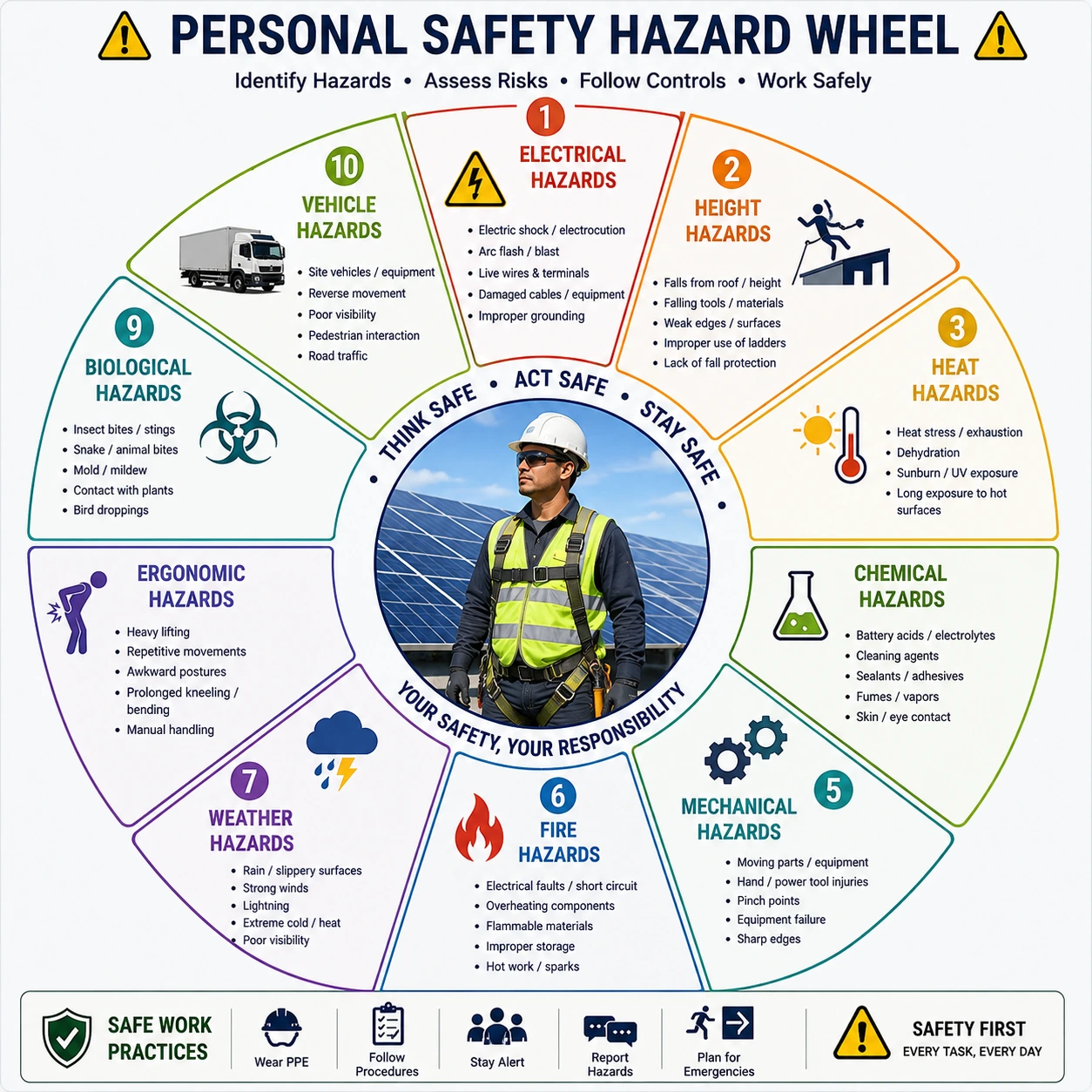
Major Personal Safety Hazards in PV Installations
The major personal safety hazards include:
1. Electric Shock
Electric shock is one of the most serious personal safety hazards in a PV installation.
Solar modules can generate DC electricity whenever they receive sufficient sunlight. Therefore, workers may be exposed to electrical energy even when the inverter is switched off.
Electric shock can occur due to:
– Contact with exposed conductors
– Damaged cables
– Incorrect electrical connections
– Faulty equipment
– Poor grounding
– Working on energized circuits
– Incorrect isolation
– Improper use of test equipment
Preventive Measures
Workers should:
– Identify all electrical energy sources.
– Follow approved isolation procedures.
– Verify electrical conditions before beginning work.
– Use appropriate electrical PPE.
– Use correctly rated test instruments.
– Avoid touching exposed conductors.
– Follow Lockout/Tagout procedures where applicable.
2. Arc-Flash Hazards
An electrical fault can produce an arc that releases significant heat and energy.
Arc-flash exposure may cause:
– Severe burns
– Eye injuries
– Hearing damage
– Flying debris injuries
– Clothing ignition
– Equipment damage
Preventive Measures
– Maintain electrical equipment properly.
– Inspect connections regularly.
– Use correctly rated equipment.
– Follow approved switching procedures.
– Maintain appropriate working clearances.
– Use task-specific PPE where required.
3. Falls from Height
Many solar systems are installed on rooftops, elevated structures, or other locations where workers are exposed to fall risks.
Falls may occur from:
– Roof edges
– Ladders
– Scaffolding
– Platforms
– Mounting structures
– Fragile roof surfaces
Preventive Measures
Depending on the site and applicable requirements:
– Install guardrails where appropriate.
– Use suitable fall-arrest systems.
– Secure ladders properly.
– Use approved anchor points.
– Inspect access equipment.
– Train workers in work-at-height procedures.
– Restrict access to unsafe areas.
Workers should never take unnecessary risks simply to complete a task quickly.
4. Slips, Trips, and Falls
Poor housekeeping can create hazards even on otherwise well-managed solar sites.
Common causes include:
– Loose cables
– Tools left on walkways
– Packaging materials
– Construction debris
– Wet surfaces
– Uneven ground
– Poorly organized work areas
Preventive Measures
– Keep walkways clear.
– Organize cables properly.
– Remove waste regularly.
– Clean spills immediately.
– Store tools safely.
– Maintain adequate lighting.
Good housekeeping is one of the simplest ways to improve personal safety.
5. Heat Stress
Solar PV workers frequently operate outdoors under direct sunlight.
High temperatures combined with physical activity can cause:
– Dehydration
– Heat exhaustion
– Heat cramps
– Heat stroke
– Fatigue
– Reduced concentration
Warning Signs
Workers should watch for:
– Excessive sweating
– Dizziness
– Headache
– Weakness
– Nausea
– Confusion
Preventive Measures
– Provide adequate drinking water.
– Schedule suitable rest periods.
– Provide shaded recovery areas.
– Use appropriate clothing.
– Monitor workers during extreme heat.
– Avoid unnecessary exposure during peak heat conditions.
Heat-related illness can become a medical emergency, so symptoms should never be ignored.
6. Manual-Handling Hazards
Solar modules, mounting structures, batteries, cables, and electrical equipment can be heavy or awkward to carry.
Incorrect handling can cause:
– Back injuries
– Muscle strains
– Sprains
– Crush injuries
– Dropped equipment
Safe Handling Practices
– Assess the load before lifting.
– Use mechanical lifting equipment where appropriate.
– Use team lifting for suitable loads.
– Maintain stable footing.
– Avoid twisting while carrying heavy loads.
– Ask for assistance when required.
7. Cuts and Lacerations
PV modules and mounting structures can contain:
– Sharp metal edges
– Cut cable ends
– Sheet-metal components
– Broken glass
Workers may suffer cuts when handling modules, structures, cables, or tools.
Preventive Measures
– Wear suitable protective gloves.
– Handle modules carefully.
– Inspect equipment for sharp edges.
– Dispose of broken components safely.
– Use appropriate tools for cutting and stripping cables.
8. Burns
Workers may encounter hot surfaces during solar operations.
Potentially hot equipment includes:
– PV modules
– Inverters
– Transformers
– Batteries
– Electrical connections
– Cables
Preventive Measures
– Allow equipment to cool where appropriate.
– Avoid touching hot surfaces unnecessarily.
– Use appropriate protective equipment.
– Follow manufacturer maintenance procedures.
9. Chemical Hazards
Certain solar PV activities involve chemicals such as:
– Battery electrolyte
– Cleaning agents
– Solvents
– Corrosion-control products
– Maintenance chemicals
Exposure may cause:
– Skin irritation
– Chemical burns
– Eye injuries
– Respiratory irritation
Preventive Measures
Workers should:
– Read applicable Safety Data Sheets.
– Use appropriate gloves and eye protection.
– Store chemicals correctly.
– Maintain adequate ventilation.
– Follow approved handling procedures.
– Maintain spill-response arrangements.
10. Battery-Related Personal Safety Hazards
Battery-based solar systems introduce additional risks.
Depending on battery technology, hazards may include:
– Electric shock
– High short-circuit current
– Chemical exposure
– Thermal hazards
– Fire
– Gas release
Safety Measures
– Follow battery manufacturer instructions.
– Restrict access to authorized personnel.
– Inspect battery enclosures.
– Use appropriate PPE.
– Maintain ventilation where required.
– Keep conductive objects away from exposed terminals.
– Follow emergency procedures.
11. Eye Hazards
Workers may be exposed to eye injuries from:
– Dust
– Flying particles
– Drilling
– Cutting
– Grinding
– Chemical splashes
– Electrical arcs
Preventive Measures
Use suitable eye protection according to the task. Safety glasses, goggles, or face shields may be required depending on the hazard.
12. Noise Hazards
Construction and maintenance equipment can generate high noise levels.
Sources may include:
– Drills
– Grinders
– Generators
– Compressors
– Heavy machinery
Long-term exposure can contribute to hearing damage.
Preventive Measures
– Assess noise levels.
– Maintain equipment properly.
– Limit exposure duration where practical.
– Use suitable hearing protection when required.
13. Dust Exposure
Solar installation and maintenance activities may generate dust.
Dust may come from:
– Drilling
– Cutting
– Excavation
– Construction
– Cleaning
– Dry site conditions
Dust can irritate the eyes and respiratory system.
Preventive Measures
– Use suitable respiratory protection where required.
– Control dust generation.
– Maintain ventilation.
– Use appropriate cleaning methods.
– Avoid unnecessary exposure.
14. Weather-Related Hazards
Outdoor PV workers can be exposed to:
– High temperatures
– Heavy rain
– Lightning
– Strong winds
– Dust storms
– Cold conditions
– High humidity
Severe weather can increase multiple risks simultaneously.
For example, rain can make surfaces slippery while also increasing electrical safety concerns.
Preventive Measures
– Monitor weather forecasts.
– Establish work stoppage criteria.
– Provide suitable protective clothing.
– Avoid outdoor electrical work during unsafe conditions.
– Secure loose materials before strong winds.
15. Vehicle and Equipment Hazards
Large solar projects often use:
– Trucks
– Forklifts
– Cranes
– Earthmoving machinery
– Service vehicles
Workers may be injured by:
– Vehicle collisions
– Reversing vehicles
– Falling loads
– Moving machinery
Preventive Measures
– Establish designated vehicle routes.
– Separate pedestrians from vehicles.
– Use trained operators.
– Follow site traffic rules.
– Use appropriate signaling and communication systems.
16. Ergonomic Hazards
Repeated activities can cause musculoskeletal problems.
Examples include:
– Repetitive lifting
– Bending
– Kneeling
– Working overhead
– Prolonged standing
– Repetitive tool use
Preventive Measures
– Rotate tasks where appropriate.
– Use ergonomic tools.
– Take appropriate breaks.
– Improve working positions.
– Use mechanical assistance for repetitive heavy tasks.
17. Wildlife and Biological Hazards
Outdoor solar installations may attract or encounter:
– Snakes
– Insects
– Rodents
– Birds
– Other animals
Wildlife may also damage PV equipment.
Preventive Measures
– Inspect work areas before starting.
– Maintain vegetation appropriately.
– Avoid disturbing animals unnecessarily.
– Use trained personnel for wildlife-related situations.
– Protect cables from animal damage.
18. Fire Hazards
Solar installations may present fire risks associated with:
– Electrical faults
– Damaged cables
– Loose connections
– Batteries
– Overheated equipment
– Improperly installed components
Workers should understand site emergency procedures and know the locations of relevant emergency equipment.
19. Fatigue and Human-Factor Hazards
Fatigue can affect concentration, judgment, coordination, and reaction time.
Solar workers may become fatigued because of:
– Long working hours
– Heat exposure
– Physically demanding tasks
– Repetitive work
– Inadequate rest
Fatigue can increase the likelihood of mistakes and accidents.
Preventive Measures
– Maintain reasonable work schedules.
– Provide suitable rest periods.
– Avoid unnecessary overtime.
– Monitor workers performing high-risk tasks.
– Encourage reporting of fatigue-related concerns.
Personal Safety During Solar PV Installation
During installation, workers should pay particular attention to:
– Safe module handling
– Work-at-height protection
– Electrical isolation
– Tool safety
– Lifting operations
– Structural stability
– Weather conditions
– Cable management
– Housekeeping
A pre-work briefing should be conducted before high-risk activities.
Personal Safety During Commissioning
Commissioning involves energizing and testing equipment.
Workers should:
– Review system documentation.
– Confirm equipment installation.
– Verify electrical connections.
– Follow approved startup procedures.
– Restrict unauthorized access.
– Use appropriate test instruments.
– Follow electrical safety procedures.
Personal Safety During Maintenance
Maintenance activities may expose workers to energized equipment, hot surfaces, batteries, damaged components, and work-at-height hazards.
Before maintenance:
- Review the work order.
- Identify hazards.
- Isolate equipment where required.
- Verify safe conditions.
- Wear appropriate PPE.
- Perform the task according to procedure.
- Inspect the work before restoring the system.
Personal Safety During Troubleshooting
Troubleshooting should never become an excuse for bypassing safety procedures.
A technician should:
– Understand the fault before intervening.
– Review system documentation.
– Identify all energy sources.
– Use appropriate test equipment.
– Avoid unnecessary exposure.
– Escalate complex faults to qualified personnel.
If a fault cannot be safely diagnosed, work should stop until appropriate technical support is available.
Emergency Preparedness
Every PV worksite should have suitable emergency arrangements.
Workers should know:
– Emergency contact procedures
– First-aid arrangements
– Emergency exits
– Fire equipment locations
– Electrical isolation points
– Assembly points
– Incident-reporting procedures
Emergency procedures should be communicated before work begins.
Conclusion
Personal safety is a fundamental requirement for every solar photovoltaic installation. Although PV technology provides clean and sustainable renewable energy and solar energy, the installation and maintenance of PV systems expose workers to a variety of hazards that must be carefully managed.
Electrical shock, arc flash, falls from height, heat stress, manual handling, sharp components, chemical exposure, battery hazards, fire, weather conditions, vehicle movement, noise, dust, ergonomic stress, wildlife, and fatigue can all affect worker safety. The severity of these hazards depends on the type of system, the work being performed, environmental conditions, and the competence and preparation of the personnel involved.
The safest approach is to identify hazards before starting work, assess their potential consequences, and apply the hierarchy of controls. Wherever possible, hazards should be eliminated or controlled through engineering measures before relying on administrative procedures and PPE. Workers should receive appropriate training, use suitable tools, follow approved work procedures, and understand when a task should be stopped or escalated.
Personal safety should also remain a priority after installation. During commissioning, operation, inspection, maintenance, and troubleshooting, workers must continue to assess changing conditions and follow appropriate isolation and protection procedures.
For solar EPC companies and O&M teams, strong safety practices can provide benefits beyond worker protection. Fewer accidents and equipment failures can reduce downtime, prevent avoidable repair costs, improve maintenance quality, and support reliable solar electricity generation. This contributes to better lifecycle economics, including improved control over solar installation cost, solar installation cost per kWh, and the cost of solar per kWh installed.
Whether a project involves solar energy for home use, a commercial rooftop, an industrial facility, or a large utility-scale solar plant, personal safety must remain an integral part of every activity. A successful solar project is not simply one that generates electricity; it is one that generates clean energy while ensuring that every person involved in designing, installing, operating, and maintaining the system can work safely.
FAQs
Q1. What are personal safety hazards in a solar PV installation?
Ans: Personal safety hazards are conditions or activities associated with PV installation, operation, or maintenance that can cause injury or illness. They include electrical shock, falls, heat stress, cuts, burns, chemical exposure, manual-handling injuries, and other workplace risks.
Q2. What is the most common personal safety risk in rooftop solar installation?
Ans: Working at height is one of the major risks during rooftop solar installation. Electrical hazards, manual handling, heat exposure, and slips and trips are also important risks.
Q3. Why is PPE important for solar PV workers?
Ans: PPE provides a final layer of protection against hazards that cannot be completely eliminated or controlled through other measures. The type of PPE should depend on the specific task and risk assessment.
Q4. Can solar workers receive an electric shock even when the inverter is switched off?
Ans: Yes. PV modules can continue producing DC electricity when exposed to sunlight. Workers must therefore identify and isolate relevant energy sources according to approved procedures before performing electrical work.
Q5. How can heat stress be prevented during solar installation?
Ans: Providing drinking water, rest breaks, shaded areas, suitable clothing, heat monitoring, and appropriate work scheduling can help reduce heat-related risks.
Essential Tools for PV System Testing Guide
A complete guide to battery bank enclosure and rack installation, including site verification, setup procedures, and safety practices for solar PV systems.
Solar Charge Controller Explained: Purpose, Need & Advantages
A charge controller is a vital component of any solar system. Learn what it does, how it works, and why a solar system cannot function safely without it.
How Are Solar PV Modules Made? Complete Guide to the Manufacturing Process
Choosing the right solar panels can be confusing with so many options in the market. This guide simplifies solar panel selection by comparing types, efficiency ratings, and cost factors. Whether for your home, business, or industry, learn how to make an informed decision and maximize the return on your solar investment.
Minimum Land Requirement for Solar Power Plants in India
Understanding the land requirement for solar plant projects in India is essential for accurate planning and approvals. This article explains minimum land needed per kW and MW, key influencing factors, and differences between rooftop and ground-mounted solar plants.
China’s Solar Industry Poised for Continued Growth in 2023 and Beyond
China’s solar industry is set for continued growth in 2023 and beyond, driving global renewable energy expansion and technological advancements.
Yes, I Have Installed an Optimized Solar PV Rooftop System at My Premises
A solar power generating system converts sunlight into electricity for residential, industrial, and commercial use. This blog explains the components, working, and benefits of solar systems, helping you understand how to harness solar energy efficiently and sustainably.

Solar PV AC or DC: How Solar Electricity Is Generated
Total solar PV power represents the combined power output of a solar photovoltaic system. This guide explains its meaning, calculation, and how it directly impacts solar performance, efficiency, and long-term energy generation.
New IREDA Loan Scheme for Solar Rooftop Projects: Benefits, Eligibility & Interest Rates
India’s renewable energy push gets a major boost with the new IREDA loan scheme for solar rooftop projects. This scheme offers low-interest financing, simplified approvals, and better support for residential, commercial, and industrial consumers. Here’s a detailed look at its benefits, eligibility, interest rates, and how to apply for funding.