
An industrial solar plant is designed to generate a predictable amount of electricity and reduce the facility’s dependence on grid power. But sometimes, the plant generates less electricity than expected even though the solar panels and inverters appear to be working.
This condition is called solar plant underperformance.
Underperformance does not always mean that the plant has completely stopped working. In many cases, the system continues generating electricity, but its actual output remains below the expected level. Over time, this small difference can become a significant financial loss for an industrial facility.
Understanding why an industrial solar plant underperforms is therefore an important part of solar operations and maintenance (O&M).
What Does Solar Plant Underperformance Mean?
A solar plant is considered to be underperforming when its actual energy generation is consistently lower than the expected generation after considering factors such as solar irradiation, temperature, system design, plant availability and other normal losses.
Two important parameters are commonly used to evaluate plant performance:
- Performance Ratio (PR): Helps compare actual plant output with the expected output based on the available solar resource.
- Plant Availability: Shows how much of the time the plant is operational and capable of generating electricity.
A plant can have good PR while suffering from downtime, or good availability while producing less energy than expected. Therefore, both parameters should be monitored together.
What Are the Common Causes of Underperformance?
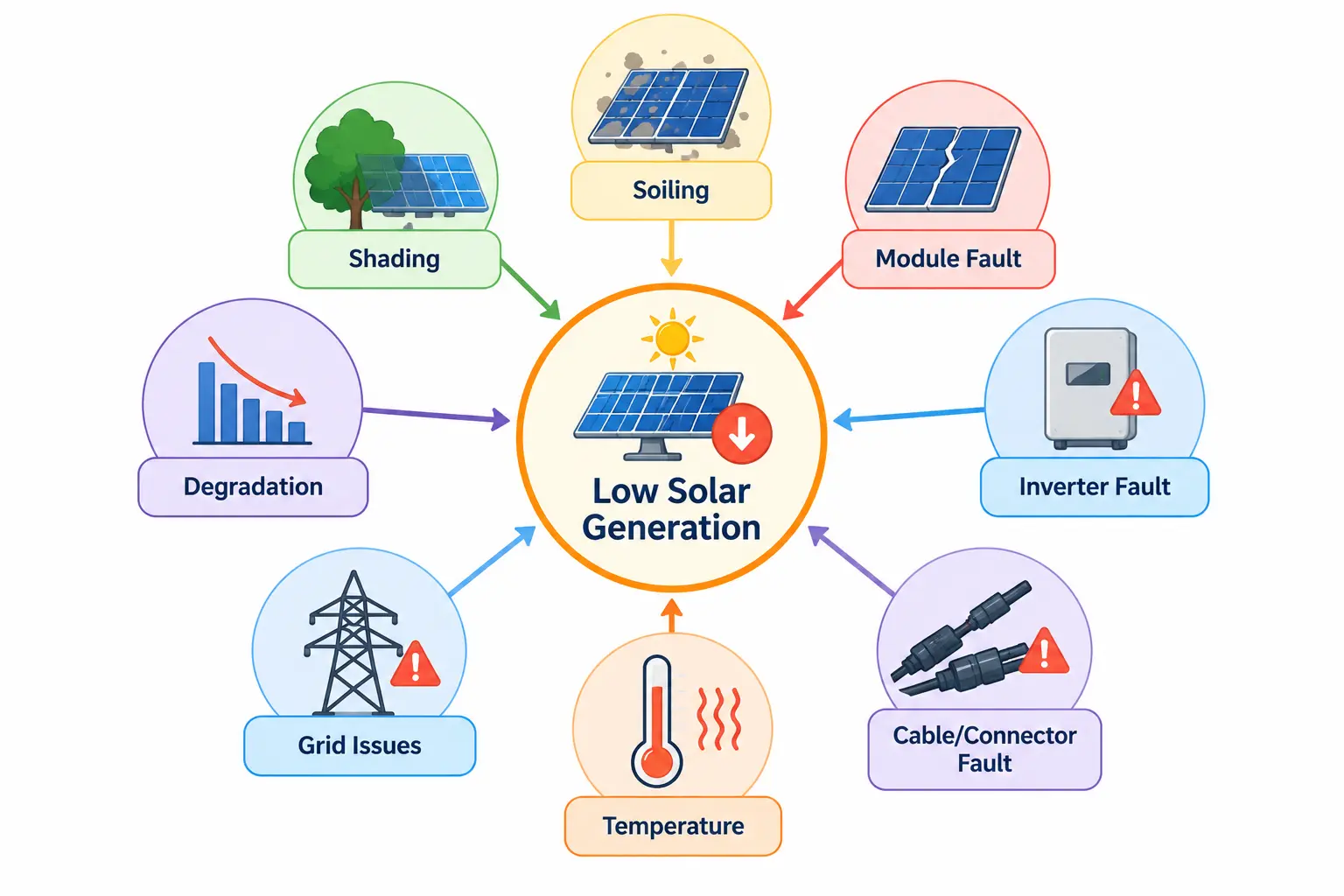
Several technical and environmental factors can reduce the output of an industrial solar plant.
1. Dust and Soiling
Dust is one of the most common causes, particularly for industrial facilities located in dry or dusty areas.
Dust, mud, bird droppings, and other deposits can reduce the amount of sunlight reaching the solar cells. Industrial areas may also have additional dust or particles from nearby manufacturing, construction, cement, mining, or transportation activities.
If cleaning is not planned according to actual site conditions, energy generation can gradually fall.
2. Shading
New buildings, structures, trees, equipment or even temporary objects can create shadows on solar panels.
Partial shading can be particularly problematic because affected modules or strings may produce considerably less electricity. The shading pattern may also change during different times of the day and different seasons.
Therefore, shading should be checked during regular site inspections.
3. Module Degradation or Damage
Solar modules gradually lose some generating capability as they age.
However, abnormal performance can also result from:
- Cracked modules
- Hotspots
- Delamination
- Damaged junction boxes
- Failed bypass diodes
- Water ingress
- Micro-cracks
- Manufacturing defects
These problems may not always be visible during a simple visual inspection and may require specialised testing.
4. Inverter Problems
Inverters are critical because they convert DC electricity from the solar array into usable AC electricity.
Inverter faults, overheating, component failures, poor ventilation, repeated trips or derating can reduce plant output. Inverter problems can sometimes affect a large portion of the plant, especially where a central inverter serves a significant block of the array. (The Department of Energy’s Energy.gov1)
5. Faulty Cables, Connectors or Protection Devices
Loose connections, damaged cables, faulty fuses, connector problems, or protection-device failures can reduce the output of individual strings or sections.
A plant may continue operating while one or more strings produce significantly less energy. Without string-level monitoring, these losses can remain unnoticed.
6. High Module Temperature
Solar panels require sunlight to generate electricity, but their electrical output generally decreases as module temperature increases.
During very hot conditions, the plant may therefore produce less power than expected even when the sky is clear.
Good system design, ventilation around equipment and appropriate performance analysis help operators understand these temperature-related losses.
7. Grid-Related Problems and Curtailment
An industrial solar plant may also generate less electricity because of grid restrictions, outages, voltage issues, or instructions to reduce power export.
This is different from a technical fault in the solar plant itself. The performance analysis should therefore separate grid-related losses from equipment-related losses. (Scribd2)
What Happens Financially When a Plant Underperforms?
The biggest impact of underperformance is lost energy generation.
Suppose an industrial facility expects its solar plant to generate a certain amount of electricity every year. If the plant consistently produces less, the facility must purchase more electricity from the grid or another source.
This can affect:
- Electricity cost savings
- Solar project payback period
- Return on investment
- Cost of electricity generated
- Annual renewable energy contribution
- Long-term project economics
For this reason, even a seemingly small generation loss should not be ignored.
How Can Underperformance Be Detected?
The first step is to compare actual generation with expected generation.
Operators should regularly review:
- Daily and monthly energy generation
- Performance Ratio
- Plant availability
- Specific yield
- Inverter-wise generation
- String-level performance
- Solar irradiation
- Module temperature
- Fault and alarm history
- Grid availability
- Cleaning records
A single low-generation day does not necessarily mean that the plant has a fault. Weather conditions and grid conditions must also be considered.
The important point is to identify consistent or unusual trends.
How Is an Underperforming Solar Plant Troubleshot?
A systematic approach is better than immediately replacing equipment.
Step 1: Confirm the Generation Loss
Compare actual generation with expected generation using reliable monitoring and site conditions.
Step 2: Check Weather and Irradiation
Determine whether low solar irradiation, clouds, high temperature, or unusual weather explains the reduction.
Step 3: Check Plant Availability
Look for inverter shutdowns, grid interruptions, alarms, and equipment downtime.
Step 4: Check the Solar Array
Inspect modules for:
- Dust
- Shading
- Physical damage
- Hotspots
- Loose connections
- Visible abnormalities
Step 5: Compare Inverters and Strings
If one inverter or string is producing significantly less than similar sections, it can help narrow down the problem.
Step 6: Conduct Detailed Testing
Where required, qualified personnel can use tools such as thermal imaging, I-V curve testing, insulation testing, and electrical measurements to identify hidden faults.
Step 7: Correct the Root Cause
Cleaning, repairing connections, replacing faulty components, correcting shading, or involving the inverter/module manufacturer may be required depending on the diagnosis.
Why Regular O&M Matters
The purpose of O&M is not simply to repair equipment after it fails.
A good maintenance programme should identify performance losses before they become major problems.
Regular monitoring, preventive inspections, module cleaning, inverter maintenance, electrical checks and proper documentation help maintain plant performance over its operating life.
Industry guidance also highlights the importance of monitoring and comprehensive O&M for maintaining performance and availability throughout the long operating life of a PV system.
Practical Underperformance Investigation Checklist
When an industrial solar plant shows lower-than-expected generation, check:
- Actual vs expected generation
- Performance Ratio trend
- Plant availability
- Solar irradiation
- Module temperature
- Module cleanliness
- Shading conditions
- Inverter alarms
- Inverter-wise generation
- String-wise current/output
- Cables and connectors
- Fuses and protection devices
- Grid interruptions
- Curtailment
- Module condition
- Previous maintenance records
Conclusion
An industrial solar plant does not have to completely stop working to become a financial problem. Even when the system continues generating electricity, a persistent gap between expected and actual generation can result in significant energy and financial losses over time.
The right approach is to measure, compare, investigate, and correct.
Regular monitoring of Performance Ratio, availability, generation, irradiation, inverter performance, and string output can help identify problems early. Proper cleaning, preventive maintenance, and timely troubleshooting can then restore lost performance.
For industries investing in solar energy, solar roof panels or a large solar plant, plant performance should be treated as a long-term business priority, not just a technical responsibility. A well-designed system combined with strong O&M practices can help the facility achieve better energy savings, more predictable returns, and a stronger renewable energy performance throughout the project life.
I’ve kept the keywords such as solar installation cost, solar installation charges, solar roof panels, renewable energy, solar energy, solar plant, solar electricity, and solar energy installation cost natural rather than stuffing them into every section.
FAQs
Q1. What is solar plant underperformance?
Ans: Solar plant underperformance occurs when actual electricity generation remains below the expected generation after considering normal operating and environmental conditions.
Q2. What is the most common cause of solar plant underperformance?
Ans: Soiling, shading, equipment faults, temperature, degradation, and grid-related issues can all contribute. The dominant cause varies according to the plant location and operating conditions.
Q3. Can a solar plant underperform even when the inverter is running?
Ans: Yes. An inverter can be operating normally while the plant produces less energy because of dirty modules, shading, faulty strings, module degradation, or other losses.
Q4. How does dust affect industrial solar panels?
Ans: Dust reduces the sunlight reaching the PV cells and can lower energy generation. Industrial locations with high dust levels may require more frequent cleaning.
Q5. What is Performance Ratio in a solar plant?
Ans: Performance Ratio is an important indicator used to evaluate how effectively a PV plant converts the available solar resource into electrical energy.
Industrial Solar Power: 7 Reasons to Make the Switch
Top 7 benefits of solar energy for industries, including cost savings, environmental impact, and improved energy reliability.

Solar Energy for Petrol Pumps: Benefits, Savings, and Implementation
Petrol pumps can significantly reduce energy costs and carbon footprint by adopting solar power. This guide explains the benefits, types of solar installations, and how fuel stations can leverage renewable energy for sustainable and efficient operations.
Open Circuit Voltage (Voc) Testing Guide for Solar PV Systems
A complete guide to measuring open circuit voltage (Voc) in solar PV systems, including testing procedures, safety guidelines, and performance evaluation techniques.
US Lawmakers Approve Tariffs on Solar Imports from Southeast Asia
US lawmakers vote to restore tariffs on solar imports from Southeast Asia, affecting pricing, supply, and the solar industry landscape.
Ground Mounted Solar Systems: Complete Guide for Commercial & Industrial Projects in India
Ground mounted solar systems are ideal for commercial and industrial projects with available land. This guide explains cost, land requirement, installation process, and ROI in India.

Battery Polarity & Voltage Testing Guide for Safe Installation
A complete guide to battery polarity and voltage testing, ensuring safe battery installation and reliable performance in solar PV systems.

Latest MNRE List: Approved Solar Module Manufacturers
Check the latest MNRE-approved list of solar module manufacturers to ensure quality and compliance for your solar projects in India.
Maintenance of Cables, Connectors & Switches Guide
A complete guide to maintaining cables, connectors, and switches in solar PV systems, including inspection, cleaning, testing, and preventive maintenance for long-term system reliability.