
Grid-connected solar photovoltaic (PV) systems have become one of the most widely adopted renewable energy solutions for residential, commercial, industrial, and utility-scale applications. Unlike standalone systems, grid-connected solar installations operate in coordination with the utility power grid, allowing excess solar electricity to be exported while drawing power from the grid whenever solar generation is insufficient.
The startup of a grid-connected solar PV system is one of the most critical stages of commissioning. It involves safely energizing the solar array, inverter, protection devices, monitoring systems, and utility interconnection equipment while ensuring compliance with manufacturer instructions, utility regulations, and project design specifications. A properly executed startup process verifies that all electrical and mechanical components function correctly, confirms grid synchronization, establishes baseline operational data, and ensures long-term renewable solar system reliability.
Improper startup procedures can result in inverter faults, synchronization failures, equipment damage, electrical hazards, inaccurate energy metering, and delays in project commissioning. Therefore, solar installers, commissioning engineers, EPC contractors, and operations and maintenance (O&M) professionals must follow a structured startup procedure to ensure safe and efficient solar electricity generation.
Proper commissioning and startup procedures are fundamental for ensuring safe, efficient, and reliable operation of grid-connected solar PV systems.
This comprehensive guide explains the startup sequence, pre-commissioning inspections, grid synchronization process, energy meter verification, safety precautions, documentation requirements, troubleshooting methods, and industry best practices.
What is a Grid-Connected Solar PV System?
A grid-connected solar PV system is a renewable energy system that generates electricity from solar panels and operates in parallel with the utility electrical grid.
Unlike off-grid systems, these installations generally do not rely solely on battery storage. Instead, they export surplus electricity to the grid and import electricity when solar generation is insufficient.
A typical grid-connected system includes:
- Solar PV modules
- Mounting structures
- DC combiner boxes
- DC disconnect switches
- Grid-tied inverter
- AC distribution panel
- AC disconnect switch
- Energy meter (net meter or generation meter)
- Monitoring system
- Grounding and lightning protection system
Importance of Proper Startup Procedures
Startup is the first controlled energization of the completed solar PV installation.
A structured startup process helps:
- Protect equipment
- Ensure personnel safety
- Verify installation quality
- Confirm utility compliance
- Establish baseline performance data
- Enable reliable solar electricity generation
Proper startup minimizes commissioning risks and improves long-term system performance.
Major Components Involved During Startup
Several components participate in the startup process.
1. Solar PV Array
Generates DC electricity from sunlight.
2. DC Combiner Box
Collects power from multiple PV strings.
3. DC Disconnect Switch
Provides safe isolation of the PV array.
4. Grid-Tied Inverter
Converts DC electricity into synchronized AC power.
5. AC Distribution Panel
Distributes inverter output to connected loads and the utility grid.
6. Utility Disconnect Switch
Allows safe isolation from the utility network.
7. Net Meter or Generation Meter
Measures imported, exported, or generated electricity.
8. Monitoring System
Records system performance and operating data.
Pre-Startup Inspection Requirements
Comprehensive inspections should be completed before startup.
Verify Mechanical Installation
Inspect:
- Mounting structures
- Module fastening
- Equipment enclosures
- Cable supports
Mechanical installation should comply with project drawings.
Verify Electrical Installation
Check:
- Cable routing
- Cable terminations
- Polarity
- Grounding connections
- Conduit installation
Verify Protection Devices
Confirm correct installation of:
- DC fuses
- AC breakers
- Surge protection devices
- Disconnect switches
Verify Grounding System
Inspect:
- Grounding conductors
- Earth electrodes
- Bonding connections
Proper grounding improves system safety.
Verify Equipment Labeling
Ensure all equipment is clearly labeled.
Labels should identify:
- Inverters
- Disconnect switches
- Combiner boxes
- Distribution panels
- Emergency shutdown devices
Confirm Completion of Electrical Tests
Before startup, verify successful completion of:
- Continuity testing
- Insulation resistance testing
- Polarity verification
- Grounding resistance measurement
- Inverter testing
The startup should not proceed if the required tests remain incomplete.
Tools Required During Startup
Typical commissioning equipment includes:
- Digital multimeter
- Clamp meter
- Insulation resistance tester
- Earth resistance tester
- Commissioning checklist
- Manufacturer manuals
- Personal protective equipment (PPE)
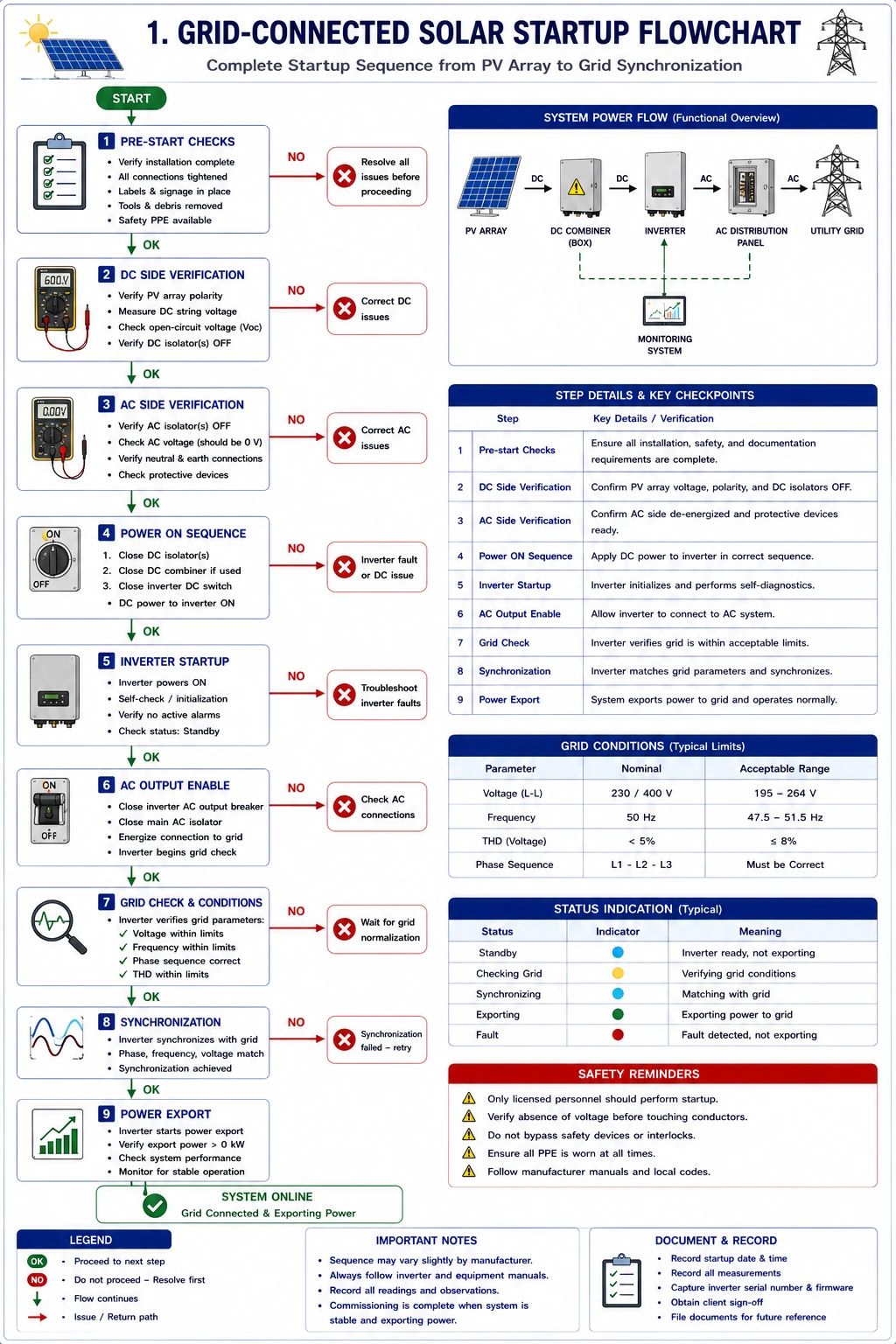
Step-by-Step Startup Procedure for Grid-Connected Solar PV Systems
Step 1 – Review Manufacturer Documentation
Review:
- Inverter manuals
- Utility interconnection requirements
- Startup procedures
- Safety instructions
Only trained personnel should perform commissioning.
Step 2 – Verify Safe Working Conditions
Confirm:
- Work area is clear
- Equipment is accessible
- Personnel are informed
- Required PPE is being used
Safety must always take priority.
Step 3 – Inspect the DC Side
Verify:
- PV string connections
- Combiner box wiring
- DC disconnect status
- Array voltage
- Correct polarity
Correct any abnormalities before proceeding.
Step 4 – Verify Utility Availability
Confirm:
- Grid voltage
- Frequency
- Utility authorization (where required)
Grid parameters should meet inverter operating requirements.
Step 5 – Energize the DC Side
Close the DC disconnect switch according to manufacturer instructions.
Observe:
- Inverter display
- DC voltage readings
- Fault indicators
The inverter should recognize the PV array.
Step 6 – Start the Grid-Tied Inverter
Power up the inverter following the manufacturer’s startup sequence.
Verify:
- Successful self-test
- No active fault codes
- Correct operating mode
Modern inverters perform automatic diagnostics before synchronization.
Step 7 – Energize the AC Side
After confirming inverter readiness:
Close:
- AC disconnect switch
- Distribution breaker
The inverter prepares for grid synchronization.
Step 8 – Verify Grid Synchronization
The inverter automatically compares:
- Grid voltage
- Frequency
- Phase
Once acceptable parameters are detected, synchronization occurs.
Verify:
- Grid-connected status
- Power export
- Stable operation
Step 9 – Verify Energy Meter Operation
Inspect:
- Net meter
- Generation meter
- Import/export readings
Record initial startup readings. These values serve as baseline operational data.
Step 10 – Verify Monitoring System
Confirm operation of:
- Data acquisition system
- Monitoring software
- Communication equipment
- Remote monitoring platform
Real-time system data should be available.
Step 11 – Observe Initial System Operation
Monitor:
- DC voltage
- DC current
- AC voltage
- AC current
- Frequency
- Power output
Ensure values remain within expected operating limits.
Step 12 – Record Startup Data
Document:
- Date
- Time
- Weather conditions
- Meter readings
- Electrical measurements
- Equipment status
These records become part of the commissioning documentation.
Grid Synchronization Explained
Grid synchronization ensures the inverter output matches the utility supply.
The inverter continuously compares:
- Voltage
- Frequency
- Phase angle
Power export only begins after successful synchronization.
This process protects both the utility network and the solar installation.
Parameters Recorded During Startup
Typical startup measurements include:
Parameter | Description |
DC Voltage | PV array voltage |
DC Current | PV operating current |
AC Voltage | Inverter output voltage |
AC Current | Output current |
Grid Frequency | Utility frequency |
Power Output | Generated power |
Energy Meter Reading | Initial Generation Value |
Inverter Status | Operational condition |
Conclusion
The startup of a grid-connected solar PV system is one of the most important phases of project commissioning, ensuring that every component operates safely, efficiently, and in compliance with technical and utility requirements. A well-executed startup process verifies installation quality, confirms successful grid synchronization, establishes baseline operational data, and supports reliable long-term renewable solar system performance.
Following structured startup and commissioning procedures is essential for achieving safe and efficient solar electricity generation. Furthermore, adhering to technical standards and operational guidelines promoted by the Ministry of New and Renewable Energy, along with applicable utility regulations, helps ensure compliant and professional grid-connected solar PV installations.
By conducting thorough pre-start inspections, following manufacturer-recommended startup sequences, verifying grid synchronization, recording commissioning measurements accurately, maintaining complete documentation, and addressing any anomalies promptly, solar installers, EPC contractors, commissioning engineers, and operations and maintenance teams can optimize solar panel system cost, improve renewable solar system reliability, maximize energy production, and ensure the long-term success of residential, commercial, industrial, and utility-scale solar energy projects.
FAQs
Q1. What is the purpose of starting up a grid-connected solar PV system?
Ans: The startup process verifies installation quality, confirms safe operation, ensures successful grid synchronization, and establishes baseline performance data before regular operation.
Q2. Why is grid synchronization important?
Ans: Grid synchronization ensures that the inverter matches the utility grid’s voltage, frequency, and phase before exporting electricity, protecting both the solar system and the utility network.
Q3. What should be checked before starting a grid-connected solar system?
Ans: Inspectors should verify mechanical installation, electrical connections, grounding, protection devices, equipment labeling, completed electrical tests, and utility availability.
Q4. What measurements are recorded during startup?
Ans: Typical measurements include DC voltage, DC current, AC voltage, AC current, frequency, inverter status, power output, and energy meter readings.
Q5. What should be done if the inverter fails to synchronize with the grid?
Ans: The startup process should be paused, the fault investigated according to manufacturer instructions and utility requirements, corrective actions implemented, and synchronization reattempted only after the issue has been resolved.
Workmanship Inspection and Tool Proficiency in Solar PV Projects
A complete guide to solar PV workmanship and tool proficiency, helping installers maintain quality standards and demonstrate technical competency.
Tools to Perform Shading Analysis Prior to Solar Installation
A solar site assessment helps installers evaluate location, shading, structure, and energy requirements before installation. This guide explains the essential steps for accurate solar system planning.

Sir! Solar Mein Itna Chalta Hai!” When to Reject a Site: The Truth About Shadow Analysis
Discover the importance of solar site assessment and shadow analysis to optimize rooftop solar performance, prevent shading losses, and maximize energy generation.
Renewable Energy Hits New Heights: 440 GW Capacity in 2023
Learn how global renewable energy capacity is set to surpass 440 GW in 2023, marking record growth and a major shift toward clean, sustainable power.

Different Technical Parameters and Performance of a Solar PV Module
Earthing and lightning protection are critical safety components in solar PV installations. This guide explains their importance, types, components, and best practices for solar installers.
Everything You Need to Know About Solar PV Modules
Solar PV modules explained: how they generate electricity, their benefits, and why they’re key to renewable energy growth.

How to Calculate PV Power Output? Step-by-Step Guide
Calculating PV power output helps you estimate how much electricity a solar system can generate. This step-by-step guide explains the PV power output formula, examples, and key factors affecting solar energy production.
500 kW Solar Power Plant Cost in UP 2025 | Latest Price, Subsidy & ROI
Thinking of setting up a 500 kW solar power plant in Uttar Pradesh? Discover the 2025 cost estimate, available subsidies, and expected ROI. Learn how commercial and industrial projects in UP can reduce energy expenses and achieve long-term savings with solar energy.