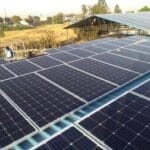
Solar technology is rapidly advancing with new features and modifications being added daily. The most crucial component of a solar system, the solar panels, must also advance to function more effectively and to overcome present constraints. In this article, we will explore the features and benefits of a new solar panel technology called bifacial solar panels and how it differs from other solar panels already on the Indian market.
What are Bifacial Solar Panels?
Bifacial solar panels are two-faced energy plants that generate solar electricity on both their top and bottom sides. In contrast to mono facial panels, bifacial solar panels show both the front and back of the solar cells. Some bifacial panel manufacturers claim that the additional power produced from the back can enhance total energy production by up to 30% when bifacial modules are mounted on highly reflective surfaces.
Bifacial modules come in different types of designs. Some of them have frames, while others don’t. Some have two layers of glass, while others have clear back sheets. Although there are polycrystalline designs, most use monocrystalline cells. One thing that always remains the same is that power is generated from both sides of the panels.
How do Bifacial Solar Panels work?
Bifacial solar panels operate just like regular solar panels. A portion of the sun’s energy is directly absorbed by solar cells and used to create electricity. The top solar cells on the panels work exactly like the cells of conventional solar panels. What makes bifacial panels different is that they absorb the light that is reflected off the ground. This is done by the bottom cells of the bifacial solar panels.
How are Bifacial Solar Panels installed?
The installation of the bifacial solar panels depends upon the type of module. Due to the fact that conventional mounting and racking methods are already configured to accommodate framed models, a framed bifacial module may be simpler to install than a frameless one. The majority of bifacial solar panel manufacturers offer their own clamps to install their brand’s solar panels, eliminating any installation concerns.
For the frameless bifacial modules, the module clamps have rubber guards to protect the glass. It is important to avoid the overtightening of bolts and breaking of the glass. The efficiency of the bifacial solar panels increases with the tilt of the module. Any reflected light is prevented from reaching the backside of the cells the bottom side is directly attached to a rooftop. The more the tilt in the solar panel module, the more the light is absorbed and hence, more power is generated. Because of this very reason, bifacial modules perform better on flat commercial rooftops as they have more area for tilt.
The performance of the bifacial modules can be impacted by the mounting system itself. Back rows of bifacial cells will be shaded by rack systems with support rails, which are typically covered by the back sheet of a mono facial module. In order to avoid shading, junction boxes on bifacial panels have also shrunk or been divided into several pieces that are positioned along the panel’s edge. The issue of rear shading is eliminated by mounting and racking techniques designed specifically for bifacial installations.
Advantages of using Bifacial Solar Panels
- Higher Efficiency: Bifacial modules boost overall energy generation since they generate power from both sides of the panel. Bifacial solar panels, according to certain manufacturers, can produce up to 30% more energy than traditional mono facial solar panels.
- Lesser Space and Panels: Since they generate power from both sides of the panel, they have higher efficiency. Due to the less space required per watt due to the improved efficiency, homeowners can install fewer panels to suit their needs.
- More Durable: Bifacial panels are more durable since they are frameless and have tempered glass on both sides. The tempered glass can survive high temperatures and powerful winds in addition to being UV and weather-resistant. Bifacial solar panels are expected to last longer due to their durability.
- Aesthetically Pleasing: Bifacial solar panels come in many designs and one of them is the frameless bifacial modules. ones. Compared to mono facial solar panels, many people find the entire glass frame to be aesthetically beautiful.
- Energy Production in Bad Weather: If you choose mono-facial panels, the bad weather will have a direct impact on how much your solar panels produce. However, installing bifacial panels makes a difference. Though the front side of the panels is hindered by the bad weather conditions, the back side of the panels continues to operate effectively.
Like every other thing, bifacial solar panels also have certain drawbacks to them. Here are the disadvantages of the bifacial solar panels-
- Overweight: Bifacial solar panels are extremely heavy and need care in handling. Their heavy weight can also compromise the strength of the roof if the installation is roof-mounted. The maintenance of the solar panels also becomes difficult as they are difficult to move. For installing the panels, a person should hire experts to assess the structural integrity of the roof before installation.
- Overpriced: The bifacial solar panels are not only heavier than the mono-facial panels, but they are also more expensive. Their installation fees are on par with those of standard installations. Although they are more expensive, bifacial solar panels make up for this by producing more electricity. When that is taken into account, they are equivalent to mono facial in terms of overall energy cost.
Bifacial solar panels have their pros and cons, but they have a remarkable impact on the solar market. They have a ton of advantages and can turn out to be a perfect purchase for you.