
The rapid expansion of solar photovoltaic (PV) technology has made renewable solar one of the most important contributors to the global transition toward clean and sustainable energy. From residential rooftop systems to commercial buildings, industrial facilities, and utility-scale solar farms, photovoltaic installations are helping reduce carbon emissions while providing reliable solar electricity. Although solar PV systems are environmentally friendly during operation, the installation, operation, maintenance, and decommissioning of these systems expose workers and equipment to a variety of environmental hazards that must be properly identified and managed.
Environmental hazards are natural or site-related conditions that can adversely affect worker safety, equipment performance, project timelines, and long-term system reliability. Unlike electrical or mechanical hazards, environmental hazards often originate from weather conditions, geographical features, biological factors, pollution, and surrounding ecosystems. Examples include extreme heat, heavy rainfall, lightning, flooding, high winds, dust storms, wildlife interference, vegetation growth, poor air quality, waterlogging, corrosive environments, and unstable terrain.
Failure to recognize and mitigate environmental hazards can lead to equipment failures, workplace accidents, reduced solar electricity generation, increased maintenance costs, project delays, and shortened component lifespan. Therefore, environmental hazard identification is an essential part of site assessment, risk management, installation planning, commissioning, operation, and preventive maintenance.
Every solar project should include a detailed environmental assessment before installation begins. Engineers, installers, supervisors, Health, Safety, and Environment (HSE) professionals, EPC contractors, and Operations & Maintenance (O&M) teams should evaluate site-specific environmental risks and implement suitable mitigation measures throughout the project lifecycle.
Identifying environmental hazards and adopting preventive measures are critical responsibilities for ensuring safe, efficient, and reliable solar PV installations.
This comprehensive guide explains the major environmental hazards associated with photovoltaic installations, their impact on system performance and worker safety, mitigation strategies, documentation requirements, and industry best practices.
What Are Environmental Hazards?
Environmental hazards are naturally occurring or site-specific conditions that may negatively affect workers, equipment, infrastructure, or project operations.
These hazards can arise from:
- Weather conditions
- Geographical features
- Biological organisms
- Environmental pollution
- Climate-related events
- Natural disasters
Proper identification helps reduce operational risks and improve project planning.
Why Is Environmental Hazard Identification Important?
Identifying environmental hazards helps organizations:
- Protect workers
- Prevent equipment damage
- Improve project planning
- Reduce maintenance costs
- Increase equipment lifespan
- Maintain uninterrupted solar electricity generation
- Ensure regulatory compliance
- Improve overall system reliability
Proactive hazard identification also contributes to optimizing the long-term solar panel system cost.
Common Environmental Hazards in Photovoltaic Installations
1. Extreme Heat
Solar installations often operate in regions with high ambient temperatures.
Potential impacts include:
- Heat stress for workers
- Reduced PV module efficiency
- Inverter overheating
- Battery performance degradation
- Faster cable insulation aging
Mitigation Measures
- Schedule work during cooler hours.
- Provide shaded rest areas.
- Encourage regular hydration.
- Install adequate inverter ventilation.
- Monitor equipment temperatures.
2. Heavy Rainfall and Flooding
Excessive rainfall may cause:
- Water ingress into electrical equipment
- Foundation erosion
- Cable damage
- Waterlogging around equipment
- Delayed installation work
Mitigation Measures
- Install proper drainage systems.
- Elevate sensitive equipment where necessary.
- Use weatherproof enclosures.
- Inspect drainage channels regularly.
3. Lightning
Lightning presents serious hazards including:
- Electrical surges
- Equipment damage
- Fire
- Worker injury
Mitigation Measures
- Install lightning protection systems.
- Use surge protection devices (SPDs).
- Suspend outdoor work during thunderstorms.
- Ensure proper grounding and bonding.
4. High Winds
Strong winds may cause:
- Module displacement
- Mounting structure damage
- Falling objects
- Unsafe rooftop conditions
Mitigation Measures
- Design structures for local wind loads.
- Secure loose materials.
- Inspect mounting bolts regularly.
- Stop rooftop work during severe winds.
5. Dust and Sand
Dust accumulation reduces module performance.
Common problems include:
- Reduced light absorption
- Hot spots
- Increased cleaning frequency
- Abrasive wear
Mitigation Measures
- Clean modules regularly.
- Monitor performance trends.
- Install modules with appropriate tilt angles.
- Schedule preventive maintenance.
6. Snow and Ice (Applicable in Cold Regions)
Snow accumulation can:
- Reduce energy production
- Increase structural loading
- Delay maintenance activities
Mitigation Measures
- Design mounting structures for snow loads.
- Remove excessive snow safely.
- Inspect structures after severe weather.
7. Corrosive Environments
Coastal and industrial areas expose equipment to:
- Salt spray
- Chemical pollutants
- Corrosion of metal components
- Electrical connection degradation
Mitigation Measures
- Use corrosion-resistant materials.
- Apply protective coatings.
- Conduct frequent inspections.
- Replace corroded components promptly.
8. Vegetation Growth
Uncontrolled vegetation can:
- Shade PV modules
- Increase fire risk
- Obstruct maintenance access
- Attract wildlife
Mitigation Measures
- Implement regular vegetation management.
- Maintain safe clearance distances.
- Remove dry grass and combustible materials.
9. Wildlife and Animals
Birds, rodents, insects, and reptiles may:
- Damage cables
- Build nests beneath modules
- Block ventilation
- Increase maintenance requirements
Mitigation Measures
- Install cable protection.
- Use wildlife deterrents where appropriate.
- Conduct regular inspections.
- Remove nests safely and legally.
10. Poor Air Quality
Industrial pollution and airborne contaminants may reduce module efficiency.
Mitigation Measures
- Increase module cleaning frequency.
- Monitor environmental conditions.
- Select appropriate module coatings where applicable.
11. Unstable Ground Conditions
Weak soil or unstable terrain may cause:
- Foundation settlement
- Mounting structure movement
- Misalignment of PV arrays
Mitigation Measures
- Conduct geotechnical surveys.
- Design suitable foundations.
- Monitor structural stability.
12. Natural Disasters
Potential natural disasters include:
- Earthquakes
- Cyclones
- Floods
- Landslides
- Wildfires
Mitigation Measures
- Incorporate disaster-resistant design.
- Develop emergency response plans.
- Perform post-disaster inspections before restarting operations.
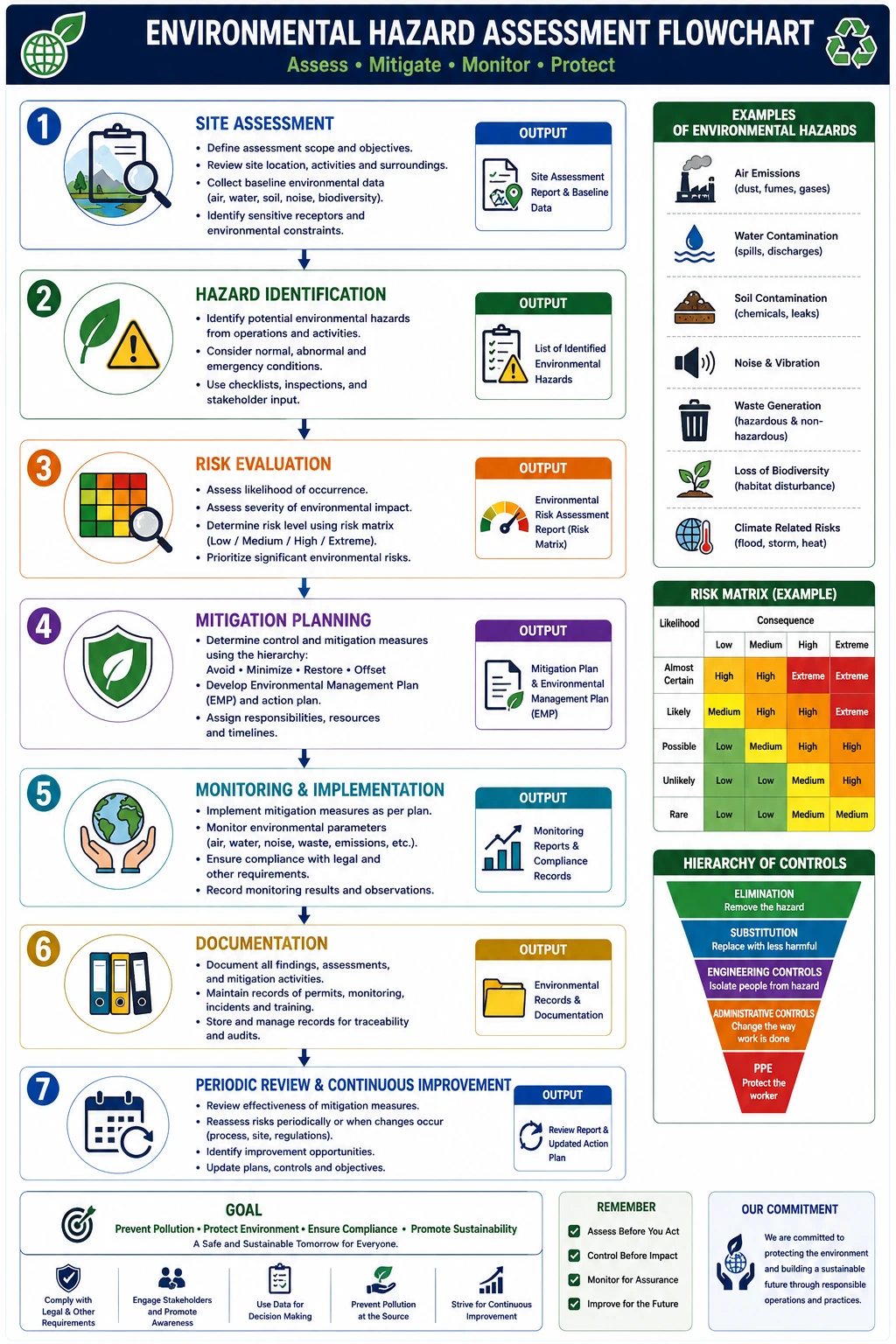
Environmental Hazard Identification Process
A systematic approach includes:
Step 1 – Site Assessment
- Evaluate local environmental conditions before installation.
Step 2 – Risk Assessment
- Determine the likelihood and severity of identified hazards.
Step 3 – Mitigation Planning
- Develop control measures for each identified risk.
Step 4 – Continuous Monitoring
- Inspect environmental conditions regularly during operation.
Step 5 – Documentation and Review
- Record hazards, inspections, and corrective actions for future reference.
Environmental Monitoring During Operation
Routine monitoring should include:
- Weather forecasts
- Temperature trends
- Dust accumulation
- Vegetation growth
- Wildlife activity
- Drainage systems
- Corrosion inspections
- Structural stability
Continuous monitoring improves preventive maintenance planning.
Conclusion
Identifying environmental hazards associated with photovoltaic installations is an essential step in ensuring safe, efficient, and reliable solar PV operations. Environmental conditions such as extreme temperatures, heavy rainfall, flooding, lightning, dust, strong winds, corrosion, vegetation growth, wildlife activity, and unstable terrain can significantly affect worker safety, equipment performance, and long-term project success if not properly managed. A proactive approach to hazard identification and mitigation enables organizations to reduce operational risks, improve maintenance planning, and maximize system performance.
Environmental hazard assessment should be integrated into every stage of a solar PV project, from site selection and installation to commissioning, operation, maintenance, and eventual decommissioning. Furthermore, organizations should align their environmental management practices with the guidance provided by the Ministry of New and Renewable Energy, applicable environmental regulations, manufacturer recommendations, and recognized engineering standards to ensure safe, sustainable, and compliant operations.
By conducting comprehensive environmental assessments, implementing effective mitigation strategies, maintaining detailed documentation, performing regular inspections, and fostering a culture of environmental responsibility, solar professionals can optimize solar panel system cost, improve renewable solar system reliability, maximize solar electricity generation, reduce the cost of solar per kWh installed, lower the solar installation cost per kWh, and support the long-term growth of renewable energy and solar energy across residential, commercial, industrial, and utility-scale applications.
FAQs
Q1. What are environmental hazards in photovoltaic installations?
Ans: Environmental hazards are natural or site-specific conditions, such as extreme heat, flooding, lightning, dust, high winds, wildlife, vegetation growth, and corrosive environments, that can affect worker safety, equipment performance, or project operations.
Q2. Why is it important to identify environmental hazards before installing a solar PV system?
Ans: Early identification allows engineers and installers to implement preventive measures, improve system design, protect equipment, reduce safety risks, minimize maintenance costs, and ensure reliable solar electricity generation.
Q3. How does dust affect solar PV system performance?
Ans: Dust accumulates on PV module surfaces, reducing the amount of sunlight reaching the solar cells. This lowers energy production, creates hot spots in some cases, and increases the need for regular cleaning and maintenance.
Q4. What environmental hazards are most common in utility-scale solar power plants?
Ans: Utility-scale projects commonly face challenges such as flooding, soil erosion, vegetation growth, wildlife interference, dust accumulation, extreme temperatures, lightning, and strong winds, all of which require ongoing monitoring and mitigation.
Q5. How can environmental hazards be mitigated in solar PV systems?
Ans: Hazards can be mitigated through proper site selection, effective drainage systems, lightning protection, corrosion-resistant materials, vegetation management, wildlife control measures, regular inspections, preventive maintenance, and continuous environmental monitoring.
Solar Financing for Businesses: Complete Guide to Funding Commercial & Industrial Solar Projects in India
Discover solar financing options for businesses in India, including CAPEX, OPEX, PPA models, solar loans, ROI, and funding strategies for commercial and industrial solar projects.

1 MW Solar Plant Cost in Uttar Pradesh | A Complete Guide
Planning to install a 1 MW solar power plant in Uttar Pradesh? This guide covers 2025 pricing, subsidy details, ROI, and savings for industries and businesses.
Solar Chankya: Complete Guide to Solar Systems and Components
Discover the key components of solar systems—from panels to inverters and batteries—and how they work together for efficient energy solutions
Commercial Solar Power Plant Subsidy in India: What Businesses Need to Know
Businesses in India can reduce their solar installation costs through various MNRE-backed subsidies and state incentives. Learn eligibility, benefits, and the application process for commercial solar plants.
Difference Between Electric Power and Energy: Why Is It Important for Solar Installers?
Electric power and electrical energy are fundamental concepts in solar installations. This guide explains their differences, formulas, units, and importance for solar PV system performance.
Solar Installation on Sloped Roofs: Design, Mounting Systems & Best Practices
A practical guide to flat roof solar installation covering key design considerations, mounting system types, and best practices for efficient and reliable performance.
The Rise of Clean Energy: Solar Energy Trends in 2023
The solar energy industry is on the rise, as the demand for clean and renewable energy sources continues to increase. 2023 is shaping up to be a big year for the solar energy sector, as new technologies and innovations are expected to drive growth and expand the reach of solar energy.
Flat Roof Solar Installation Guide: Design, Mounting Systems & Best Practices
A practical guide to flat roof solar installation covering key design considerations, mounting system types, and best practices for efficient and reliable performance.