
Before installing a solar photovoltaic (PV) system, it is essential to understand the electricity consumption pattern of the household or facility. One of the most reliable ways to determine energy usage is by carefully analyzing the electricity bill. Reading and interpreting the electricity bill helps solar installers and customers decide the appropriate solar plant capacity, ensuring that the solar system can meet energy needs efficiently.
Electricity bills provide critical information such as monthly energy consumption, tariff structure, sanctioned load, and billing cycle. These details are used to estimate the required solar system size, optimize solar panel system cost, and calculate the expected return on investment. Electricity bill analysis is one of the primary steps in designing an efficient solar PV system.
This article explains how to read an electricity bill and use the information to determine the appropriate capacity of a solar plant.
Why Electricity Bill Analysis is Important for Solar Installation
Electricity bill analysis helps installers understand how much electricity a household or building consumes. This information is essential for designing an efficient solar energy system for home use or commercial installations.
Key reasons why electricity bill analysis is important include:
- Determining daily and monthly electricity consumption
- Estimating required solar plant capacity
- Optimizing solar energy installation cost
- Improving renewable solar system efficiency
Without analyzing the electricity bill, installers may incorrectly size the solar plant, which can lead to higher solar installation charges or inadequate electricity generation.
Key Information Found in an Electricity Bill
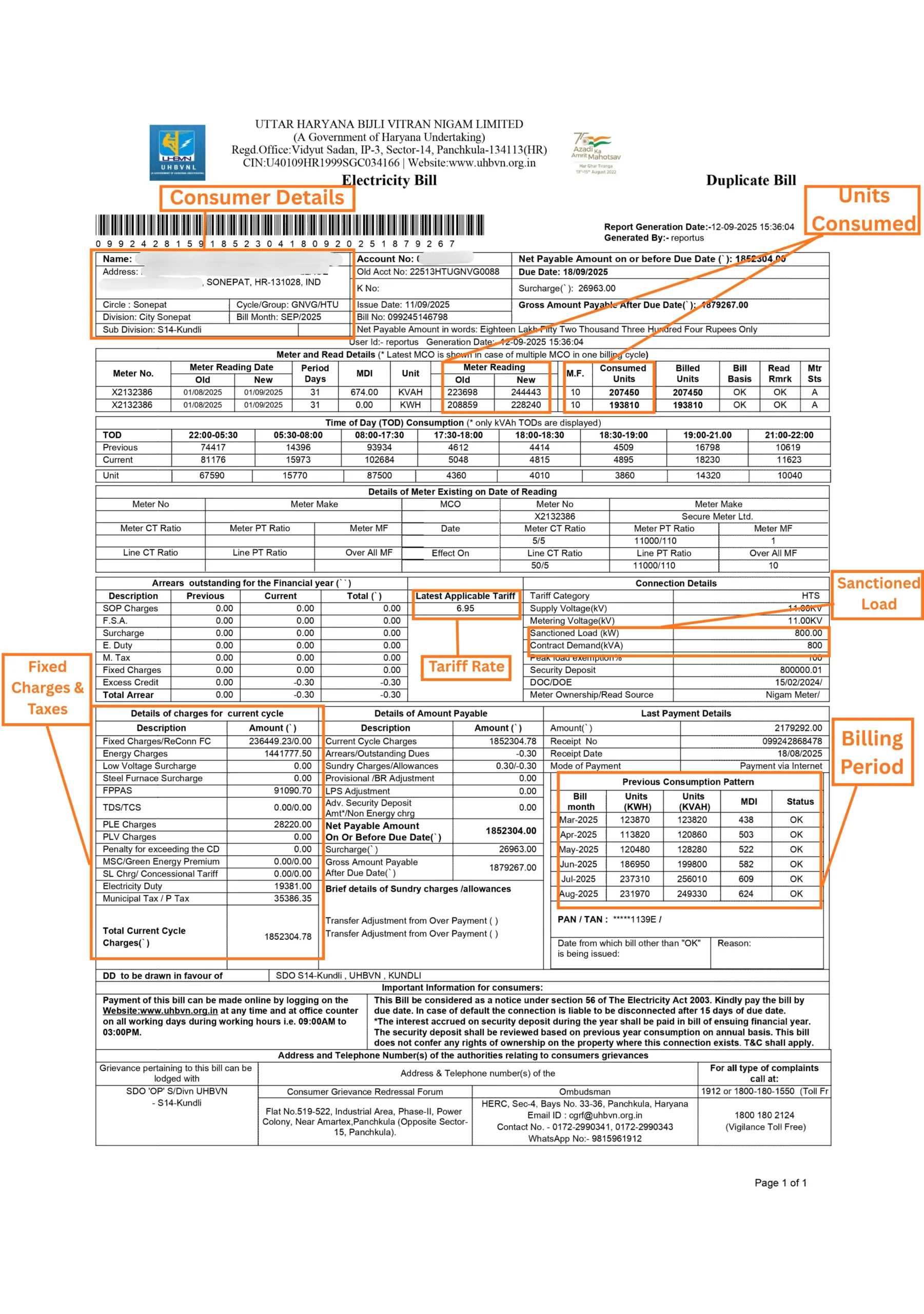
Electricity bills contain several important details that are useful for solar system planning.
1. Consumer Details
The top section of the bill usually includes:
- Consumer name
- Consumer number
- Address
- Tariff category (residential, commercial, or industrial)
These details help installers verify the type of connection and electricity tariff applicable to the property.
2. Billing Period
The billing period indicates the time duration for which electricity consumption is calculated.
For example:
- Monthly billing cycle
- Bi-monthly billing cycle
Understanding the billing period helps calculate average electricity usage per day.
3. Units Consumed (kWh)
One of the most important sections of the electricity bill is the total units consumed, usually measured in kilowatt-hours (kWh).
For example:
- 400 units in a month = 400 kWh energy consumption.
This data is used to determine the required solar plant capacity.
Example Calculation
If a household consumes:
- 400 units per month
Daily consumption = 400 ÷ 30 ≈ 13.3 kWh per day
- This value helps estimate the required solar system size.
4. Sanctioned Load or Connected Load
The electricity bill often mentions the sanctioned load, which represents the maximum electrical load allowed for the connection.
Example:
- 3 kW connection
- 5 kW connection
This information helps determine the suitable inverter capacity for the solar system.
5. Tariff Rate
Tariff rates indicate the cost per unit of electricity charged by the utility provider.
Understanding tariff rates helps estimate:
- Potential savings from solar electricity
- Payback period of the solar installation
- Cost of solar per kWh installed
6. Fixed Charges and Taxes
Electricity bills include additional charges such as:
- Fixed charges
- Electricity duty
- Fuel surcharge
- Taxes
These charges help customers understand the financial benefits of switching to renewable solar systems.
Steps to Read an Electricity Bill for Solar System Capacity Calculation
Below are the steps typically followed by solar installers.
Step 1 – Collect Electricity Bills for 12 Months
Analyzing electricity bills for the entire year helps understand seasonal energy consumption patterns.
For example:
- Higher usage in summer due to air conditioners
- Higher consumption in winter due to heating devices
This helps determine accurate system capacity.
Step 2 – Calculate Average Monthly Consumption
Add the total units consumed in a year and divide by 12 to calculate the average monthly consumption.
Example:
- Annual consumption = 4800 units
- Average monthly consumption = 4800 ÷ 12 = 400 units per month
Step 3 – Calculate Daily Energy Requirement
Daily energy requirement can be calculated using:
- Average monthly consumption ÷ 30
Example:
- 400 units ÷ 30 ≈ 13.3 kWh per day
Step 4 – Estimate Solar Plant Capacity
A general rule used by installers is:
- 1 kW solar plant generates approximately 4-5 units of electricity per day.
Using this estimation:
- Daily requirement = 13.3 units
Required solar plant capacity:
- 13.3 ÷ 4.5 ≈ 3 kW solar system
This helps determine the optimal solar panel system cost.
Step 5 – Verify Rooftop Space Availability
After calculating system capacity, installers must check if sufficient roof area is available for panel installation.
Typically:
- 1 kW solar system requires about 8–10 square meters of rooftop space.
- This ensures efficient solar panels in rooftop installations.
Impact of Electricity Bill Analysis on Solar Energy Installation Cost
Proper electricity bill analysis helps optimize solar system design.
Benefits include:
- Accurate solar plant sizing
- Reduced solar installation charges
- Better financial planning
- Improved renewable solar system performance
It also helps estimate the cost of solar per kWh installed, which determines long-term savings.
Benefits of Using Electricity Bills for Solar System Planning
Analyzing electricity bills provides several advantages.
- Helps determine energy consumption patterns
- Prevents oversizing or undersizing of solar systems
- Improves solar electricity generation efficiency
- Reduces overall solar energy installation cost
It also helps customers understand how renewable energy technology can reduce electricity expenses.
Conclusion
Electricity bill analysis is one of the most important steps in planning a solar PV system. By carefully examining energy consumption patterns, installers can determine the appropriate solar plant capacity that meets the customer’s electricity requirements. This ensures optimal solar electricity generation, reduced solar installation charges, and improved financial returns.
Understanding electricity bills allows solar professionals to design efficient renewable solar systems tailored to customer needs. Accurate bill analysis helps optimize solar panel system cost, reduce solar energy installation cost, and ensure long-term benefits from renewable energy technology.
With proper electricity bill evaluation, solar installations can deliver reliable solar energy for home use and contribute to the growing adoption of renewable solar energy solutions.
FAQs
Q1. Why is it necessary to read the electricity bill before installing solar panels?
Ans: Electricity bill analysis helps determine the energy consumption of a household or facility, which is required to calculate the appropriate solar plant capacity.
Q2. What information from the electricity bill is used for solar system design?
Ans: Important details include units consumed, billing period, sanctioned load, tariff rate, and total electricity charges.
Q3. How many units does a 1 kW solar system generate per day?
Ans: On average, a 1 kW solar system generates around 4–5 units of solar electricity per day, depending on sunlight conditions.
Q4. How does electricity bill analysis affect solar panel system cost?
Ans: Accurate analysis helps determine the correct system size, preventing unnecessary equipment costs.
Q5. Can electricity bills help estimate savings from solar energy?
Ans: Yes. By comparing current electricity expenses with solar electricity generation, customers can estimate potential savings and payback periods.
Industrial Solar Plants with Diesel Generator Backup: What You Need to Know
Discover how industries can efficiently run rooftop solar plants alongside diesel generators (DG). Learn the benefits, setup tips, and hybrid system strategies to ensure uninterrupted power and maximize energy savings.
Solar Electrical Installation Toolkit: Inspection & Usage Guide
A complete guide to the electrical installation toolkit for solar installers, including inspection procedures, tool usage, and safety practices.

Workplace Safety Violations in Solar PV Projects
A complete guide to establishing and following safe work procedures in solar PV systems, ensuring worker safety during installation, testing, commissioning, operation, and maintenance.

Rajasthan Rooftop Solar Subsidy: What Homeowners Need to Know
Rajasthan homeowners can save big with the 2025 rooftop solar subsidy. Learn about the updated rates, eligibility criteria, and benefits to make your switch to solar more affordable.

Electrical Hazards in Solar PV Systems Guide
A complete guide to identifying electrical hazards in solar PV systems, covering shock, arc flash, DC voltage, wiring, grounding, and electrical fire risks.
Grid-Connected Solar PV System Startup Guide
A complete guide to starting up a grid-connected solar PV system, including commissioning, grid synchronization, electrical safety checks, and operational verification.

How Quickly Can Solar Panels Pay for Themselves? Payback Period Explained
Learn how the solar panel payback period works, factors that affect ROI, and how soon you can recover your solar investment.

100 kW Solar Plant Cost in Rajasthan: Latest Cost, Maintenance & Payback Time
Installing a 100 kW solar plant in Rajasthan costs around ₹40–60 lakh in, with annual savings up to ₹10–12 lakh. Discover maintenance needs, ROI, and payback period of 4–6 years.