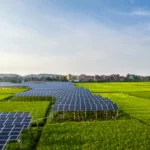
India’s Renewable Energy Revolution: The Role of Agrivoltaics
The International Institute for Sustainable Development (IISD) recently published a report outlining different business models that can help India overcome the challenges of implementing agrivoltaics, a practice where solar panels are installed on agricultural land.
The report suggests three specific models:
- Joint ownership between farmers and developers
- Sole ownership by either party
- Developer-led partnerships with farmers.
Currently, India has around 14,636.6 kW of agrivoltaics capacity in the pilot stages. The report emphasizes the difficulties faced by Indian farmers and developers in adopting agrivoltaics and recommends following the third model, where developers take the lead and farmers become partners. However, this model is only suitable for barren or uncultivated areas due to poor land productivity or state ownership.
Around 53% of India’s land area is classified as arid or semi-arid, and most solar power capacity is installed in such regions with low cropping intensity. These areas, along with peri-urban regions, are favorable for agrivoltaics. However, successful implementation requires proximity to markets for high-value horticultural products.
The report suggests that state governments introduce land-use regulations and define clear standards for agrivoltaics. Different market mechanisms and tariff structures should also be explored to support agrivoltaics.
The use of bifacial solar panels is recommended in Indian agrivoltaic projects as they reduce shading effects, increase power generation, and offer more crop choices.
Integrating rainwater harvesting structures with agrivoltaics is also seen as a promising solution. However, further research and peer learning are necessary due to India’s unique weather conditions. Battery storage is an option for energy storage, but alternative technologies should be considered for farmers who cannot afford it.
Most agrivoltaic pilots in India, initiated under the Pradhan Mantri Kisan Urja Suraksha evam Utthaan Mahabhiyan (PM-KUSUM) program, have not yet grown mainstream crops like paddy and wheat. Proper planning is required to ensure solar panels do not hinder crop production. The report also suggests exploring the option of open access, where developers can directly sell power from agrivoltaic projects to consumers at agreed-upon prices.
Countries like China, Germany, France, and Japan are actively promoting and updating designs and standards for agrivoltaics. They integrate solar panels with different farming systems, such as greenhouses and conventional open farming systems, to adapt to diverse agricultural activities and weather conditions. These countries have a cumulative installed agrivoltaics capacity of approximately 2.5 GW. Italy and France also have significant investments in agrivoltaics.
The report concludes that grid-connected agrivoltaic systems are more scalable than off-grid systems due to higher power production. However, adequate evacuation capacity and proximity to substations are crucial for grid-connected renewable energy to minimize losses. Exploring these aspects in Indian agrivoltaics is an area that requires further exploration.
Suggested Articles

Solar for Industrial Use in India: Costs, Benefits & Energy Savings Explained
Solar for industrial use in India is rapidly transforming how factories manage energy costs and efficiency. This guide covers system sizes, costs, benefits, ROI, and how solar energy helps manufacturing units, warehouses, and industrial plants reduce power bills and ensure long-term sustainability.

Rooftop Solar: Reduce Your Electricity Bill and Increase Savings
Discover how installing a rooftop solar system can help you save on electricity bills, reduce peak demand charges, and take advantage of government incentives.

Solar PV Procurement Process Guide for EPC & Installers | Step-by-Step
A well-planned procurement process is critical for the success of any solar PV project. This guide explains step-by-step how EPC companies and installers can efficiently source solar panels, inverters, and balance of system components while ensuring quality, cost-effectiveness, and timely delivery.

Cable Continuity Testing in Solar Installations Guide
A complete guide to cable termination in solar installations, including tools, step-by-step methods, and best practices for safe connections.

Solar Module Support & Racking Frame Installation
A practical guide to solar racking frame installation, covering module support structures, alignment, and best practices for reliable PV systems.

Solar PV Startup & Energy Meter Recording Guide
A complete guide to solar PV startup procedures and energy meter recording, ensuring proper commissioning, documentation, and system performance verification.

UPNEDA Solar Subsidy 2025: How to Maximize Savings on Rooftop Solar
Discover how the UPNEDA Solar Subsidy 2025 can help you cut electricity costs and make rooftop solar more affordable. Learn about eligibility, subsidy rates, and the step-by-step application process.

Safe Handling of Solar PV Components: Complete Guide for EPC & Installers
Proper material handling is crucial in solar PV projects to avoid damage, reduce losses, and ensure safety. This guide covers best practices for transporting, storing, and installing solar components efficiently.