
Workplace safety is one of the most critical aspects of the solar photovoltaic (PV) industry. As solar projects continue to expand across residential, commercial, industrial, and utility-scale sectors, organizations must establish and implement comprehensive corporate safety policies that protect employees, contractors, customers, equipment, and the environment. Whether installing a rooftop solar plant, commissioning a utility-scale solar farm, maintaining an inverter, or inspecting battery storage systems, every activity must be governed by clearly defined workplace safety policies.
Corporate safety policies provide standardized guidelines that help organizations manage occupational health and safety risks while ensuring compliance with legal requirements and industry standards. These policies define responsibilities, establish safe work practices, outline emergency response procedures, regulate the use of Personal Protective Equipment (PPE), promote hazard reporting, and encourage continuous improvement in workplace safety.
The solar industry presents several unique hazards, including electrical shock, arc flash, falls from height, manual handling injuries, fire hazards, battery chemical exposure, confined spaces, and adverse weather conditions. Without effective corporate policies, these hazards can lead to accidents, project delays, equipment damage, financial losses, and legal consequences.
A strong safety culture begins with management commitment and extends to every employee, supervisor, contractor, and visitor. Organizations that prioritize safety experience fewer workplace incidents, improved employee confidence, better project quality, enhanced operational efficiency, and greater reliability of solar electricity generation systems.
Understanding workplace safety policies is a fundamental responsibility for solar installers, commissioning engineers, EPC contractors, supervisors, and Operations & Maintenance (O&M) professionals.
This comprehensive guide explains the corporate policies commonly required for workplace safety in solar PV projects, their objectives, implementation methods, documentation requirements, and best practices.
What Are Corporate Safety Policies?
Corporate safety policies are officially documented organizational rules and procedures designed to protect employees, contractors, visitors, equipment, and the environment from workplace hazards.
These policies establish:
- Safety expectations
- Employee responsibilities
- Management responsibilities
- Safe work practices
- Reporting procedures
- Emergency response requirements
- Compliance obligations
They apply throughout the lifecycle of a solar plant, including design, installation, commissioning, operation, maintenance, and decommissioning.
Why Are Corporate Safety Policies Important?
Well-defined safety policies help organizations:
- Prevent workplace accidents
- Reduce occupational injuries
- Protect valuable equipment
- Improve employee awareness
- Maintain legal compliance
- Reduce project delays
- Improve productivity
- Support reliable solar electricity generation
Strong policies also contribute to reducing operational costs and improving the overall solar panel system cost over the system’s lifetime.
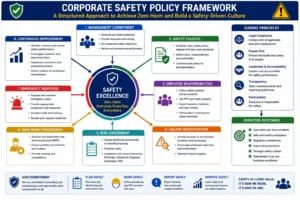
Essential Corporate Policies for Workplace Safety
1. Occupational Health and Safety (OHS) Policy
The Occupational Health and Safety Policy defines the organization’s commitment to maintaining a safe and healthy workplace.
It typically includes:
- Safety objectives
- Employee responsibilities
- Management commitment
- Compliance requirements
- Continuous improvement initiatives
2. Personal Protective Equipment (PPE) Policy
This policy specifies:
- Mandatory PPE requirements
- PPE inspection procedures
- Replacement schedules
- Proper usage instructions
- Storage requirements
Common PPE includes:
- Safety helmet
- Electrical insulating gloves
- Safety glasses
- High-visibility clothing
- Safety footwear
- Fall arrest harness
3. Lockout/Tagout (LOTO) Policy
LOTO policies prevent accidental energization of electrical equipment during maintenance.
The policy includes:
Isolation procedures
Locking devices
Warning tags
Verification of de-energization
Authorization requirements
4. Working at Height Policy
Solar installations frequently involve rooftop work.
This policy defines:
- Fall protection requirement
- Ladder safety
- Scaffolding standards
- Roof access procedures
- Rescue plans
5. Electrical Safety Policy
Electrical safety policies govern:
- Safe isolation procedures
- Voltage testing
- Grounding requirements
- Arc flash protection
- Use of insulated tools
- Electrical permit systems
These policies are especially important because PV modules generate electricity whenever exposed to sunlight.
6. Permit-to-Work (PTW) Policy
Certain high-risk activities require formal authorization before work begins.
Permit systems commonly cover:
- Electrical work
- Hot work
- Working at heights
- Confined space entry
- Excavation
7. Hazard Identification and Risk Assessment (HIRA) Policy
Organizations should require:
- Hazard identification
- Risk assessment
- Risk control measures
- Periodic review
- Documentation
Every task should be evaluated before work starts.
8. Emergency Response Policy
Emergency preparedness includes:
- Fire response
- Electrical shock procedures
- Medical emergencies
- Battery chemical spills
- Evacuation plans
- Emergency communication
Emergency contact information should always be readily available.
9. Fire Safety Policy
Fire safety procedures include:
- Fire extinguisher placement
- Fire alarm systems
- Emergency exits
- Fire drills
- Combustible material handling
10. Incident Reporting Policy
Employees should report:
- Accidents
- Near misses
- Unsafe conditions
- Equipment failures
- Environmental incidents
Prompt reporting supports continuous improvement.
11. Training and Competency Policy
Organizations should ensure workers receive training on:
- Electrical safety
- First aid
- Fire safety
- PPE usage
- Equipment operation
- Emergency procedures
- Safe work practices
Regular refresher training helps maintain competency.
12. Environmental Protection Policy
Environmental policies address:
- Waste disposal
- Chemical handling
- Spill prevention
- Recycling
- Pollution control
These practices support sustainable renewable solar development.
13. Substance Abuse Policy
Workers should not perform safety-sensitive tasks while impaired by alcohol or drugs.
Policies should clearly define:
- Prohibited substances
- Testing requirements
- Reporting obligations
- Disciplinary actions
14. Contractor Safety Policy
Contractors should:
- Follow company safety procedures
- Attend safety inductions
- Wear required PPE
- Report hazards
- Participate in toolbox talks
Safety requirements should apply equally to employees and contractors.
Employee Responsibilities
Employees should:
- Follow all corporate safety policies.
- Wear required PPE.
- Report hazards immediately.
- Use approved tools.
- Attend safety training.
- Follow supervisor instructions.
- Participate in emergency drills.
- Maintain good housekeeping.
Every employee shares responsibility for workplace safety.
Management Responsibilities
Management should:
- Demonstrate leadership commitment.
- Provide adequate training.
- Supply appropriate PPE.
- Conduct workplace inspections.
- Investigate incidents.
- Review safety performance.
- Encourage hazard reporting.
- Promote continuous improvement.
Strong leadership builds a positive safety culture.
Conclusion
Corporate safety policies are essential for creating a safe, compliant, and productive working environment in the solar PV industry. They establish clear expectations for employees, contractors, and management while providing structured procedures for hazard identification, risk assessment, PPE usage, electrical safety, emergency preparedness, incident reporting, and continuous improvement. When implemented effectively, these policies reduce workplace risks, improve operational efficiency, and contribute to the long-term success of solar energy projects.
Every solar professional should understand and follow workplace safety policies as part of their daily responsibilities. Furthermore, organizations should align their corporate safety programs with the guidance of the Ministry of New and Renewable Energy, applicable occupational safety regulations, manufacturer recommendations, and recognized electrical standards to ensure safe and responsible operations.
By fostering a proactive safety culture, investing in employee training, maintaining accurate documentation, conducting regular audits, and continuously improving corporate safety policies, organizations can optimize solar panel system cost, enhance renewable solar system reliability, maximize solar electricity generation, reduce the cost of solar per kWh installed, lower the solar installation cost per kWh, and support the sustainable growth of renewable energy and solar energy across residential, commercial, industrial, and utility-scale applications.
FAQs
Q1. Why are corporate safety policies important in the solar PV industry?
Ans: Corporate safety policies provide standardized procedures that help prevent workplace accidents, protect employees, ensure legal compliance, improve project quality, and support the safe installation, operation, and maintenance of solar PV systems.
Q2. What are the most important workplace safety policies for solar projects?
Ans: Key policies include Occupational Health and Safety (OHS), Personal Protective Equipment (PPE), Lockout/Tagout (LOTO), Electrical Safety, Working at Heights, Permit-to-Work (PTW), Hazard Identification and Risk Assessment (HIRA), Emergency Response, Fire Safety, and Incident Reporting.
Q3. What responsibilities do employees have regarding workplace safety policies?
Ans: Employees are responsible for following company safety procedures, wearing appropriate PPE, reporting hazards and incidents, attending safety training, using approved tools correctly, and participating in emergency drills and toolbox talks.
Q4. How do corporate safety policies improve solar project performance?
Ans: By reducing accidents, minimizing equipment damage, improving work quality, preventing delays, and encouraging consistent safety practices, corporate policies contribute to reliable solar electricity generation and more efficient project execution.
Q5. How often should workplace safety policies be reviewed?
Ans: Corporate safety policies should be reviewed periodically, especially after workplace incidents, changes in regulations, introduction of new technologies, or updates to organizational processes, to ensure they remain effective and relevant.
Understanding Solar Cells and Modules: A Complete Guide
Understand solar cells and modules, their functioning, and advantages for residential and commercial solar installations.

Importance of MPPT in Solar System: Maximizing Solar Power Efficiency
MPPT plays a crucial role in solar systems by extracting maximum power from panels under varying conditions. Learn how MPPT improves efficiency, performance, and savings.

Rooftop Solar for Factories: Cost, Benefits, ROI & Installation Guide in India
Learn how rooftop solar for factories in India lowers power costs with high ROI, faster payback, and long-term energy savings for industrial facilities.
Fuses & Circuit Breakers Inspection Guide for Solar PV Systems
A complete guide to inspecting fuses and circuit breakers in solar PV systems, including testing methods, fault identification, preventive maintenance, and safety checks for reliable system operation.

Solar Sector Growth in India Slows as Investments Decline in Q1 2023
India’s solar sector experiences an investment slowdown in Q1 2023, reflecting challenges in funding and growth for renewable energy projects.
How to Check Equipment Location for Solar PV Systems
A complete guide to battery bank enclosure and rack installation, including site verification, setup procedures, and safety practices for solar PV systems.
From Solar Design to Site: Locating Footings for Solar Mounting Structures
A complete guide to translating solar design drawings into accurate footing locations on-site, including survey methods, marking techniques, and EPC best practices.

What Is an Array Junction Box in Solar PV Modules? | Complete Guide
The Array Junction Box (AJB) is a critical component in solar PV systems, connecting multiple solar modules and ensuring safe flow of electricity to the inverter. This blog explains what an AJB is, its key features, types, and why it is essential for both residential and commercial solar installations. Understand how AJBs protect your system from overload, short circuits, and environmental factors while maintaining optimal performance.