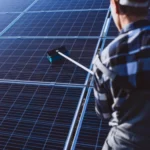
How to Safely Install Solar Panels on Metal and Asbestos Rooftops
Factories in Delhi and NCR regions have a variety of roofs ranging from flat concrete roofs, metal sheds which are mostly inclined and even the asbestos sheets laid over the top.
Solar on Metal & Asbestos Roofs
The Solar Plant can be installed on any roof that has sufficient strength.
Solar on Concrete Roofs
On flat concrete roofs, it is quite easy to lay the solar panels. The civil foundations need to be laid in a way that the water should not seep into the roof. Over the foundations, the structure made up of hot dipped galvanized steel needs to be built of sufficient strength. The structure should preferably give a tilt of 20 degree around in Delhi and NCR to get the best solar irradiation. The panels should face to the South side to the extent possible.
Solar on Metal Sheds
The Metal sheds can be facing east-west or north-south. If the metal structure has sufficient strength, the solar panels can be easily laid. The solar panel structure should be such that it is light and strong enough to hold panels. In typical sheds, the purlins and associated structures are designed to take weights of more than 100 kg per square meter. Solar plant will weight around 20-25 kgs per square meter, hence the weight of plant is never a problem unless the purlins are not strong enough.
However, the factory owners should be careful while allowing the puncture in the roof. Water leakages would tend to happen from the punctured holes in the roof. Over time, the screws put on these punctured roofs will have movement due to the pressure from strong winds and the puncture size will increase. So, while installing panels or building pathways or side rails, these punctures need to be reduced to the maximum.
Solar on Asbestos Sheets
Similarly, panels can be installed on asbestos sheets. The old sheets need to be replaced in such installations. Typical asbestos sheet has a life of 10 years. Again, it is not the sheet but the purlin structure that has to take the weight of the solar panels and structures. Asbestos sheets should have enough strength that the man power for plant installation can freely walk and do their work.
Suggested Articles

Solar O&M Services: How to Ensure Peak Performance & Maximum Power for Solar System
Discover how Solar O&M services keep your solar system running at its best. From routine maintenance to performance monitoring, ensure maximum power and efficiency.
Optimizing Solar Layout for DC Combiner Box Placement
A complete guide to choosing the best location for DC combiner box placement to improve safety, cable routing, and solar system efficiency.
What Is a Solar Power Generating System? | Complete Guide
A solar power generating system converts sunlight into electricity for residential, industrial, and commercial use. This blog explains the components, working, and benefits of solar systems, helping you understand how to harness solar energy efficiently and sustainably.
Solar Installation on Sloped Roofs: Design, Mounting Systems & Best Practices
A practical guide to flat roof solar installation covering key design considerations, mounting system types, and best practices for efficient and reliable performance.

Solar Panel Unpacking Guide: Do’s & Don’ts on Site
A practical solar panel unpacking guide covering safe handling, on-site precautions, and key do’s and don’ts to avoid module damage.
Solar for Manufacturing Units: Cost, Benefits, ROI & Installation in India
A detailed guide on 1 MW solar plant for industry covering installation cost, area requirement, power generation, ROI, and long-term savings in India.
How to Monitor Industrial Solar Plant Performance
A complete guide to monitoring industrial solar plant performance, covering energy generation tracking, performance ratio, inverter efficiency, data analytics, fault detection, and preventive maintenance.
Safety Hazard Identification & Mitigation in Solar PV
A complete guide to identifying and mitigating safety hazards in solar PV systems, including risk assessment, hazard control, preventive measures, and workplace safety practices.