
Batteries are one of the most critical components of off-grid and hybrid solar photovoltaic (PV) systems. They store excess electricity generated by solar panels during the day and supply power when solar generation is unavailable, such as during the night, cloudy weather, or grid outages. Since batteries directly influence the reliability, efficiency, and lifespan of a renewable solar system, regular inspection and maintenance are essential to ensure safe operation and optimal performance.
Unlike solar PV modules that require relatively minimal maintenance, batteries demand periodic inspection, cleaning, testing, and performance monitoring. Improper battery maintenance can lead to reduced storage capacity, voltage imbalance, corrosion, overheating, electrolyte loss (in flooded batteries), shortened battery life, and even safety hazards such as fire or acid leakage.
Routine battery maintenance helps identify issues before they become major failures, ensuring uninterrupted solar electricity generation and reducing costly battery replacements. Whether the system uses lead-acid, VRLA (Valve-Regulated Lead-Acid), AGM, Gel, or Lithium-ion batteries, following manufacturer recommendations and preventive maintenance schedules significantly improves system reliability.
Battery maintenance is a vital responsibility for solar installers, commissioning engineers, EPC contractors, and operations and maintenance (O&M) professionals to ensure safe and efficient operation of solar PV systems.
This comprehensive guide explains the importance of battery maintenance, inspection procedures, testing methods, safety precautions, documentation requirements, and industry best practices.
Why are Batteries Important in Solar PV Systems?
Batteries store excess solar electricity and provide backup power when solar generation is insufficient.
They are commonly used in:
- Off-grid solar systems
- Hybrid solar systems
- Telecom solar installations
- Rural electrification projects
- Mini-grid solar projects
- Emergency backup systems
Proper battery maintenance ensures uninterrupted power availability and efficient renewable solar operation.
Objectives of Battery Maintenance
Regular battery maintenance helps to:
- Improve battery lifespan
- Maintain storage capacity
- Prevent unexpected failures
- Enhance the renewable solar system efficiency
- Ensure safe operation
- Reduce replacement costs
- Support preventive maintenance
Types of Batteries Used in Solar PV Systems
Different battery technologies require different maintenance practices.
Common battery types include:
Flooded Lead-Acid Batteries
- Require periodic electrolyte level checks and hydrometer testing.
AGM (Absorbent Glass Mat) Batteries
- Maintenance-free but requires regular inspection.
Gel Batteries
- Sealed batteries with minimal maintenance requirements.
Lithium-Ion Batteries
- Require electronic monitoring through the Battery Management System (BMS).
VRLA Batteries
- Valve-Regulated Lead-Acid batteries require visual inspection and electrical testing.
Importance of Routine Battery Maintenance
Regular maintenance helps:
- Detect corrosion
- Identify loose terminals
- Monitor voltage
- Prevent overheating
- Improve charging efficiency
- Maintain battery balance
- Reduce downtime
Routine maintenance improves overall renewable solar system reliability.
Components to Inspect During Battery Maintenance
1. Battery Terminals
Inspect for:
- Corrosion
- Loose connections
- Overheating
- Damaged terminals
Clean terminals improve electrical conductivity.
2. Battery Cables
Check for:
- Loose connections
- Damaged insulation
- Corrosion
- Proper routing
Replace damaged cables immediately.
3. Battery Enclosure
Inspect:
- Ventilation
- Structural condition
- Cleanliness
- Moisture
- Security
Proper ventilation prevents overheating.
4. Battery Rack
Verify:
- Structural integrity
- Corrosion
- Tight fastening
- Proper spacing
Secure racks improve safety.
5. Electrolyte Level (Flooded Batteries)
- Check electrolyte level regularly.
- Only use distilled water if topping up is required.
- Never overfill.
6. Battery Voltage
Measure:
- Individual battery voltage
- Bank voltage
Voltage imbalance may indicate battery deterioration.
7. Battery Temperature
- Monitor battery temperature regularly.
- High temperatures reduce battery lifespan significantly.
Tools Required for Battery Maintenance
Common maintenance tools include:
- Digital multimeter
- Hydrometer (for flooded batteries)
- Clamp meter
- Infrared thermometer
- Torque wrench
- Terminal cleaning brush
- Distilled water
- Personal protective equipment (PPE)
- Battery inspection checklist
Always use calibrated instruments.
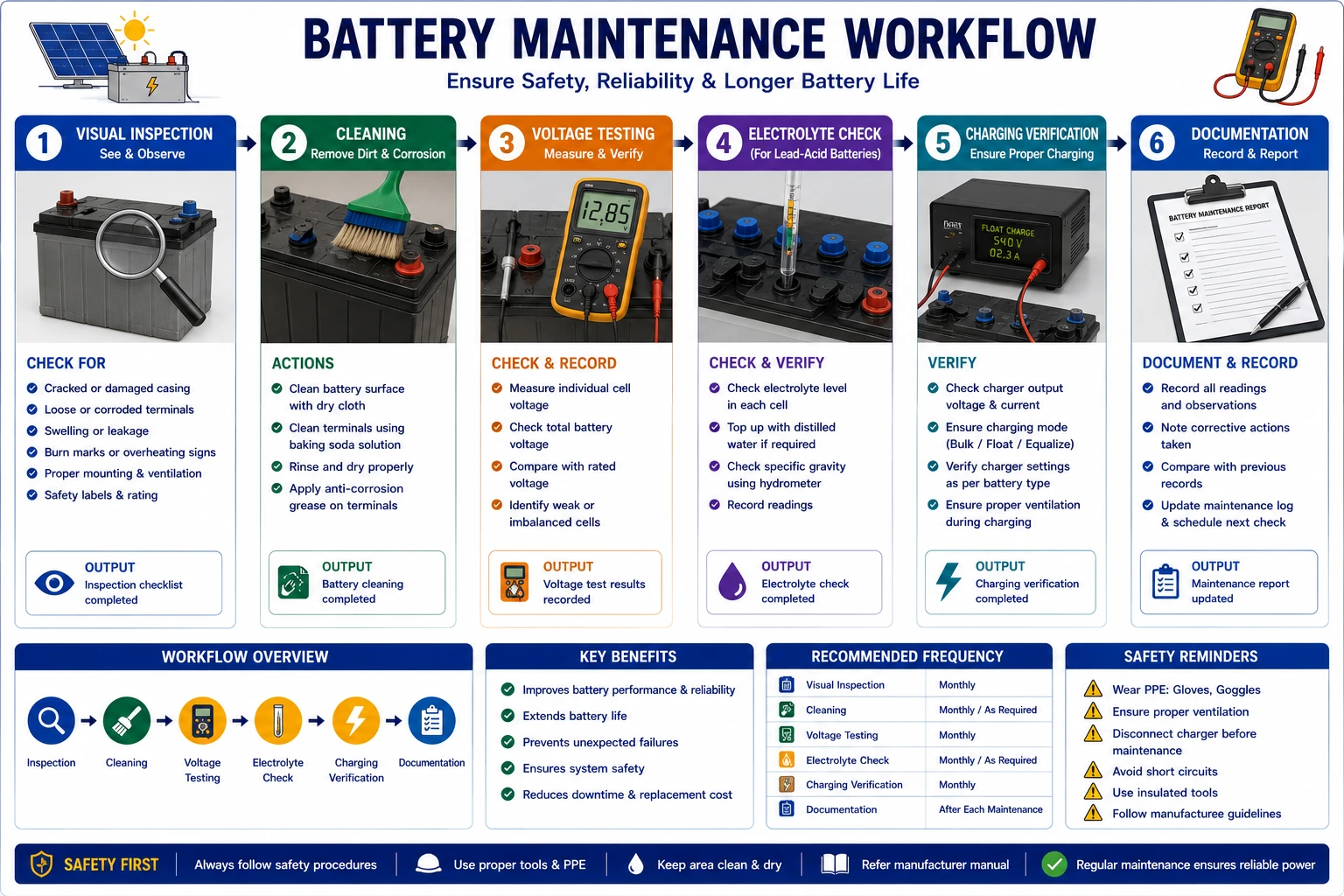
Step-by-Step Battery Maintenance Procedure
Step 1 – Review Maintenance Records
Before inspection:
Review:
- Previous maintenance reports
- Charging history
- Battery replacement records
- Manufacturer recommendations
Historical records assist fault diagnosis.
Step 2 – Ensure Safe Working Conditions
Before maintenance:
- Isolate electrical hazards where required.
- Ensure adequate ventilation.
- Remove ignition sources.
- Wear appropriate PPE.
Safety must always be the first priority.
Step 3 – Perform Visual Inspection
Inspect batteries for:
- Cracks
- Bulging
- Leakage
- Corrosion
- Dirt
- Loose terminals
Record all observations.
Step 4 – Clean Battery Surface
Remove:
- Dust
- Dirt
- Corrosion
Use approved cleaning materials. Avoid allowing moisture to enter battery terminals.
Step 5 – Inspect Battery Terminals
Check:
- Tightness
- Corrosion
- Signs of overheating
Apply anti-corrosion compound if recommended by the manufacturer.
Step 6 – Measure Battery Voltage
Measure:
- Individual battery voltage
- Battery bank voltage
Compare values with design specifications. Voltage imbalance may indicate faulty batteries.
Step 7 – Check Electrolyte Level (Flooded Batteries)
Inspect the electrolyte level carefully.
If necessary:
- Add only distilled water.
- Never add acid during routine maintenance.
Step 8 – Test State of Charge
Depending on battery type:
Use:
- Hydrometer
- Battery monitor
- Battery Management System (BMS)
Verify battery state of charge.
Step 9 – Inspect Charging System
Verify proper operation of:
- Solar charge controller
- Inverter charger
- Battery Management System
Improper charging shortens battery lifespan.
Step 10 – Record Maintenance Activities
Document:
- Battery voltage
- Temperature
- Electrolyte level
- State of charge
- Cleaning performed
- Corrective actions
- Technician details
Update maintenance logbooks.
Common Battery Problems
Routine inspections often identify:
- Corrosion
- Sulfation
- Low electrolyte
- Loose terminals
- Overheating
- Swollen battery cases
- Voltage imbalance
- Reduced capacity
Early detection minimizes failures.
Preventive Maintenance Activities
Routine maintenance includes:
- Cleaning terminals
- Tightening connections
- Voltage measurement
- Capacity testing
- Temperature monitoring
- Electrolyte inspection
- Battery balancing
- Charging system inspection
Preventive maintenance extends battery life.
Recommended Maintenance Frequency
General recommendations include:
Maintenance Activity | Typical Frequency |
Visual inspection | Monthly |
Terminal cleaning | Every 3 months |
Voltage measurement | Monthly |
Electrolyte inspection (Flooded batteries) | Monthly |
Capacity testing | Annually |
Comprehensive maintenance | Annually |
Always follow manufacturer recommendations.
Conclusion
Routine battery maintenance is essential for ensuring the safety, efficiency, and long-term reliability of solar PV systems that rely on energy storage. By performing regular inspections, monitoring voltage and temperature, maintaining clean terminals, checking electrolyte levels where applicable, verifying charging performance, and documenting maintenance activities, technicians can significantly extend battery lifespan, reduce operating costs, and maintain uninterrupted renewable solar energy supply.
Systematic battery maintenance is a core responsibility of solar installers, EPC contractors, commissioning engineers, and operations and maintenance professionals. Furthermore, following technical recommendations and safety practices promoted by the Ministry of New and Renewable Energy, together with manufacturer guidelines, helps ensure safe, standards-compliant, and efficient operation of battery-based solar PV systems.
By implementing preventive maintenance schedules, using calibrated testing instruments, maintaining accurate maintenance records, responding promptly to abnormal conditions, and following industry best practices, solar professionals can optimize solar panel system cost, maximize renewable solar system reliability, improve energy storage performance, and ensure the long-term success of residential, commercial, industrial, and utility-scale solar energy projects.
FAQs
Q1. Why is battery maintenance important in solar PV systems?
Ans: Battery maintenance helps improve battery lifespan, maintain energy storage capacity, prevent unexpected failures, ensure safe operation, and support reliable solar electricity generation.
Q2. How often should solar batteries be inspected?
Ans: Visual inspections and voltage checks are commonly performed monthly, while comprehensive maintenance and capacity testing should follow the manufacturer’s recommendations and site maintenance schedule.
Q3. What should be checked during routine battery maintenance?
Ans: Routine maintenance includes inspecting battery terminals, cables, voltage, temperature, electrolyte levels (for flooded batteries), battery enclosure, charging system, and overall physical condition.
Q4. Can tap water be used to refill flooded lead-acid batteries?
Ans: No. Only distilled water should be used to maintain electrolyte levels. Tap water contains minerals that can reduce battery performance and shorten battery life.
Q5. What are the most common signs of battery problems?
Ans: Common indicators include corrosion on terminals, electrolyte leakage, swollen battery cases, loose connections, overheating, low voltage, reduced backup time, unusual odors, and charging abnormalities.

Electrical Wiring Requirements Before Installing a Solar Power System
Before designing a solar power system, assessing the building’s electrical wiring is essential. Proper inspection ensures the wiring can safely handle solar power integration, prevents electrical risks, and improves overall system efficiency.

India and Japan Strengthen Renewable Energy Cooperation
India and Japan have initiated a partnership under the Asia Energy Transition Initiative (AETI) to support India’s clean energy transition. India has set an ambitious target of achieving net-zero by 2070, while Japan aims to achieve the same by 2050.
Industrial Solar Plants with Diesel Generator Backup: What You Need to Know
Discover how industries can efficiently run rooftop solar plants alongside diesel generators (DG). Learn the benefits, setup tips, and hybrid system strategies to ensure uninterrupted power and maximize energy savings.
Solar Inverter Inspection & Maintenance Guide
A complete guide to battery maintenance for solar PV systems, including inspection, cleaning, testing, charging, and preventive maintenance to ensure long battery life and reliable performance.
Everything You Need to Know About Solar PV Modules
Solar PV modules explained: how they generate electricity, their benefits, and why they’re key to renewable energy growth.
How to Inspect and Maintain Solar Arrays
A complete guide to solar array inspection and maintenance, helping improve system reliability, energy output, and long-term performance through routine inspections and preventive care.
Poor vs Good Solar Installation: Key Differences Explained
A solar system’s performance depends heavily on installation quality. This blog explains the clear differences between a poor and good solar installation — from wiring practices and panel alignment to mounting structures and system safety — helping you make an informed choice and ensure long-term efficiency.
Complete Guide to Rooftop Solar Components for Industries
A rooftop solar system for factories typically includes solar panels, inverters, mounting structures, wiring, and monitoring systems. Additional components like net meters and energy storage may also be installed to optimize energy usage and track performance