
Alternating current (AC) electricity is an essential part of most solar photovoltaic (PV) installations. While PV modules generate direct current (DC), the inverter converts this electricity into AC power for household loads, commercial equipment, or grid supply. AC systems therefore play a critical role in delivering usable solar electricity.
However, AC power can cause severe injury, equipment damage, fire, or even fatal accidents if it is not handled correctly. Hazards may occur during installation, commissioning, operation, inspection, maintenance, troubleshooting, and repair. Understanding these hazards and following appropriate safety procedures is essential for anyone working with solar PV electrical systems.
What Are AC Power Hazards?
AC power hazards are risks associated with the generation, conversion, distribution, and use of alternating current electricity.
In solar PV installations, AC hazards may be present around:
- Inverter AC output terminals
- AC distribution boards
- Switchboards
- Circuit breakers
- Service panels
- AC combiner or junction equipment
- Energy meters
- Grid connection points
- Electrical cables and connectors
- Backup power circuits
The severity of an electrical incident depends on factors such as voltage, current, duration of contact, body resistance, and the path electricity takes through the body.
Major AC Power Hazards
1. Electric Shock
Electric shock is one of the most serious AC hazards. A person can be exposed by touching an energized conductor, faulty equipment, damaged insulation, or an improperly grounded component.
Possible consequences include:
- Burns
- Muscle contractions
- Loss of consciousness
- Internal injuries
- Cardiac arrest
- Fatality
Workers should never assume that a circuit is de-energized simply because equipment is switched off.
2. Electrical Burns
Electrical current can produce significant heat when it passes through the body or when an electrical fault occurs.
Burns may also result from contact with:
- Energized conductors
- Hot electrical components
- Electrical arcs
- Faulty connections
Appropriate PPE, safe isolation, and proper electrical practices are essential controls.
3. Arc-Flash and Arc Hazards
An electrical arc can occur when electricity travels through an unintended path between conductors or from a conductor to ground.
An arc can produce:
- Extremely high temperatures
- Intense light
- Pressure
- Molten metal
- Smoke
- Serious burns
Loose connections, damaged insulation, incorrect switching, and short circuits can contribute to arc events.
Where applicable, the work should be assessed for arc-flash risk and appropriate procedures, and PPE should be implemented.
4. Short Circuits
A short circuit occurs when current flows through an unintended low-resistance path.
In AC systems, short circuits can cause:
- High fault currents
- Sparks
- Electrical arcs
- Fire
- Equipment damage
- Circuit-breaker operation
Appropriately rated circuit breakers, fuses, disconnects, and protective devices should be provided according to the system design.
5. Overloaded Circuits
An AC circuit becomes overloaded when it carries more current than its components are designed to handle.
Overloading can cause:
- Excessive heating
- Insulation deterioration
- Cable damage
- Circuit-breaker tripping
- Fire
Correct cable sizing, protective-device selection, and load assessment are essential parts of safe PV system design.
AC Hazards at the Solar Inverter
The inverter’s AC output is a major area requiring attention.
Before working on the AC side, technicians should:
- Follow the inverter manufacturer’s shutdown procedure.
- Identify all AC sources.
- Disconnect the appropriate AC supply.
- Isolate the relevant circuit.
- Apply lockout/tagout where required.
- Verify the circuit’s safe condition using appropriately rated equipment.
- Begin work only after proper isolation has been confirmed.
In grid-connected systems, the utility supply must always be considered as a potential energy source.
Backfeed and Multiple Power Sources
Solar PV installations can have multiple sources of electrical energy.
For example, a commercial installation may receive electricity from:
- PV inverters
- The utility grid
- Backup generators
- Battery systems
- Other distributed generation sources
This creates a risk of backfeed if isolation is incomplete.
Therefore, workers should understand the complete single-line diagram (SLD) and identify all possible sources before starting electrical work.
Grounding and Earthing Hazards
Proper grounding and earthing are important safety measures in AC electrical systems.
A fault to an exposed conductive surface can become dangerous if the grounding path is inadequate.
Grounding arrangements should be:
- Properly designed
- Correctly installed
- Periodically inspected
- Maintained in good condition
Any damaged, loose, or corroded grounding connection should be investigated and repaired by qualified personnel.
Damaged Cables and Insulation
AC cables can deteriorate because of:
- Mechanical damage
- Heat
- Moisture
- UV exposure
- Rodents
- Incorrect installation
- Aging
Damaged insulation can expose conductors and create shock, short-circuit, and fire hazards.
During inspection, workers should look for:
- Cuts
- Cracks
- Exposed conductors
- Discoloration
- Melted insulation
- Loose connections
- Signs of overheating
Damaged cables should not remain in service without appropriate assessment.
Loose Connections
Loose connections create electrical resistance and can generate localized heat.
Signs may include:
- Discoloration
- Burn marks
- Melted insulation
- Unusual smell
- Hot terminals
- Repeated breaker operation
Connections should be checked and tightened according to the manufacturer’s specified requirements. Thermal imaging may also be useful for identifying abnormal heating when performed by trained personnel.
Electrical Panels and Service Panels
AC distribution boards and service panels contain energized components and should only be accessed by appropriately qualified personnel.
Common hazards include:
- Exposed terminals
- Incorrectly rated breakers
- Loose wiring
- Overloaded circuits
- Poor labeling
- Damaged enclosures
Panels should remain properly closed, clearly labeled, and maintained according to the applicable electrical requirements.
AC Power and Wet Conditions
Water and electricity create a particularly dangerous combination.
Electrical equipment should be protected from:
- Rain
- Flooding
- Water leakage
- Condensation
- Excessive moisture
Workers should never handle electrical equipment with wet hands or in unsuitable wet conditions.
If water enters an electrical enclosure, the equipment should be isolated and assessed by qualified personnel before being returned to service.
Safe Working Practices for AC Systems
A safe AC maintenance procedure generally follows:
Identify → Isolate → Lock/Tag → Verify → Work → Inspect → Restore
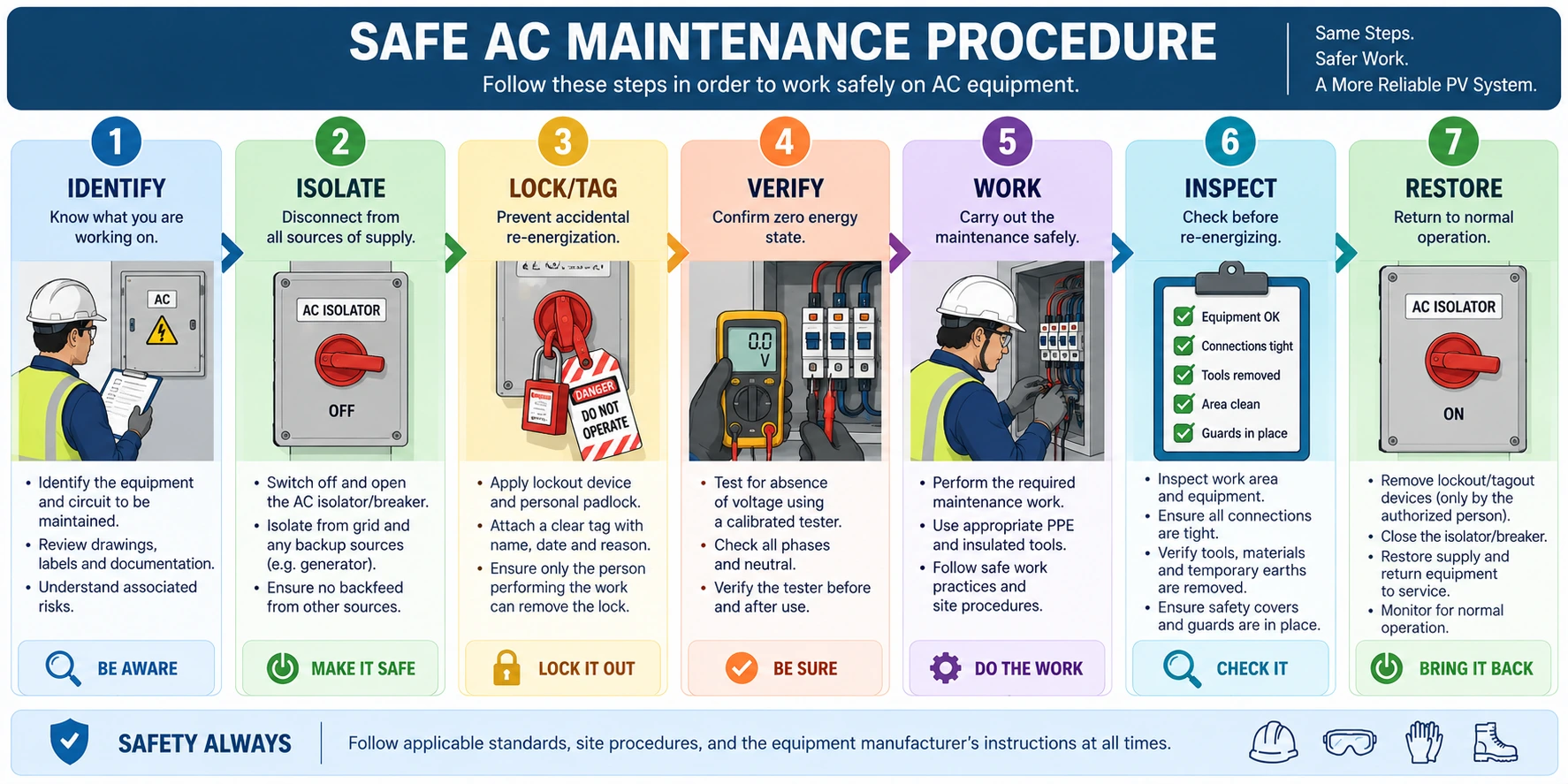
Before beginning work:
- Review the electrical drawings.
- Identify all power sources.
- Shut down the equipment.
- Isolate the circuit.
- Prevent accidental re-energization.
- Verify the required safe condition.
- Use appropriate PPE and tools.
The exact procedure should follow site safety rules and applicable electrical requirements.
PPE for AC Electrical Work
Depending on the task and hazard assessment, PPE may include:
- Safety helmet
- Safety glasses
- Face shield
- Electrical gloves
- Safety footwear
- Arc-rated clothing where required
- Protective clothing
PPE should be correctly selected, inspected, maintained, and used according to the task.
AC Power Hazards During Troubleshooting
Troubleshooting should be systematic rather than based on trial and error.
A basic approach is:
- Identify the reported problem.
- Review system documentation.
- Check alarms and operating conditions.
- Identify possible power sources.
- Isolate the system where required.
- Perform appropriate measurements.
- Identify the cause.
- Repair or escalate the fault.
- Test the system before returning it to service.
- Record the findings.
Protective devices should never be bypassed simply to keep the system running.
AC Power Hazards and Solar System Performance
AC faults can cause inverter shutdowns, equipment damage, power interruptions, and reduced energy production. Problems with cables, breakers, connections, or distribution equipment can therefore affect the reliability of a solar plant.
Regular inspection and preventive maintenance help reduce unexpected downtime and support consistent solar electricity generation.
AC Hazards and Solar Installation Cost
Electrical faults can increase the overall solar installation cost through emergency repairs, equipment replacement, downtime, and additional labor.
Proper electrical design, correctly sized cables, suitable protection, quality installation, and preventive maintenance can help control the lifecycle solar energy installation cost and improve system reliability.
Common AC Safety Mistakes to Avoid
Avoid:
- Working on energized circuits unnecessarily.
- Assuming a switched-off circuit is automatically safe.
- Ignoring the possibility of backfeed.
- Failing to identify all power sources.
- Using incorrectly rated test instruments.
- Bypassing circuit breakers or fuses.
- Ignoring damaged insulation.
- Working with wet electrical equipment.
- Leaving electrical panels poorly labeled.
- Ignoring overheating or burning smells.
- Performing unauthorized electrical repairs.
Conclusion
AC power is an essential part of every grid-connected and many standalone or hybrid solar PV systems, but it presents significant safety risks if handled improperly. Electric shock, electrical burns, arc-flash, short circuits, overloads, damaged cables, loose connections, backfeed, and moisture-related faults are among the major hazards that must be addressed.
Safe AC operation begins with proper system design, correct equipment selection, suitable grounding, appropriate protection, and clear labeling. During maintenance, workers should identify every potential energy source, isolate the circuit, prevent accidental re-energization, and verify the safe condition before beginning work.
Regular inspection of cables, terminals, panels, circuit breakers, grounding connections, and electrical enclosures can help identify faults before they develop into serious incidents. Proper preventive maintenance also supports reliable system performance and helps manage the overall solar installation cost and solar energy installation cost.
FAQs
Q1. What are the main AC power hazards in solar PV systems?
Ans: Major hazards include electric shock, electrical burns, arc-flash, short circuits, overloads, damaged insulation, loose connections, backfeed, and fire.
Q2. Why is AC electricity dangerous?
Ans: AC electricity can cause current to pass through the human body, potentially resulting in severe injury, burns, cardiac effects, or fatality.
Q3. Can AC equipment remain energized after the inverter is switched off?
Ans: Yes. The grid or another electrical source may continue supplying the AC circuit. All possible sources must therefore be identified before maintenance.
Q4. What is backfeed in a solar PV system?
Ans: Backfeed occurs when electricity flows into a circuit from an unexpected or unintended source. Solar inverters, batteries, generators, or the grid can create multiple possible sources.
Q5. Why are circuit breakers important?
Ans: Circuit breakers help protect electrical circuits against conditions such as overloads and short circuits. They must be correctly selected and maintained.
Solar Site Safety Plan and Work Area Management Guide
A step-by-step guide to solar inverter stand installation as per drawings and manuals, ensuring proper alignment, stability, and safety.
Solar Energy for Industries Explained: Everything You Need to Know
Solar energy can greatly benefit industrial and factory owners as they require a constant and substantial source of electricity 24/7.

Commercial Solar Power Plant Subsidy in India: What Businesses Need to Know
Businesses in India can reduce their solar installation costs through various MNRE-backed subsidies and state incentives. Learn eligibility, benefits, and the application process for commercial solar plants.

500 kW Solar System Price in Haryana: Latest Cost, Benefits & Savings
Looking to install a 500 kW solar system in Haryana? Discover the latest 2025 price range, government incentives, and key benefits for commercial and industrial users. Learn how adopting solar can cut electricity bills and boost long-term savings.
Solar Inverter Stand Installation: Step-by-Step Guide
A step-by-step guide to solar inverter stand installation as per drawings and manuals, ensuring proper alignment, stability, and safety.
Industrial Solar Plants with Diesel Generator Backup: What You Need to Know
Discover how industries can efficiently run rooftop solar plants alongside diesel generators (DG). Learn the benefits, setup tips, and hybrid system strategies to ensure uninterrupted power and maximize energy savings.
Different Components of a Solar PV System: Importance and Operation
Earthing and lightning protection are critical safety components in solar PV installations. This guide explains their importance, types, components, and best practices for solar installers.
Charge Controller Troubleshooting Guide for Solar PV Systems
A complete guide to troubleshooting charge controllers in solar PV systems, including fault diagnosis, electrical testing, error identification, and corrective maintenance for reliable system performance.