
Maintaining a safe workplace is essential in every solar photovoltaic (PV) project, from residential rooftop installations to large utility-scale solar power plants. Despite comprehensive safety procedures, regular training, and strict compliance with workplace regulations, incidents and safety violations can still occur due to unsafe acts, hazardous conditions, equipment failures, environmental factors, or human error. When such situations arise, providing accurate, timely, and complete information about the incident or violation becomes a critical part of effective workplace safety management.
Incident and violation reporting is not merely an administrative requirement—it is an essential process that helps organizations identify hazards, investigate root causes, implement corrective actions, prevent recurrence, and continuously improve workplace safety. Accurate reporting protects employees, contractors, equipment, and the environment while supporting regulatory compliance and maintaining the operational reliability of renewable solar systems.
In the solar industry, incidents may involve electrical shock, arc flash, falls from height, fire, battery electrolyte leakage, equipment malfunction, cable damage, improper Lockout/Tagout (LOTO) practices, failure to wear Personal Protective Equipment (PPE), or unauthorized work on energized systems. Even near misses and minor safety violations should be reported because they provide valuable opportunities to prevent future accidents.
Every employee, supervisor, contractor, and safety professional should understand what information needs to be documented, who should receive the report, how incidents should be communicated, and why complete documentation is essential. Proper reporting strengthens the organization’s safety culture, improves accountability, supports legal compliance, and ensures the long-term performance of solar electricity generation systems.
Reporting incidents and safety violations accurately and promptly is a fundamental responsibility for solar installers, commissioning engineers, EPC contractors, supervisors, and Operations & Maintenance (O&M) personnel.
This comprehensive guide explains how to provide information about workplace incidents and violations, what details should be included in reports, reporting procedures, documentation requirements, and industry best practices.
What Is a Workplace Incident?
A workplace incident is any unplanned event that has caused—or had the potential to cause—injury, illness, property damage, equipment damage, environmental harm, or operational disruption.
Examples include:
- Electrical shock
- Arc flash
- Fire
- Falls from height
- Battery electrolyte spills
- Equipment malfunction
- Structural failure
- Vehicle accidents
- Tool-related injuries
- Environmental contamination
Not all incidents result in injuries, but every incident should be reported.
What Is a Workplace Safety Violation?
A workplace safety violation occurs when established safety procedures, corporate policies, or legal requirements are not followed.
Examples include:
- Failure to wear PPE
- Ignoring Lockout/Tagout procedures
- Working without authorization
- Using damaged tools
- Unsafe ladder usage
- Poor housekeeping
- Entering restricted areas
- Removing safety guards
- Improper cable routing
- Unsafe battery handling
Even if no accident occurs, violations must be documented.
Why Is Incident and Violation Reporting Important?
Reporting helps organizations:
- Protect employees
- Prevent future accidents
- Improve workplace safety
- Identify root causes
- Meet regulatory requirements
- Reduce equipment damage
- Maintain uninterrupted solar electricity generation
- Improve operational efficiency
Timely reporting also strengthens organizational accountability.
Who Should Provide Incident Information?
Incident information may be provided by:
- Employees
- Supervisors
- Site engineers
- Safety officers
- Contractors
- Witnesses
- Project managers
- Operations & Maintenance personnel
Every worker has a responsibility to report hazards and incidents promptly.
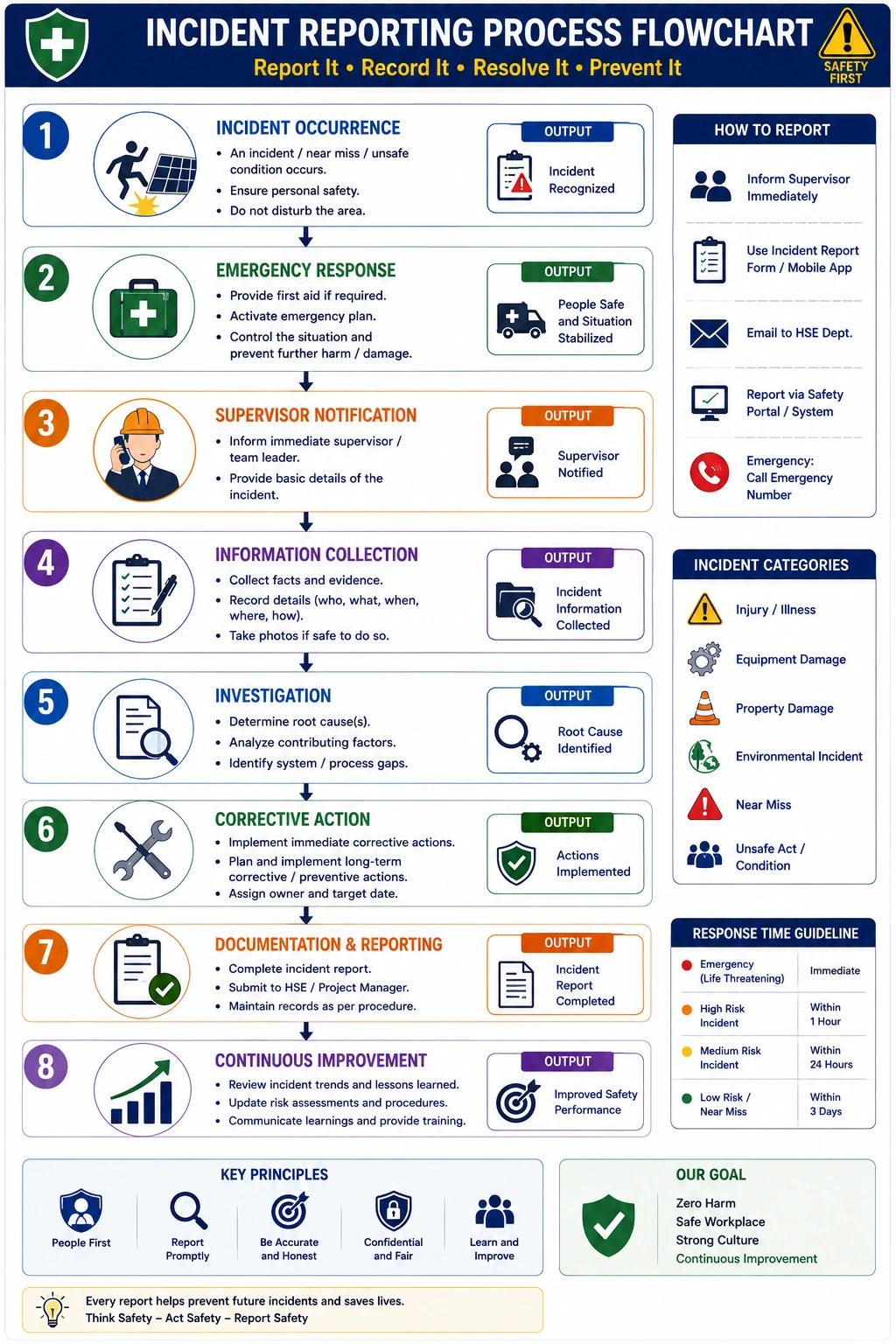
What Information Should Be Included?
A complete report should include the following:
1. Basic Incident Details
Record:
- Date
- Time
- Location
- Project name
- Weather conditions
- Work activity being performed
These details establish the context of the event.
2. Description of the Incident
Clearly explain:
- What happened
- How it happened
- Sequence of events
- Equipment involved
- Persons involved
Use factual language and avoid assumptions.
3. Type of Incident or Violation
Identify whether the event involved:
- Electrical hazard
- Mechanical hazard
- Fire
- Fall
- PPE violation
- Equipment damage
- Environmental issue
- Near miss
- Unsafe act
- Unsafe condition
Proper classification supports investigation and trend analysis.
4. Persons Involved
Include:
- Employee names
- Contractor names
- Job roles
- Witnesses
- Supervisors present
Ensure information is accurate and verified.
5. Equipment Affected
Identify equipment such as:
- Solar PV modules
- Inverters
- Batteries
- Combiner boxes
- Cables
- Switchgear
- Measuring instruments
- Mounting structures
Document any damage observed.
6. Immediate Actions Taken
Record actions such as:
- Work stopped
- Equipment isolated
- Area secured
- First aid provided
- Emergency services contacted
- Supervisor notified
Immediate response is important for safety and investigation.
7. Injuries or Damage
Document:
- Nature of injuries
- Property damage
- Equipment damage
- Environmental impact
If no injuries occurred, record it as a near miss where appropriate.
8. Photographic Evidence
Where safe and permitted:
- Photograph equipment
- Photograph damaged components
- Capture workplace conditions
- Preserve evidence without disturbing the scene
Photographs assist during investigations.
9. Witness Statements
Witnesses should provide:
- Factual observations
- Timeline of events
- Actions taken
- Conditions observed
Witness accounts should be objective.
10. Corrective Actions
Include recommendations such as:
- Equipment repair
- Additional training
- PPE enforcement
- Procedure revision
- Workplace inspection
- Hazard removal
Corrective actions reduce the likelihood of recurrence.
Conclusion
Providing accurate and timely information about workplace incidents and safety violations is a vital component of effective safety management in the solar PV industry. Comprehensive reporting enables organizations to investigate incidents thoroughly, identify root causes, implement corrective actions, and prevent similar events from occurring in the future. A structured reporting system also strengthens communication, promotes accountability, enhances regulatory compliance, and contributes to a safer and more productive work environment.
Every solar professional should understand the importance of documenting and communicating workplace incidents and safety violations accurately. Furthermore, organizations should align their reporting procedures with guidance issued by the Ministry of New and Renewable Energy, applicable occupational safety regulations, manufacturer recommendations, and recognized electrical standards to ensure effective incident management and continuous safety improvement.
By encouraging prompt reporting, maintaining accurate documentation, conducting detailed investigations, implementing effective corrective actions, and fostering a proactive safety culture, organizations can optimize solar panel system cost, improve renewable solar system reliability, maximize solar electricity generation, reduce the cost of solar per kWh installed, lower the solar installation cost per kWh, and support the sustainable growth of renewable energy and solar energy across residential, commercial, industrial, and utility-scale applications.
FAQs
Q1. Why is it important to report workplace incidents and safety violations?
Ans: Reporting incidents and violations helps prevent future accidents, protects employees and equipment, supports legal compliance, identifies root causes, and improves workplace safety across solar PV projects.
Q2. What information should be included in a workplace incident report?
Ans: An incident report should include the date, time, location, description of the event, people involved, equipment affected, injuries or damage, immediate actions taken, witness statements, photographs where appropriate, and recommended corrective actions.
Q3. Who should receive information about a workplace safety incident?
Ans: Incident reports should generally be submitted to the immediate supervisor, site supervisor, Health, Safety, and Environment (HSE) officer, project manager, or other designated personnel according to the organization’s reporting procedures.
Q4. Should near misses be reported even if no one is injured?
Ans: Yes. Near misses provide valuable information about potential hazards and allow organizations to implement preventive measures before a more serious incident occurs.
Q5. How does proper incident reporting improve solar project performance?
Ans: Accurate reporting enables organizations to identify recurring issues, improve safety procedures, reduce equipment failures, minimize downtime, enhance solar electricity generation, and increase the long-term reliability of renewable solar systems.
Solar Inverter Stand Installation: Step-by-Step Guide
A step-by-step guide to solar inverter stand installation as per drawings and manuals, ensuring proper alignment, stability, and safety.

How Total Solar PV Power Affects Solar System Efficiency
Total solar PV power represents the combined power output of a solar photovoltaic system. This guide explains its meaning, calculation, and how it directly impacts solar performance, efficiency, and long-term energy generation.

Latest MNRE List: Approved Solar Module Manufacturers
Check the latest MNRE-approved list of solar module manufacturers to ensure quality and compliance for your solar projects in India.
Safety Signs in Solar PV Systems
A complete guide to safety signs in solar PV systems, covering different types of signs, their importance, placement, visibility, and best practices for solar projects.

Difference Between an On-Grid Inverter and a Hybrid Solar Inverter
Confused between an on-grid inverter and a hybrid solar inverter? This blog explains their differences, advantages, and which solar inverter is right for you.

Important Factors Deciding the Type of Solar PV System to be Installed
A solar site assessment helps installers evaluate location, shading, structure, and energy requirements before installation. This guide explains the essential steps for accurate solar system planning.
Delhi Jal Board Solar Project: A Step Towards Sustainable Energy
Delhi Jal Board has embraced solar power, becoming a leader in renewable energy adoption. This initiative highlights the benefits of solar energy, including cost savings, sustainability, and promoting clean energy practices in institutional operations.
How the RESCO Model Works in Solar: A Complete Guide for Industries
The RESCO model allows businesses to adopt solar with zero upfront investment. Under this model, a developer installs, owns, and operates the solar plant while you simply pay for the power you consume—making clean energy both affordable and hassle-free.