
Solar photovoltaic (PV) systems have been designed to generate clean, reliable, and cost-effective electricity for more than 25 years. However, achieving optimum performance throughout their service life requires a well-planned maintenance schedule and accurate documentation of all inspection, testing, repair, and operational activities. Regular preventive maintenance helps identify potential issues before they develop into major failures, while a comprehensive maintenance logbook provides a complete history of the system’s condition and maintenance activities.
Whether the installation is a residential rooftop solar system, a commercial building, an industrial facility, or a utility-scale solar power plant, maintaining detailed maintenance records is essential for improving system reliability, ensuring compliance with industry standards, supporting warranty claims, simplifying troubleshooting, and maximizing renewable solar system performance.
A structured maintenance schedule defines when inspections, cleaning, electrical testing, thermal inspections, battery maintenance, inverter servicing, and performance evaluations should be carried out. At the same time, a maintenance logbook documents every maintenance activity, measurement, observation, repair, and replacement performed on the solar PV system.
Maintaining proper maintenance schedules and accurate logbooks is an essential practice for ensuring safe operation, efficient solar electricity generation, and long-term renewable energy technology reliability.
This comprehensive guide explains the importance of solar PV maintenance schedules, logbook preparation, inspection intervals, documentation procedures, preventive maintenance planning, and industry best practices.
What is a Solar PV Maintenance Schedule?
A solar PV maintenance schedule is a planned timetable that specifies when inspections, testing, servicing, cleaning, repairs, and performance evaluations should be performed throughout the operational life of the system.
The schedule helps ensure that maintenance tasks are carried out consistently and systematically.
What is a Solar PV Maintenance Logbook?
A maintenance logbook is a permanent record that documents all maintenance-related activities performed on a solar PV installation.
It typically includes:
- Inspection dates
- Test results
- Cleaning activities
- Repairs
- Equipment replacements
- Performance observations
- Technician details
A logbook provides the maintenance history of the system.
Why Are Maintenance Schedules Important?
Regular maintenance scheduling provides several benefits.
These include:
Early fault detection
Improved renewable solar system reliability
Higher energy production
Reduced equipment failures
Lower maintenance costs
Better warranty compliance
Longer equipment lifespan
Scheduled maintenance helps avoid unexpected system downtime.
Importance of Maintenance Logbooks
A maintenance logbook serves as an official record of system performance and maintenance history.
Benefits include:
- Simplified troubleshooting
- Historical performance analysis
- Regulatory compliance
- Asset management
- Warranty support
- Maintenance planning
Well-maintained records improve long-term operational efficiency.
Objectives of a Solar PV Maintenance Schedule
The primary objectives include:
Preventive Maintenance
Identify problems before failures occur.
Performance Monitoring
Ensure expected energy generation.
Equipment Protection
Extend component lifespan through timely servicing.
Safety Assurance
Verify safe operating conditions.
Documentation
Maintain accurate maintenance records.
Components Included in a Maintenance Schedule
Maintenance schedules should cover all major system components.
1. Solar PV Modules
Routine tasks include:
- Visual inspection
- Cleaning
- Damage assessment
- Performance verification
2. Mounting Structures
Inspect for:
- Loose fasteners
- Corrosion
- Structural damage
- Alignment
3. DC Cabling
Verify:
- Cable insulation
- Proper routing
- Secure terminations
- Physical damage
4. Inverters
Inspect:
- Status indicators
- Cooling systems
- Error logs
- Electrical connections
5. Battery Bank (Where Installed)
Perform:
- Voltage measurements
- Terminal cleaning
- Electrolyte checks (for flooded batteries)
- State of charge verification
6. Grounding System
Inspect:
- Ground conductors
- Bonding connections
- Earth resistance
7. Protection Devices
Verify operation of:
- Circuit breakers
- Fuses
- Surge protection devices
- Disconnect switches
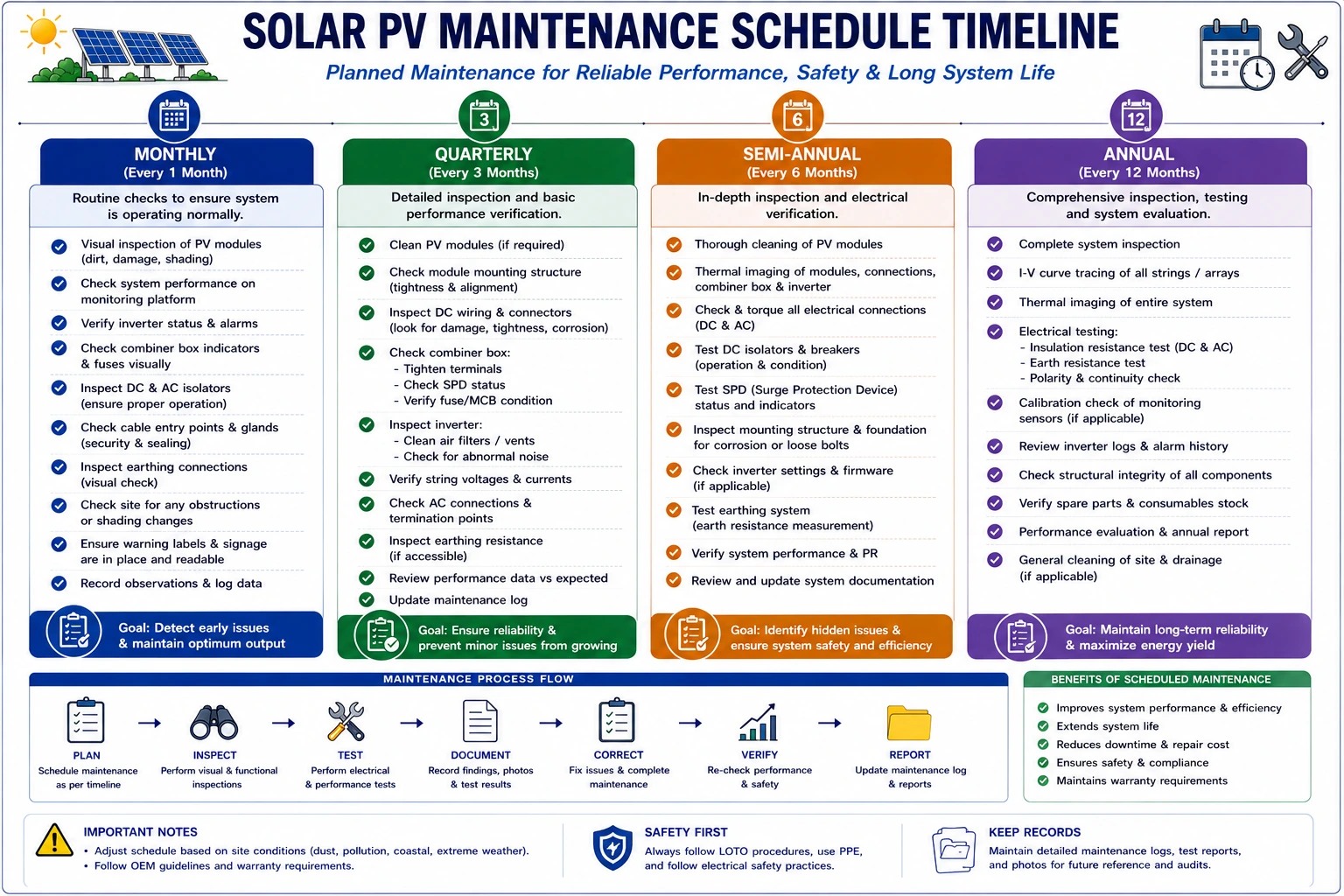
Typical Solar PV Maintenance Schedule
Maintenance intervals vary depending on environmental conditions, system size, and manufacturer recommendations.
A general schedule may include:
Maintenance Activity | Recommended Frequency |
Visual Inspection | Monthly |
Module Cleaning | Monthly or as required |
Electrical inspection | Quaterly |
Inverter inspection | Quarterly |
Battery inspection | Monthly (if applicable) |
Grounding inspection | Every 6 months |
Thermal inspection | Annually |
Insulation resistance testing | Annually |
Performance testing | Annually |
Complete preventive maintenance | Annually |
Actual maintenance intervals should always follow manufacturer guidelines and project requirements.
Information to Record in a Maintenance Logbook
Every maintenance activity should be documented.
Important entries include:
- Date
- Time
- Site location
- Equipment identification
- Weather conditions
- Inspection findings
- Test results
- Repairs completed
- Components replaced
- Technician name
- Supervisor approval
Accurate records improve future maintenance planning.
Step-by-Step Guide to Maintaining a Solar PV Logbook
Step 1 – Record Basic System Information
Include:
- Project name
- System capacity
- Installation date
- Equipment details
This information identifies the system.
Step 2 – Record Inspection Details
Document:
- Date
- Inspector name
- Components inspected
- Observations
Clear documentation improves traceability.
Step 3 – Record Test Results
Include measurements such as:
- DC voltage
- DC current
- AC voltage
- AC frequency
- Insulation resistance
- Ground resistance
- Battery voltage
Measured values should be compared with design specifications.
Step 4 – Record Maintenance Activities
Examples include:
- Module cleaning
- Cable replacement
- Inverter servicing
- Battery maintenance
- Grounding repairs
Each activity should include sufficient detail.
Step 5 – Record Faults and Repairs
Document:
- Nature of fault
- Cause (if identified)
- Corrective action
- Verification after repair
This information supports future troubleshooting.
Step 6 – Record Equipment Replacements
If components are replaced, record:
- Equipment model
- Serial number
- Installation date
- Reason for replacement
Replacement records support warranty management.
Step 7 – Record Final Verification
After maintenance:
Verify:
- System operation
- Safety
- Performance
Record final observations.
Types of Maintenance Records
Maintenance documentation may include:
- Inspection reports
- Cleaning records
- Electrical test reports
- Thermal imaging reports
- Battery maintenance records
- Inverter maintenance reports
- Fault reports
- Corrective maintenance reports
Together, these documents form a complete maintenance history.
Digital vs. Paper Logbooks
Both formats are commonly used.
Paper logbooks offer simplicity, while digital maintenance software provides:
- Faster record retrieval
- Data analysis
- Trend monitoring
- Remote access
- Automatic report generation
Many utility-scale projects use computerized maintenance management systems (CMMS).
Benefits of Accurate Record Keeping
Proper documentation helps:
- Improve the renewable solar system reliability
- Simplify maintenance planning
- Reduce troubleshooting time
- Support audits
- Enhance warranty management
- Improve operational efficiency
Historical records become increasingly valuable over time.
Common Maintenance Activities to Document
Typical logbook entries include:
- Module cleaning
- Inverter firmware updates
- Battery replacement
- Cable repairs
- Ground resistance measurements
- Thermal inspections
- Energy production analysis
- Preventive maintenance activities
Conclusion
A structured solar PV maintenance schedule and a well-maintained logbook are fundamental to the long-term success of any renewable solar system. Regular inspections, preventive maintenance, systematic testing, accurate documentation, and timely corrective actions not only improve solar electricity generation but also enhance equipment reliability, reduce operational risks, support regulatory compliance, and extend the service life of valuable solar assets.
Maintaining organized maintenance schedules and comprehensive maintenance records is an essential responsibility for solar installers, commissioning engineers, and operations and maintenance professionals. Furthermore, following technical recommendations and maintenance practices promoted by the Ministry of New and Renewable Energy helps ensure safe, professional, and standards-compliant operation of solar PV systems.
By implementing preventive maintenance programs, maintaining accurate logbooks, documenting inspections and repairs consistently, using calibrated testing equipment, reviewing historical maintenance data, and responding promptly to identified issues, solar professionals can optimize solar panel system cost, improve renewable solar system reliability, maximize energy production, and ensure the long-term success of residential, commercial, industrial, and utility-scale solar energy projects.
FAQs
Q1. What is the purpose of a solar PV maintenance schedule?
Ans: A maintenance schedule ensures that inspections, cleaning, testing, servicing, and preventive maintenance activities are carried out at regular intervals to maintain system safety and performance.
Q2. Why is a maintenance logbook important?
Ans: A maintenance logbook provides a complete history of inspections, repairs, testing, equipment replacements, and maintenance activities, making troubleshooting and future maintenance easier.
Q3. What information should be included in a solar PV maintenance logbook?
Ans: The logbook should include inspection dates, equipment details, test results, maintenance activities, faults identified, corrective actions, replacement records, technician names, and verification results.
Q4. How often should a solar PV system be inspected?
Ans: Inspection frequency depends on environmental conditions, manufacturer recommendations, and project requirements. Visual inspections are commonly performed monthly, while detailed electrical testing is often carried out annually or as specified.
Q5. Can digital maintenance logbooks replace paper records?
Ans: Yes. Digital logbooks and computerized maintenance management systems (CMMS) offer efficient data storage, trend analysis, easier retrieval, and automated reporting, although some organizations may also maintain paper records for compliance purposes.
Why Is Investing In Grade A Panels Important?
Investing in Grade A solar panels guarantees superior performance, safety, and maximum return on your solar investment.

Solar for Industrial Use in India: Costs, Benefits & Energy Savings Explained
Solar for industrial use in India is rapidly transforming how factories manage energy costs and efficiency. This guide covers system sizes, costs, benefits, ROI, and how solar energy helps manufacturing units, warehouses, and industrial plants reduce power bills and ensure long-term sustainability.
Understanding Solar Battery Specifications: Capacity, Voltage & Efficiency Explained
Solar batteries are essential for energy storage and backup in PV systems. This guide explains key specifications like capacity, voltage, efficiency, and depth of discharge to help you choose the right battery.
Hazard Mitigation Measures for Solar PV Systems
A complete guide to mitigation measures after hazards occur in solar PV systems, covering emergency response, hazard control, incident reporting, corrective actions, and follow-up inspections.
Grounding Conductor Sizing for Solar PV Systems
A complete guide to determining grounding conductor size for solar PV systems, ensuring safe, compliant, and reliable installations.
Battery Troubleshooting in Solar PV Systems Guide
A complete guide to battery troubleshooting in solar PV systems, including fault diagnosis, performance testing, common battery issues, and effective corrective measures.
Solar ROI vs Payback Period Explained for Commercial & Industrial Projects
Compare payback period and ROI for solar systems. Discover how businesses should evaluate solar investments effectively.
Faulty Solar PV Module Detection Using Shading Test
A complete guide to detecting faulty solar PV modules using the shading test and ammeter readings, helping installers quickly identify underperforming modules and restore system performance.