
The success of a solar photovoltaic (PV) installation depends not only on selecting quality components but also on placing those components in the correct locations. Solar modules, inverters, batteries, combiner boxes, disconnects, monitoring devices, and electrical panels must all be installed according to engineering drawings, manufacturer recommendations, safety regulations, and operational requirements.
Improper equipment placement can lead to energy losses, safety hazards, difficult maintenance, excessive cable runs, overheating, reduced equipment lifespan, and increased solar installation charges. Conversely, a properly planned equipment layout improves system efficiency, simplifies maintenance, enhances safety, and optimizes solar panel system cost.
Whether it is a residential rooftop installation, a commercial solar project, or a utility-scale renewable solar plant, verifying equipment locations before installation is a critical step in project execution. This process helps ensure compliance with design documents and reduces the risk of costly rework.
Proper equipment placement and layout verification are essential practices for safe solar electricity generation and successful renewable energy technology implementation.
This comprehensive guide explains how to check equipment locations for solar PV installations, including planning considerations, inspection procedures, safety requirements, and best practices.
Why Equipment Location Verification is Important
Equipment location verification helps ensure:
- Safe operation of the solar PV system
- Efficient energy generation
- Easy maintenance access
- Reduced cable losses
- Compliance with engineering designs
- Improved equipment lifespan
Failure to verify equipment locations can result in:
- Installation errors
- Safety hazards
- Increased maintenance requirements
- Reduced system performance
- Higher solar installation cost per kWh
Major Equipment Requiring Location Verification
Before installation, the location of each major component should be reviewed and approved.
1. Solar PV Modules
Solar panels are the primary energy-generating components.
Verify:
- Available installation area
- Orientation
- Tilt angle
- Shading conditions
- Structural suitability
Proper module placement is essential for maximizing solar electricity generation.
2. Solar Inverters
The inverter converts DC electricity from solar modules into usable AC power.
Location verification should consider:
- Ventilation
- Accessibility
- Environmental exposure
- Distance from the array
Improper inverter placement can cause overheating and reduced efficiency.
3. Battery Bank
In hybrid and off-grid systems, battery placement is critical.
Verify:
- Ventilation requirements
- Safety clearances
- Structural support
- Maintenance accessibility
Battery banks should be installed in secure and well-ventilated areas.
4. DC Combiner Boxes
Combiner boxes consolidate outputs from multiple solar strings.
Location considerations include:
- Proximity to solar arrays
- Weather protection
- Accessibility for inspection
5. AC Combiner Boxes and Distribution Panels
Verify:
- Accessibility
- Utility connection proximity
- Safety clearances
These components should be easily accessible for maintenance and emergency operations.
6. Disconnect Switches
Disconnect devices must be installed according to electrical codes and utility requirements.
Location considerations include:
- Visibility
- Accessibility
- Emergency operation requirements
7. Monitoring and Communication Equipment
Monitoring systems should be located where communication signals and maintenance access are available.
8. Grounding and Earthing Equipment
Grounding components should be positioned according to earthing design drawings. Proper grounding improves renewable solar system safety and reliability.
Factors to Consider When Checking Equipment Location
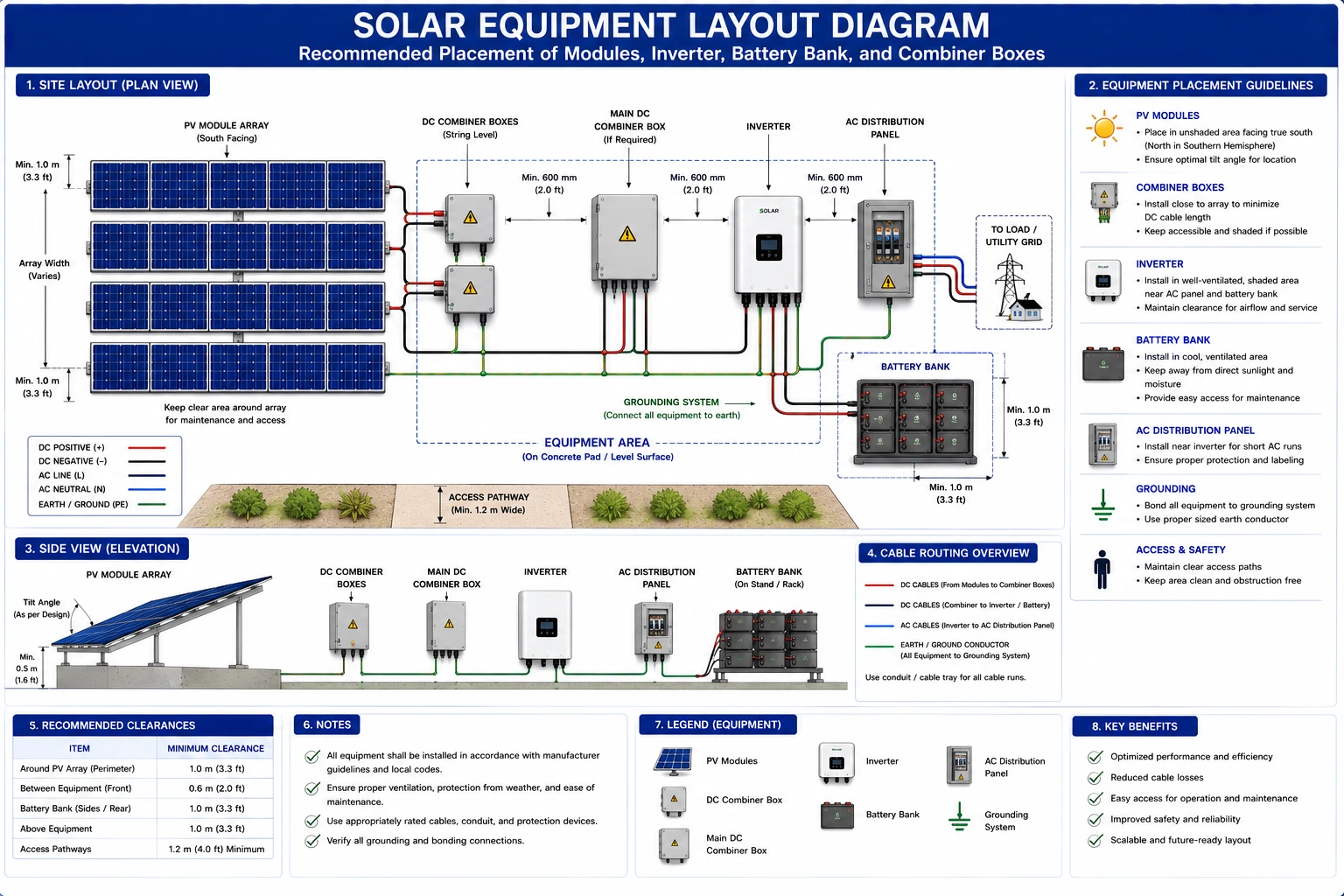
1. Compliance with Engineering Drawings
Review:
- General Arrangement (GA) drawings
- Single Line Diagram (SLD)
- Equipment layout drawings
Verify that proposed locations match approved project documents.
2. Accessibility for Operation and Maintenance
Equipment should be easily accessible for:
- Inspection
- Repairs
- Cleaning
- Testing
Restricted access increases maintenance costs and operational challenges.
3. Environmental Conditions
Assess exposure to:
- Rain
- Dust
- High temperatures
- Corrosive environments
- Flooding
Equipment should be installed in locations that minimize environmental risks.
4. Ventilation Requirements
Many electrical components generate heat during operation.
Proper ventilation is essential for:
- Inverters
- Batteries
- Electrical panels
Poor ventilation may reduce equipment lifespan.
5. Structural Suitability
Verify that mounting surfaces can support equipment weight.
Examples include:
- Roofs
- Concrete pads
- Equipment platforms
- Battery rooms
6. Cable Routing Efficiency
Equipment placement should support efficient cable routing.
Benefits include:
- Reduced voltage drop
- Lower cable costs
- Improved system efficiency
Shorter cable runs often help optimize solar panel system cost.
7. Safety Clearances
Maintain required clearances around:
- Inverters
- Electrical panels
- Batteries
- Disconnect switches
Adequate clearance supports safe operation and maintenance.
Checking Solar Module Location
Shading Analysis
Verify that the array location is free from:
- Trees
- Buildings
- Utility poles
- Future obstructions
Orientation Verification
Confirm that module orientation matches design specifications.
Structural Inspection
Assess:
- Roof condition
- Mounting area integrity
- Load-bearing capacity
Checking Inverter Location
- Ventilation Assessment
Ensure adequate airflow around the inverter.
Temperature Evaluation
- Avoid locations exposed to excessive heat.
Accessibility Verification
- Ensure technicians can safely access the inverter.
Weather Protection
- Outdoor installations should use appropriately rated enclosures.
Checking Battery Bank Location
Ventilation Verification
- Battery installations require adequate airflow.
Clearance Inspection
- Maintain spacing required by design specifications.
Safety Assessment
Ensure protection from:
- Water ingress
- Physical damage
- Unauthorized access
Checking Combiner Box Location
Verify:
- Proper mounting height
- Accessibility
- Weather protection
- Distance from solar strings
Combiner boxes should be easy to inspect and maintain.
Checking Grounding Equipment Location
Grounding components should be installed according to approved earthing layouts.
Verify:
- Ground rod locations
- Conductor routing
- Accessibility for testing
Tools Required for Equipment Location Verification
Measuring Tape
- Used to verify equipment spacing and dimensions.
Laser Distance Meter
- Provides accurate distance measurements.
Spirit Level
- Verifies alignment and level installation surfaces.
Compass
- Used for orientation verification.
Site Layout Drawings
- Essential for confirming design compliance.
Digital Camera
- Documents site conditions and installation readiness.
Conclusion
Checking equipment locations is a vital step in ensuring the successful installation and long-term performance of solar PV systems. Proper placement of solar modules, inverters, battery banks, combiner boxes, grounding systems, and other equipment helps maximize efficiency, improve safety, simplify maintenance, and reduce project costs.
Equipment layout verification is an essential part of solar project planning and quality assurance. Additionally, following recommendations from the Ministry of New and Renewable Energy helps ensure compliance with industry standards and best practices.
By carefully evaluating equipment locations, documenting site conditions, and addressing potential issues before installation, solar professionals can optimize solar panel system cost, improve renewable solar system reliability, and contribute to the successful implementation of residential, commercial, industrial, and utility-scale renewable energy technology projects.
FAQs
Q1. Why is equipment location verification important in solar PV systems?
Ans: It ensures components are installed safely, efficiently, and according to approved engineering designs.
Q2. Which solar equipment requires location verification?
Ans: Solar modules, inverters, battery banks, combiner boxes, disconnect switches, grounding systems, and monitoring equipment should all be verified before installation.
Q3. Why is inverter location important?
Ans: Proper inverter placement improves ventilation, accessibility, efficiency, and equipment lifespan.
Q4. How does equipment placement affect solar panel system cost?
Ans: Efficient placement reduces cable lengths, maintenance costs, energy losses, and installation rework.
Q5. What documents should be reviewed before checking equipment locations?
Ans: General Arrangement (GA) drawings, Single Line Diagrams (SLDs), equipment layout drawings, and manufacturer installation manuals.
Solar Structure Alignment and Leveling Guide for Installers
A step-by-step guide to solar tracking system installation, covering setup, alignment, and best practices for maximum efficiency and performance.

Everything You Need to Know About Net Metering
Discover everything about net metering – how it works, benefits, installation process, and how it helps you save on electricity bills.
Fire Hazard in a Solar Setup at Rice Mill, Kaithal – Case Study and Safety Insights
A recent fire incident at a rice mill in Kaithal highlights the critical importance of safety in solar installations. This case study analyzes the root causes, system faults, and preventive actions that can help industries avoid similar hazards in their solar setups.
Haryana and UP Face Delays in Solar Net Metering Approvals
Net metering for rooftop solar in Haryana and Uttar Pradesh faces procedural delays, affecting solar adoption and efficiency for residential and commercial consumers
Solar Inverter Installation: On-Grid, Off-Grid & Hybrid
A complete guide to on-grid, off-grid, and hybrid solar inverter installation, including setup, wiring, and best practices for safe operation.

Haryana Electricity Tariff Hike Impacts All Consumer Categories in 2015-16
Haryana electricity tariffs were increased across all consumer categories in 2015-16, raising power costs for households, industries, and businesses statewide.
Solar Rooftop Subsidy: Why It’s Time for a Change of Mindset
While solar rooftop subsidies help reduce upfront costs, true adoption requires a mindset shift. This guide discusses why businesses and homeowners should focus on long-term benefits, sustainability, and strategic planning beyond relying solely on incentives.
AC Combiner Box Installation in Solar PV Systems Guide
A step-by-step guide to AC combiner box installation in solar PV systems, covering setup, wiring, and safety best practices.