
In modern solar photovoltaic (PV) systems, accurate monitoring is just as important as proper installation. Solar plant owners, EPC contractors, operations and maintenance (O&M) teams, and investors rely on performance data to evaluate energy production, identify faults, optimize system efficiency, and ensure maximum return on investment. At the center of this monitoring infrastructure is the Data Acquisition System (DAS).
A Data Acquisition System collects, records, processes, and transmits information from various components of a solar PV system, including inverters, energy meters, weather stations, irradiance sensors, temperature sensors, and battery systems. However, the usefulness of this data depends entirely on the accuracy of the measurements being collected. This is why verifying the calibration of the Data Acquisition System is a critical activity during commissioning, operation, and maintenance of solar power plants.
An improperly calibrated DAS can lead to inaccurate performance reports, incorrect energy calculations, faulty performance ratio (PR) assessments, and poor operational decisions. Regular calibration verification ensures reliable solar electricity generation data and helps maintain optimal renewable solar system performance.
Accurate monitoring and measurement systems are essential for effective renewable energy technology management and performance evaluation.
This comprehensive guide explains the importance of DAS calibration, calibration verification procedures, required tools, testing methods, documentation requirements, and industry best practices.
What is a Data Acquisition System (DAS)?
A Data Acquisition System is a monitoring platform that gathers data from multiple devices installed throughout a solar PV system.
The DAS performs several important functions:
- Data collection
- Data storage
- Performance monitoring
- Fault identification
- Remote monitoring
- Reporting and analysis
The system enables operators to assess plant performance in real time.
Why Data Acquisition Systems are Important in Solar Projects
Modern solar plants rely heavily on performance data.
Accurate data helps:
- Measure energy generation
- Monitor equipment health
- Analyze plant efficiency
- Detect faults early
- Optimize maintenance schedules
- Improve solar panel system cost effectiveness
Without reliable monitoring data, plant performance cannot be accurately evaluated.
What is Calibration?
Calibration is the process of comparing an instrument’s readings against a known reference standard and making adjustments if necessary.
The objective is to ensure:
- Accuracy
- Repeatability
- Reliability
Calibration helps verify that monitoring devices are measuring values correctly.
What is Calibration Verification?
Calibration verification confirms that equipment remains within acceptable accuracy limits after installation or during operation.
Unlike full calibration, verification focuses on validating performance against established standards.
Why Verify DAS Calibration?
Calibration verification ensures:
- Accurate monitoring data
- Reliable performance calculations
- Correct fault detection
- Regulatory compliance
- Improved operational decisions
Failure to verify calibration may result in:
- Incorrect energy reports
- Misleading performance ratios
- Undetected equipment problems
- Financial losses
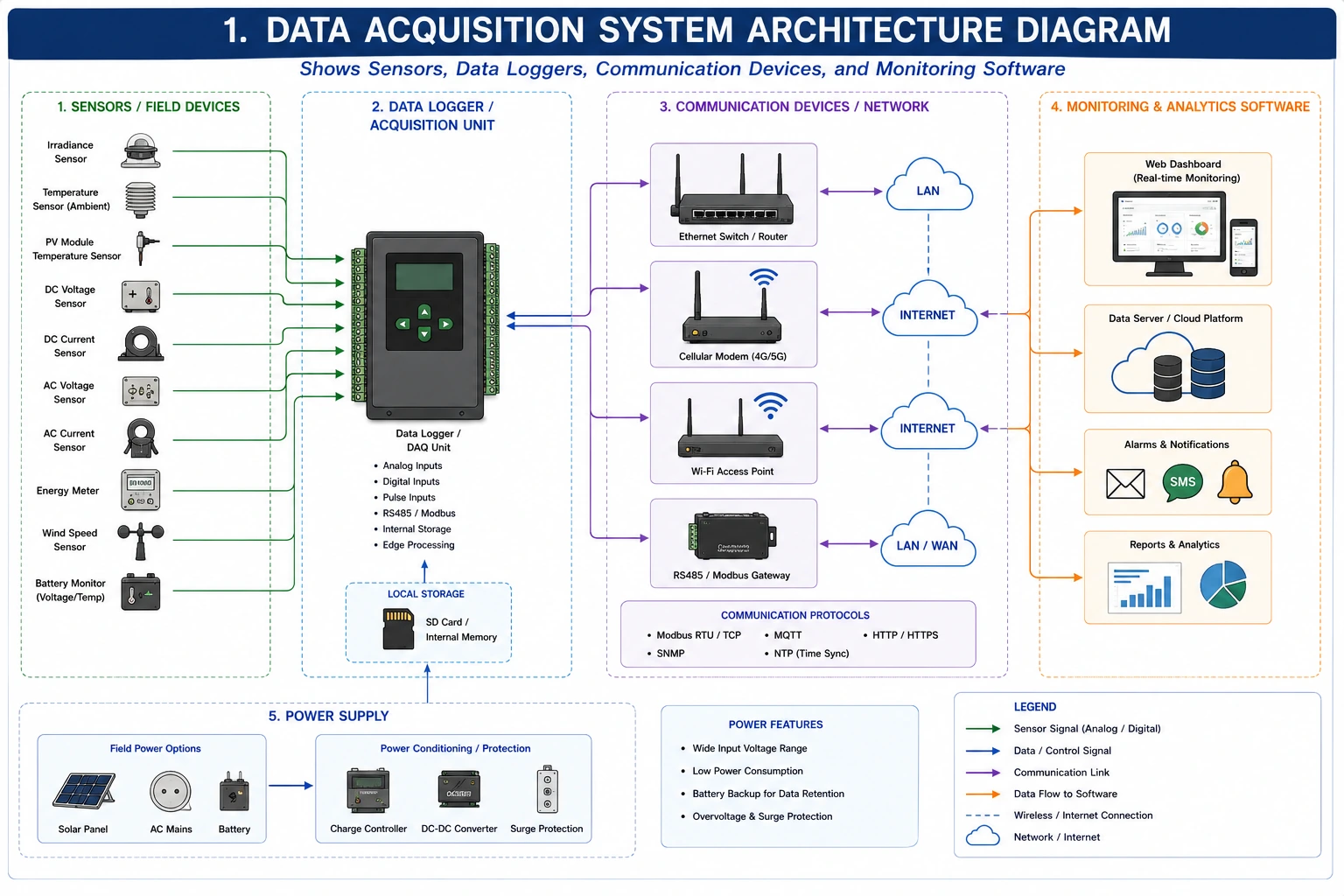
Components of a Solar DAS Requiring Calibration Verification
Several monitoring devices must be checked periodically.
1. Irradiance Sensors
These sensors measure solar radiation reaching the PV modules.
Examples include:
- Pyranometers
- Reference cells
Accurate irradiance data is essential for performance analysis.
2. Module Temperature Sensors
Used to measure PV module operating temperatures.
Temperature significantly affects solar module efficiency.
3. Ambient Temperature Sensors
Monitor environmental conditions surrounding the solar plant.
4. Wind Speed Sensors
Often installed in large utility-scale solar projects.
Used for environmental monitoring and performance evaluation.
5. Energy Meters
Measure electrical energy production and consumption.
Calibration accuracy directly affects revenue calculations.
6. DC Measurement Devices
Used for:
- Voltage monitoring
- Current monitoring
- Power calculations
7. AC Measurement Devices
Measure:
- Voltage
- Current
- Frequency
- Power factor
8. Battery Monitoring Sensors
Used in hybrid and off-grid renewable solar systems.
Monitor:
- Voltage
- Current
- Temperature
- State of charge
Importance of Accurate DAS Calibration
Proper calibration verification improves:
Performance Ratio Calculations
- PR calculations depend on accurate irradiance and energy data.
Energy Yield Analysis
- Reliable data supports accurate yield calculations.
Fault Detection
- Improves identification of underperforming equipment.
Financial Reporting
- Ensures accurate energy generation reporting.
O&M Efficiency
- Supports predictive maintenance strategies.
When Should DAS Calibration be Verified?
Calibration verification should be performed:
During Commissioning
Before project handover.
Periodic Maintenance
According to maintenance schedules.
After Sensor Replacement
Whenever monitoring equipment is replaced.
Following Repairs
After system modifications or repairs.
During Performance Audits
For independent plant performance evaluations.
Tools Required for Calibration Verification
1. Reference Calibration Instruments
Used to compare sensor readings against known standards.
Examples:
- Calibrated pyranometers
- Certified temperature meters
2. Digital Multimeter
Used for electrical signal verification.
3. Data Logger
Records readings during testing.
4. Calibration Certificates
Used to verify traceability and compliance.
5. Laptop or Monitoring Interface
Accesses DAS data and historical records.
Pre-Verification Inspection
Before calibration verification:
Review Documentation
Check:
- Sensor specifications
- Calibration records
- Commissioning reports
Inspect Sensor Condition
Look for:
- Physical damage
- Dirt accumulation
- Corrosion
- Loose connections
Verify Communication Systems
Ensure all devices communicate correctly with the DAS.
Step-by-Step Procedure for DAS Calibration Verification
Step 1 – Review Calibration Records
Verify:
- Previous calibration dates
- Calibration intervals
- Certification status
Identify equipment due for verification.
Step 2 – Inspect Sensor Installation
Confirm sensors are:
- Securely mounted
- Properly oriented
- Free from shading or obstructions
Improper installation may affect measurement accuracy.
Step 3 – Compare Sensor Readings with Reference Standards
Use certified reference instruments to compare readings.
Examples:
- Irradiance sensor vs. calibrated pyranometer
- Temperature sensor vs. certified thermometer
Step 4 – Evaluate Measurement Deviations
Calculate the difference between:
- DAS sensor readings
- Reference instrument readings
Verify that deviations remain within acceptable limits.
Step 5 – Verify Data Transmission
Ensure sensor readings are accurately transmitted to:
- DAS software
- Monitoring portals
- SCADA systems
Step 6 – Review Historical Data Trends
Analyze historical records for:
- Sudden changes
- Sensor drift
- Abnormal readings
Trend analysis often identifies calibration issues before failures occur.
Step 7 – Document Results
Record:
- Sensor identification
- Reference values
- Measured values
- Deviations
- Corrective actions
Verification of Irradiance Sensors
Irradiance measurements are among the most important parameters in solar plant performance analysis.
Verify:
- Sensor cleanliness
- Orientation
- Calibration status
- Measurement accuracy
Even small errors can significantly affect performance ratio calculations.
Verification of Temperature Sensors
Check:
- Sensor placement
- Contact quality
- Measurement accuracy
Temperature sensors should accurately reflect module operating conditions.
Verification of Energy Meters
Compare meter readings with:
- Certified reference meters
- Utility records
- Independent measurements
Accurate energy metering is critical for revenue calculations.
Common Causes of Calibration Errors
Sensor Aging
- Measurement accuracy may degrade over time.
Environmental Exposure
- Dust, moisture, and UV radiation can affect sensors.
Mechanical Damage
- Physical impacts may alter calibration.
Loose Connections
- Electrical issues may create inaccurate readings.
Improper Installation
- Incorrect mounting positions can distort measurements.
Conclusion
Verifying the calibration of a Data Acquisition System is a critical component of solar PV plant commissioning, operation, and maintenance. Accurate monitoring data forms the foundation of performance analysis, fault detection, energy reporting, and long-term asset management. Even the most advanced solar power plant cannot be effectively managed if its monitoring system provides inaccurate information.
Accurate measurement and monitoring are essential for maximizing the benefits of renewable energy technology and ensuring reliable solar electricity generation. Furthermore, following guidelines and best practices promoted by the Ministry of New and Renewable Energy helps maintain compliance, quality, and operational excellence across solar projects.
By conducting regular calibration verification, using certified reference instruments, maintaining detailed records, and addressing sensor deviations promptly, solar installers, EPC contractors, and O&M professionals can improve renewable solar system performance, optimize solar panel system cost, enhance energy yield accuracy, and ensure the long-term success of residential, commercial, industrial, and utility-scale solar PV installations.
FAQs
Q1. What is a Data Acquisition System (DAS) in a solar PV plant?
And: A DAS is a monitoring system that collects, stores, processes, and reports operational data from various solar plant components and sensors.
Q2. Why is calibration verification important?
Ans: Calibration verification ensures that sensors and measurement devices provide accurate data for performance analysis, maintenance planning, and reporting.
Q3. Which sensors typically require calibration verification?
Ans: Common devices include irradiance sensors, temperature sensors, energy meters, voltage sensors, current sensors, and weather monitoring instruments.
Q4. How often should DAS calibration be verified?
Ans: The frequency depends on manufacturer recommendations, project requirements, environmental conditions, and maintenance schedules.
Q5. What happens if monitoring sensors are not properly calibrated?
Ans: Inaccurate measurements can lead to incorrect performance evaluations, poor maintenance decisions, reduced efficiency, and financial losses.
Solar Panel Sizes and Features in Delhi/NCR: A Complete Guide
Planning to install solar panels in Delhi/NCR? Explore the different sizes, technologies, and key features of solar panels available for residential, industrial, and commercial use. Learn how to choose the right one for your energy needs and roof space.
Unintentional Islanding Test for Solar PV Systems
A complete guide to performing the solar PV anti-islanding test, ensuring safe grid-connected operation, regulatory compliance, and reliable inverter performance.
From Solar Design to Site: Locating Footings for Solar Mounting Structures
A complete guide to translating solar design drawings into accurate footing locations on-site, including survey methods, marking techniques, and EPC best practices.

1 MW Solar Plant for Industry: Cost, Generation & Payback
A detailed guide on 1 MW solar plant for industry covering installation cost, area requirement, power generation, ROI, and long-term savings in India.
UPNEDA Solar Subsidy 2025: How to Maximize Savings on Rooftop Solar
Discover how the UPNEDA Solar Subsidy 2025 can help you cut electricity costs and make rooftop solar more affordable. Learn about eligibility, subsidy rates, and the step-by-step application process.
Demystifying Battery Backup: Everything You Need to Know
Battery backup is essential for uninterrupted power at home and in industries. This guide explains different types of battery backup systems, how they work, their benefits, and tips to choose the right one for reliable energy storage.
Everything You Need to Know About Solar PV Modules
Solar PV modules explained: how they generate electricity, their benefits, and why they’re key to renewable energy growth.

Solar for Food Processing Units: Cost, Benefits, Installation & ROI in India
A complete guide on solar systems for the FMCG industry in India covering installation cost, benefits, ROI, system sizing, and the installation process.