
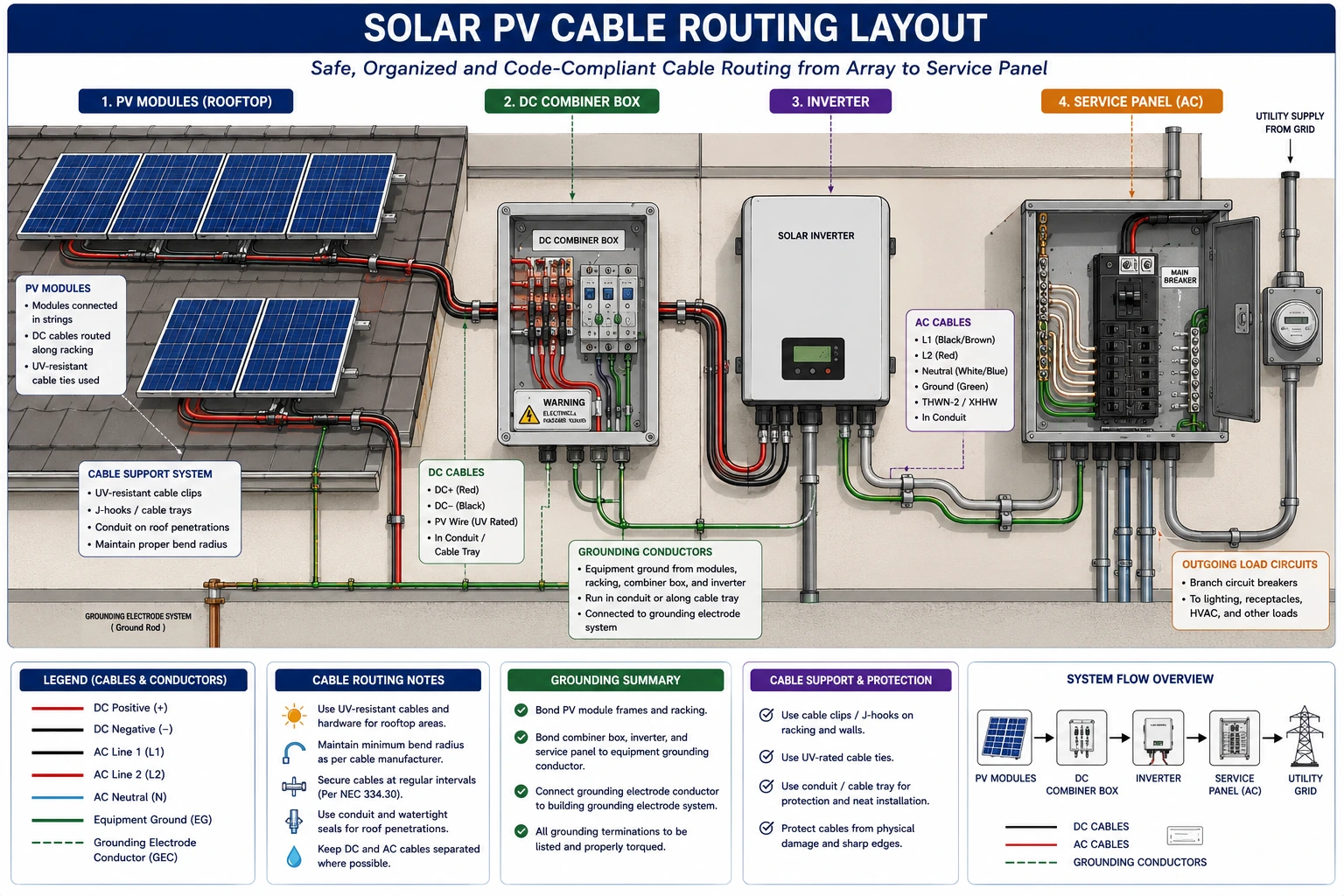
Solar photovoltaic (PV) systems rely on an extensive network of electrical cables to safely transmit power from the solar modules to the inverter, battery bank (if installed), electrical distribution panel, and utility grid. These cables form the backbone of the entire PV system, carrying both DC and AC power while ensuring efficient energy transfer with minimal losses. Since solar installations operate continuously under varying environmental conditions, cables are exposed to sunlight, high temperatures, moisture, wind, dust, chemicals, rodents, mechanical stress, and aging. Over time, these factors can damage cable insulation, connectors, or conductors, affecting system performance and safety.
Damaged cables can lead to voltage drops, reduced solar electricity generation, overheating, insulation failure, ground faults, short circuits, arc faults, inverter shutdowns, and even electrical fires. Therefore, routine inspection of all PV cables is one of the most important preventive maintenance activities for residential, commercial, industrial, and utility-scale solar projects.
During commissioning and periodic maintenance, technicians must carefully inspect the condition of DC and AC cables, verify insulation integrity, examine cable routing, check connectors and terminations, and ensure cables remain properly secured and protected from environmental damage. A systematic inspection helps identify problems before they result in expensive equipment failures or prolonged downtime.
Inspecting solar PV cables and ensuring that they remain free from damage is a fundamental maintenance responsibility for solar installers, commissioning engineers, EPC contractors, and operations and maintenance (O&M) professionals.
This comprehensive guide explains the importance of cable inspections, common causes of cable damage, inspection procedures, testing methods, required tools, documentation practices, safety precautions, and industry best practices.
Why Is Cable Inspection Important?
Regular cable inspections help to:
- Prevent electrical faults
- Minimize voltage drops
- Improve renewable solar system efficiency
- Increase solar electricity generation
- Reduce fire risks
- Protect inverters and other equipment
- Extend cable lifespan
- Lower maintenance costs
Healthy cables ensure safe and uninterrupted system operation.
Types of Cables Used in Solar PV Systems
A typical solar PV system contains:
- PV DC cables
- String cables
- DC combiner box cables
- Inverter DC input cables
- AC output cables
- Battery interconnection cables
- Grounding conductors
- Communication cables
- Monitoring system cables
Each cable type requires regular inspection.
Common Causes of Cable Damage
Solar cables may be damaged by:
- UV radiation
- High temperatures
- Moisture ingress
- Rodent attacks
- Mechanical abrasion
- Sharp edges
- Improper cable routing
- Loose cable supports
- Excessive bending
- Corrosion
- Aging insulation
- Chemical exposure
- Poor installation practices
Routine inspections help detect these issues early.
Signs of Cable Damage
Technicians should inspect for:
- Cracked insulation
- Cuts or abrasions
- Exposed conductors
- Burn marks
- Discoloration
- Swollen insulation
- Loose connectors
- Damaged cable glands
- Corrosion
- Rodent bite marks
- Water ingress
- Broken cable ties
- Sagging cables
Any damage should be corrected immediately.
Tools Required
Technicians commonly use:
- Digital multimeter
- Clamp meter
- Insulation resistance tester (Megger)
- Continuity tester
- Infrared thermal camera
- Cable tracer
- Inspection flashlight
- Torque wrench
- Personal Protective Equipment (PPE)
Only calibrated instruments should be used.
Step-by-Step Cable Inspection Procedure
Step 1 – Ensure Safety
Before inspection:
- Follow Lockout/Tagout (LOTO) procedures where applicable.
- Isolate electrical circuits if required.
- Wear appropriate PPE.
- Verify the work area is safe.
Safety should always be the first priority.
Step 2 – Review System Documentation
Verify:
- Cable routing drawings
- Single-line diagram (SLD)
- Cable schedule
- Previous maintenance records
This helps identify cable locations and expected configurations.
Step 3 – Perform Visual Inspection
Inspect all accessible cables for:
- Physical damage
- Cuts
- Cracks
- Abrasions
- UV degradation
- Discoloration
- Rodent damage
- Burn marks
- Loose cable ties
Replace damaged cables immediately.
Step 4 – Inspect Cable Supports
Check:
- Cable trays
- Cable clips
- Conduits
- Cable glands
- Support brackets
Ensure cables remain securely supported throughout their route.
Step 5 – Inspect Cable Routing
Verify that cables:
- Are not under excessive tension
- Are protected from sharp edges
- Maintain minimum bending radius
- Are separated from hot surfaces
- Are routed according to design
Improper routing shortens cable life.
Step 6 – Inspect Cable Terminations
Check all terminations for:
- Loose connections
- Corrosion
- Damaged connectors
- Overheating
- Proper tightening
Faulty terminations increase electrical resistance.
Step 7 – Perform Continuity Testing
Using a continuity tester or multimeter:
- Verify conductor continuity.
Open circuits indicate broken conductors or faulty connections.
Step 8 – Measure Insulation Resistance
Use an insulation resistance tester to measure insulation integrity.
Low insulation resistance may indicate:
- Moisture ingress
- Insulation damage
- Contamination
- Cable deterioration
Further investigation should be performed if readings fall below acceptable limits.
Step 9 – Perform Thermal Inspection
Use an infrared thermal camera to detect:
- Hot connectors
- Loose terminations
- Damaged cables
- Excessive heating
Thermal anomalies should be corrected promptly.
Step 10 – Verify Cable Identification
Ensure that:
- DC cables are properly labeled.
- AC cables are identified.
- Grounding conductors are marked.
- Cable numbering matches project documentation.
Correct labeling simplifies maintenance.
Step 11 – Replace Damaged Components
Replace:
- Damaged cables
- Defective connectors
- Broken cable glands
- Corroded terminals
- Worn cable supports
Always use approved solar-rated replacement components.
Step 12 – Perform Functional Verification
After repairs:
Verify:
- Stable inverter operation
- Normal voltage
- Correct current flow
- Proper energy generation
- Reliable monitoring system operation
Ensure the system operates normally after maintenance.
Step 13 – Prepare the Inspection Report
Document:
- Cable identification
- Inspection findings
- Test results
- Insulation resistance values
- Thermal inspection observations
- Corrective actions
- Technician details
Accurate documentation supports future preventive maintenance.
Common Cable Faults and Corrective Actions
Fault | Corrective Action |
Cracked insulation | Replace affected cable |
Loose connector | Tighten or replace connector |
Burnt cable | Replace cable and identify root cause |
Rodent damage | Replace cable and improve cable protection |
Low insulation resistance | Repair or replace damaged cable |
Corroded terminal | Clean or replace terminal |
Conclusion
Routine inspection of solar PV cables is essential for maintaining the safety, reliability, and efficiency of every solar installation. Since cables serve as the primary pathway for transmitting electrical energy throughout the system, any damage to insulation, conductors, connectors, or cable supports can reduce performance, increase electrical losses, create safety hazards, and interrupt solar electricity generation. By conducting systematic visual inspections, verifying cable routing, performing continuity and insulation resistance testing, carrying out thermal inspections, and replacing damaged components promptly, technicians can significantly improve the long-term performance of the solar PV system.
Inspecting cables and ensuring they remain free from damage is a core preventive maintenance activity for solar installers, EPC contractors, commissioning engineers, and operations and maintenance professionals. Furthermore, following technical recommendations and safety practices promoted by the Ministry of New and Renewable Energy, together with manufacturer guidelines and local electrical standards, ensures that cable inspections are performed safely, accurately, and in compliance with industry requirements.
By implementing regular inspection schedules, using calibrated testing instruments, maintaining detailed maintenance records, replacing damaged cables with approved solar-rated components, and addressing faults without delay, solar professionals can optimize solar panel system cost, enhance renewable solar system reliability, maximize solar electricity generation, reduce the cost of solar per kWh installed, and ensure the long-term success of residential, commercial, industrial, and utility-scale solar energy projects.
FAQs
Q1. Why should solar PV cables be inspected regularly?
Ans: Solar PV cables are continuously exposed to sunlight, weather, temperature changes, and mechanical stress. Regular inspections help identify insulation damage, loose connections, corrosion, and other issues before they cause equipment failure or safety hazards.
Q2. What are the most common signs of damaged solar cables?
Ans: Typical signs include cracked insulation, exposed conductors, burn marks, rodent bite marks, loose connectors, discoloration, overheating, moisture ingress, corrosion, and damaged cable glands.
Q3. Which tests are commonly performed during cable inspections?
Ans: Technicians generally perform visual inspections, continuity tests, insulation resistance tests, voltage measurements, and infrared thermal inspections to evaluate the condition of solar PV cables.
Q4. Can damaged solar cables reduce system performance?
Ans: Yes. Damaged cables increase electrical resistance, cause voltage drops, create power losses, trigger inverter faults, and may significantly reduce overall solar electricity generation.
Q5. What should be done if damaged cables are found during inspection?
Ans: Damaged cables should be replaced with approved solar-rated cables after identifying and correcting the root cause of the damage. Connectors, cable supports, and routing should also be inspected before restoring the system to service.
Different Types of Solar Photovoltaic Systems: Complete Guide
Earthing and lightning protection are critical safety components in solar PV installations. This guide explains their importance, types, components, and best practices for solar installers.

CAPEX or OPEX? How to Choose the Best Solar Ownership Model
Choosing between the CAPEX and OPEX models can greatly impact your solar savings and ownership benefits. This guide explains both models to help you make the right decision.
How Azimuth Angle Impacts Solar Panel Efficiency for Homes, Industries, and Commercial Buildings
Discover how solar panel azimuth impacts energy generation in homes, industries, and commercial buildings. Maximize efficiency with correct orientation.
UP Electricity Tariff Increase 2015-16: Rates Rise by Rs 0.40–1.00 per Unit – What Consumers need to know
Uttar Pradesh has increased electricity tariffs for 2015-16, ranging from Rs 0.40 to 1.00 per unit. This update explains the revised rates, the sectors affected, and what consumers need to know about the tariff hike.
How to Read the Electricity Bill Before Deciding Solar Plant Capacity
Load assessment is an essential step before installing a solar PV system. It helps determine electricity consumption and ensures accurate system sizing for optimal solar performance.
How to Calculate PV Power Output? Step-by-Step Guide
Calculating PV power output helps you estimate how much electricity a solar system can generate. This step-by-step guide explains the PV power output formula, examples, and key factors affecting solar energy production.
Industrial Solar Power: 7 Reasons to Make the Switch
Top 7 benefits of solar energy for industries, including cost savings, environmental impact, and improved energy reliability.
Flat Roof Solar Installation Guide: Design, Mounting Systems & Best Practices
A practical guide to flat roof solar installation covering key design considerations, mounting system types, and best practices for efficient and reliable performance.